Most farmers and growers think of feeding plants as a simple math problem: add fertilizer, get growth. But the real story is far more interesting — and far more alive. The truth is that healthy plants depend on a bustling underground community of microorganisms to unlock the nutrients sitting right in their soil. Without that community, even a nutrient-rich soil can leave crops struggling. Understanding how soil microbiology drives nutrient uptake is the key to growing healthier plants, building lasting soil fertility, and making smarter decisions about products like OrganiLock's Soil Food and Refresh.
Learning objectives
After this lesson you will be able to explain why most soil nutrients are not directly available to plants.
After this lesson you will be able to describe the key roles microorganisms play in unlocking nutrients for plant roots.
After this lesson you will be able to explain what the rhizosphere is and why it matters.
After this lesson you will be able to identify how common management practices help or harm soil microbiology.
After this lesson you will be able to explain how OrganiLock Soil Food and Refresh support a healthy soil microbial ecosystem.
Meet the Microbial Economy
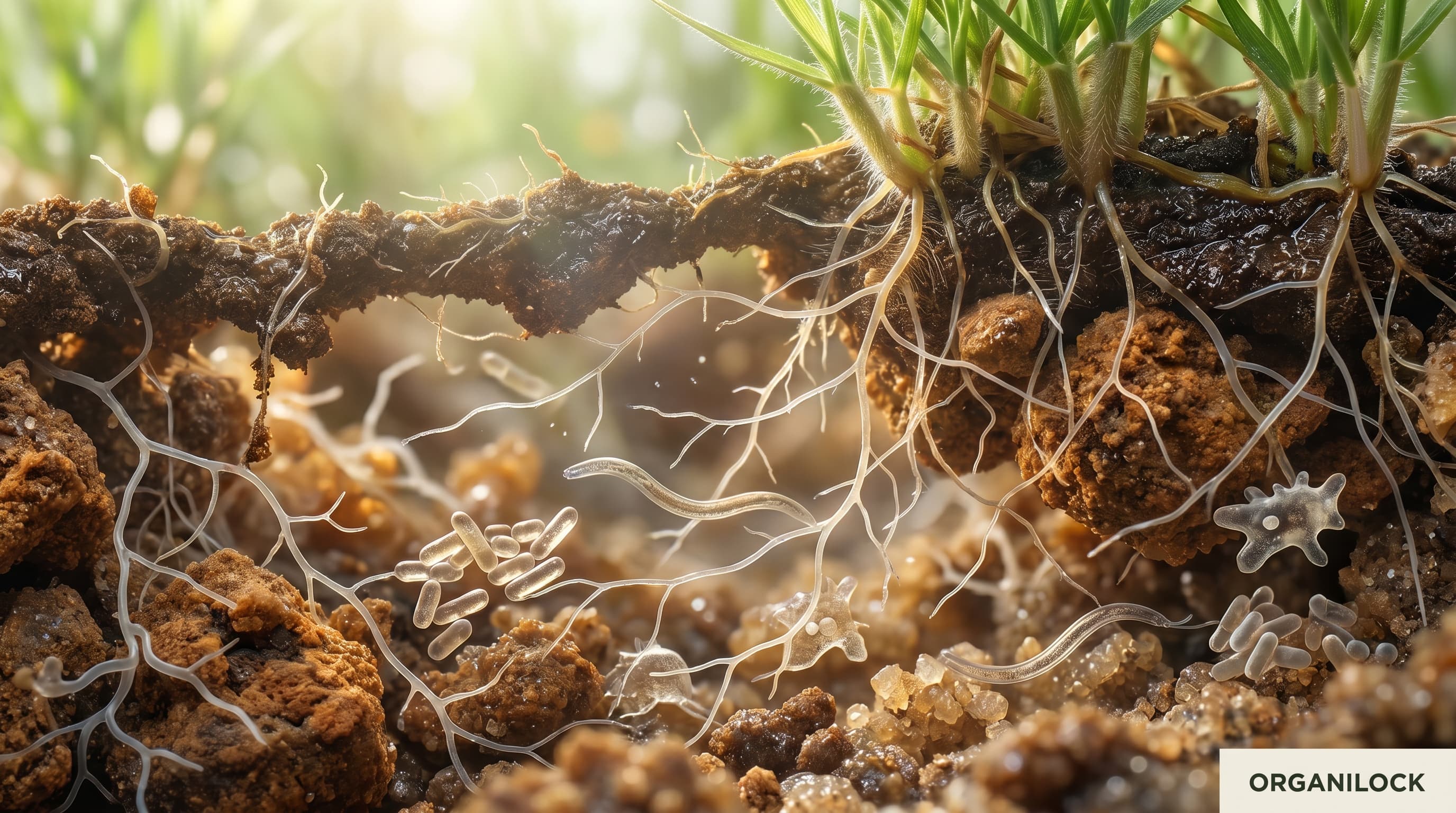
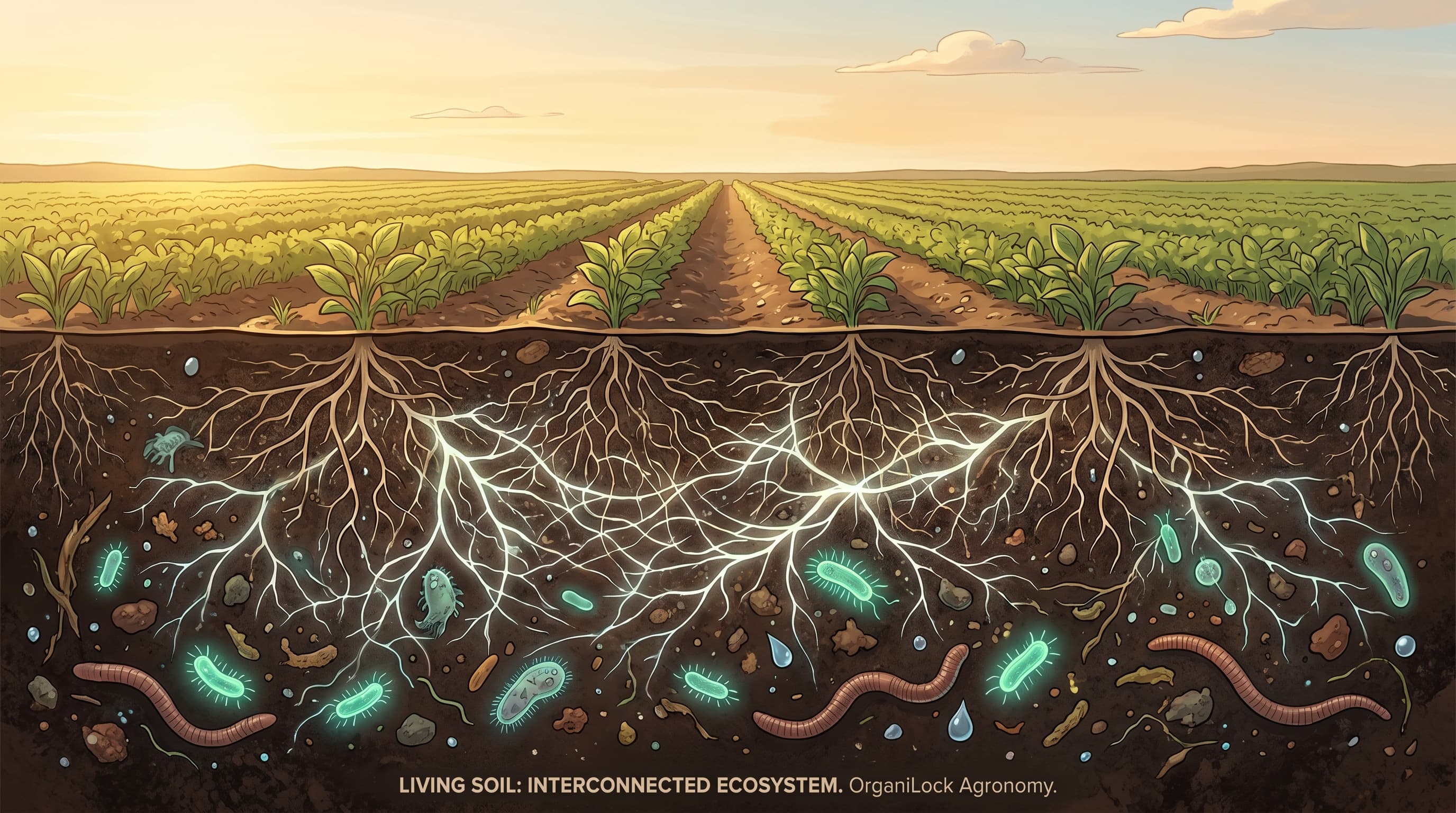
Think of the soil beneath your feet as a living economy. Billions of bacteria, fungi, protozoa, and nematodes are constantly trading, recycling, and transforming nutrients. Each group plays a specific role:
Bacteria: The Nitrogen Workers
Nitrogen is one of the most critical plant nutrients, but plants cannot use the nitrogen gas floating in the air. Specialized bacteria called nitrogen-fixing bacteria capture that atmospheric nitrogen and convert it into forms plants can use — a process called nitrogen fixation. Some of these bacteria live freely in the soil; others form partnerships directly inside plant roots (especially in legumes like beans and clover), living inside structures called nodules.
Other bacteria handle mineralization — breaking down organic matter to release nitrogen, phosphorus, and other nutrients as simple ions that roots can absorb. Still others perform nitrification, converting ammonium into nitrate, a form most plants prefer. Microbes control every step of the nitrogen cycle, from start to finish.
Mycorrhizal Fungi: The Root Extenders
Mycorrhizal fungi form one of nature's most important partnerships. They colonize plant roots and grow an enormous web of tiny threads called hyphae far out into the soil — well beyond the zone that roots can reach on their own. This dramatically expands the plant's ability to find water and nutrients, especially phosphorus, which is notoriously hard to access.
In fact, 80–90% of the phosphorus in soil is unavailable to plants without microbial help. Mycorrhizal fungi dissolve mineral-bound phosphorus using organic acids and special enzymes called phosphatases, then transport it back to the plant root through specialized protein channels. In return, the plant feeds the fungi with carbon sugars — a fair trade that has existed for hundreds of millions of years. Mycorrhizae colonize more than 80% of all plant species on Earth. They are the default partner for most crops.
Mycorrhizal fungi also produce a sticky protein called glomalin that glues soil particles together into aggregates — improving soil structure, water retention, and aeration at the same time.
Plant Growth–Promoting Rhizobacteria (PGPR)
A special group of bacteria known as PGPR live close to plant roots and act as multi-tasking helpers. They can:
Fix nitrogen and solubilize phosphorus, potassium, and zinc.
Produce plant hormones that stimulate root growth.
Create siderophores — tiny molecules that grab scarce iron from the soil and deliver it to the plant.
Help plants manage stress from drought, salt, and disease.
Protozoa and Nematodes: The Recyclers
Protozoa (single-celled organisms) and beneficial nematodes graze on bacteria, releasing nutrients that were locked inside bacterial cells back into the soil. This grazing activity drives roughly 30% of net nitrogen mineralization in healthy soils — a significant contribution that is easy to overlook.
The Rhizosphere: Where the Magic Happens
The thin zone of soil surrounding plant roots is called the rhizosphere. It is the hottest, most active spot in any soil ecosystem. Plant roots release a rich mix of sugars, amino acids, and chemical signals called exudates into this zone, deliberately attracting and feeding beneficial microorganisms.
Plants are not passive in this relationship. They actively invest in their microbiome. Research shows that plants spend 10–40% of everything they produce through photosynthesis feeding the microbes around their roots. Specific chemical signals — like flavonoids and strigolactones — recruit the right partners, triggering bacteria to form nodules and fungi to colonize roots.
In short: the plant is farming its own microbiome, and the microbiome is feeding the plant in return. It is a continuous, negotiated exchange.
What Destroys Soil Microbiology
Understanding what harms the microbial community is just as important as understanding what builds it. Common culprits include:
Excessive tillage — physically destroys fungal hyphae networks and disrupts soil aggregates.
Soil compaction — squeezes out oxygen, which kills aerobic (oxygen-loving) microbes.
Extreme pH — most beneficial microbes thrive in a pH range of 6.0–7.5; very acidic or alkaline soils suppress microbial activity.
Lack of organic matter — microbes need carbon to eat; without it, populations crash.
Over-reliance on synthetic inputs — certain chemical fertilizers and pesticides can reduce microbial diversity over time.
Bare soil — no living roots means no exudates, no food for the rhizosphere community.
When the microbial community collapses, the nutrient cycle breaks down. Plants become dependent on external inputs — and even then, nutrient deficiencies persist because the biological delivery system is gone.
Management Is Microbiome Management
Every management decision a grower makes — tillage, cover cropping, composting, pH adjustment, irrigation — ultimately acts by shaping the living system that feeds the plant. Good management protects and feeds the biology. Poor management depletes it.
Cover crops keep living roots in the ground year-round, feeding the rhizosphere community continuously. Reducing tillage preserves fungal networks. Adding organic matter provides the carbon that microbes need to thrive. Maintaining balanced soil pH keeps the full range of beneficial organisms active.
Inoculants — products that add specific beneficial microbes directly to the soil — can help, especially in degraded soils. But research consistently shows that inoculants alone are no substitute for feeding the soil biology with carbon and protecting its structure. The microbial community needs food and a good home to truly thrive.
Where OrganiLock Soil Food and Refresh Come In
This is exactly the problem that OrganiLock's Soil Food and Refresh products are designed to address.
Soil Food is formulated to supply the biological inputs and carbon-rich nutrition that soil microorganisms need to establish and multiply. By feeding the existing microbial community — and introducing beneficial organisms — Soil Food works with the natural processes described in this lesson to help restore and maintain the biological engine that drives nutrient availability. When microbes are well-fed and active, the entire nutrient cycle accelerates: nitrogen gets fixed, organic matter gets mineralized, phosphorus gets solubilized, and plant roots gain access to the full wealth of nutrients already present in the soil.
Soil Food also contains a great amount of NPK and important micronutrients important for plant health. The nitrogen is in its organic form, which is long lasting and ready for microbes to do their thing.
Refresh supports the ongoing health and renewal of soil microbiology between growing seasons or after stressful events. Tillage, drought, heavy chemical applications, and compaction can all knock back the microbial community. Refresh is designed to help soils recover — replenishing microbial populations and the organic matter they depend on, so the soil food web can bounce back and continue doing its job. Refresh contains soil food in addition to the added woody biomass (organic carbon) and biochar. Refresh also includes added microbes and beneficial bacteria, just like Soil Food does.
Together, these two products represent a complete approach to supporting the soil food web: Soil Food builds and feeds it, Refresh restores and renews it. Rather than bypassing the biology with synthetic inputs, they invest in the living system that makes nutrient uptake possible in the first place — turning locked-up nutrients into plant-available forms, building soil structure, and creating the conditions for lasting, resilient fertility.
Key takeaways
Most soil nutrients are locked up and unavailable to plants until microorganisms transform them — nutrient uptake is a biological process, not just a chemical one.
Bacteria, mycorrhizal fungi, PGPR, protozoa, and nematodes each play specific roles in releasing and delivering nutrients to plant roots.
The rhizosphere is the carbon-fueled microbial hotspot that plants actively cultivate, spending 10–40% of their photosynthetic output to feed their microbial partners.
Phosphorus is the locked vault of soil nutrients — 80–90% is unavailable without microbial help, especially from mycorrhizal fungi.
Microbes also build soil structure through glomalin and aggregation — biology and structure are inseparable.
Management is microbiome management — tillage, organic matter, pH, cover crops, and inputs all act by shaping the living system that feeds the plant.
OrganiLock Soil Food feeds and supports the microbial community, activating the biological engine that unlocks nutrients for plants.
OrganiLock Refresh restores and renews soil microbiology after stress or depletion, keeping the soil food web healthy and productive over time.