Most conversations about plant growth start with nutrients — nitrogen, phosphorus, potassium — and the bags or bottles that deliver them. But beneath every healthy garden, farm, or lawn is something even more fundamental: a living community of organisms that unlock nutrients, build soil structure, and form active trading partnerships with plant roots. Understanding this underground world changes the way you think about growing anything. This lesson explains who lives in your soil, what each group does, why the trade between plants and microbes matters, and what it takes to keep that biology thriving.
Learning objectives
- After this lesson you will be able to describe the main groups of organisms in the soil food web and explain the role each plays in plant nutrition and soil health.
- After this lesson you will be able to explain the underground trade between plant roots and soil microbes — and why disrupting it slows plant growth.
- After this lesson you will be able to distinguish between the two types of mycorrhizal fungi and identify which plants partner with each type.
- After this lesson you will be able to explain why microbe variety, a food supply, and stable habitat matter more than raw microbe count.
- After this lesson you will be able to identify common myths about soil biology and correct them with accurate, evidence-based explanations.
What lives in your soil?
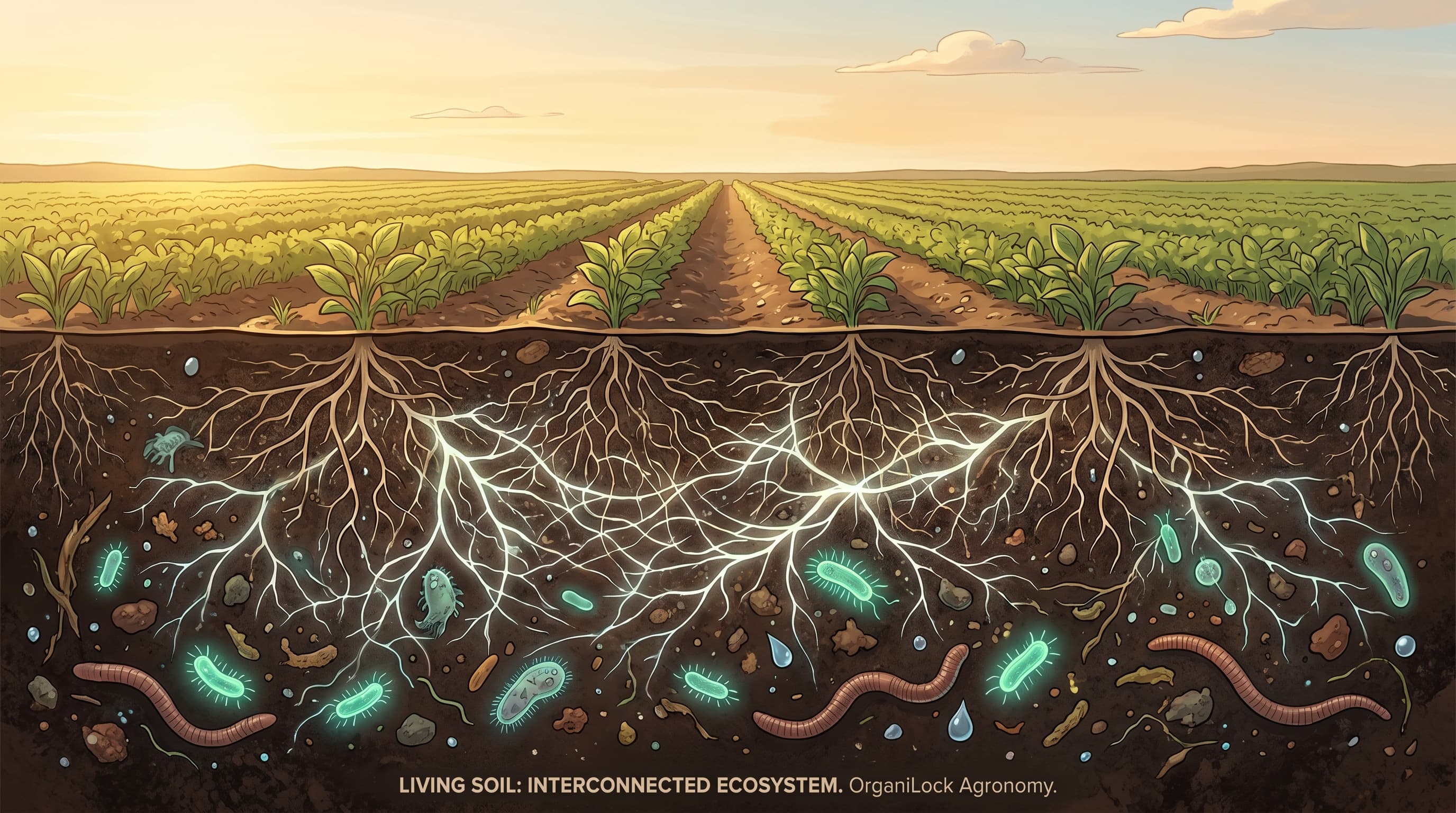
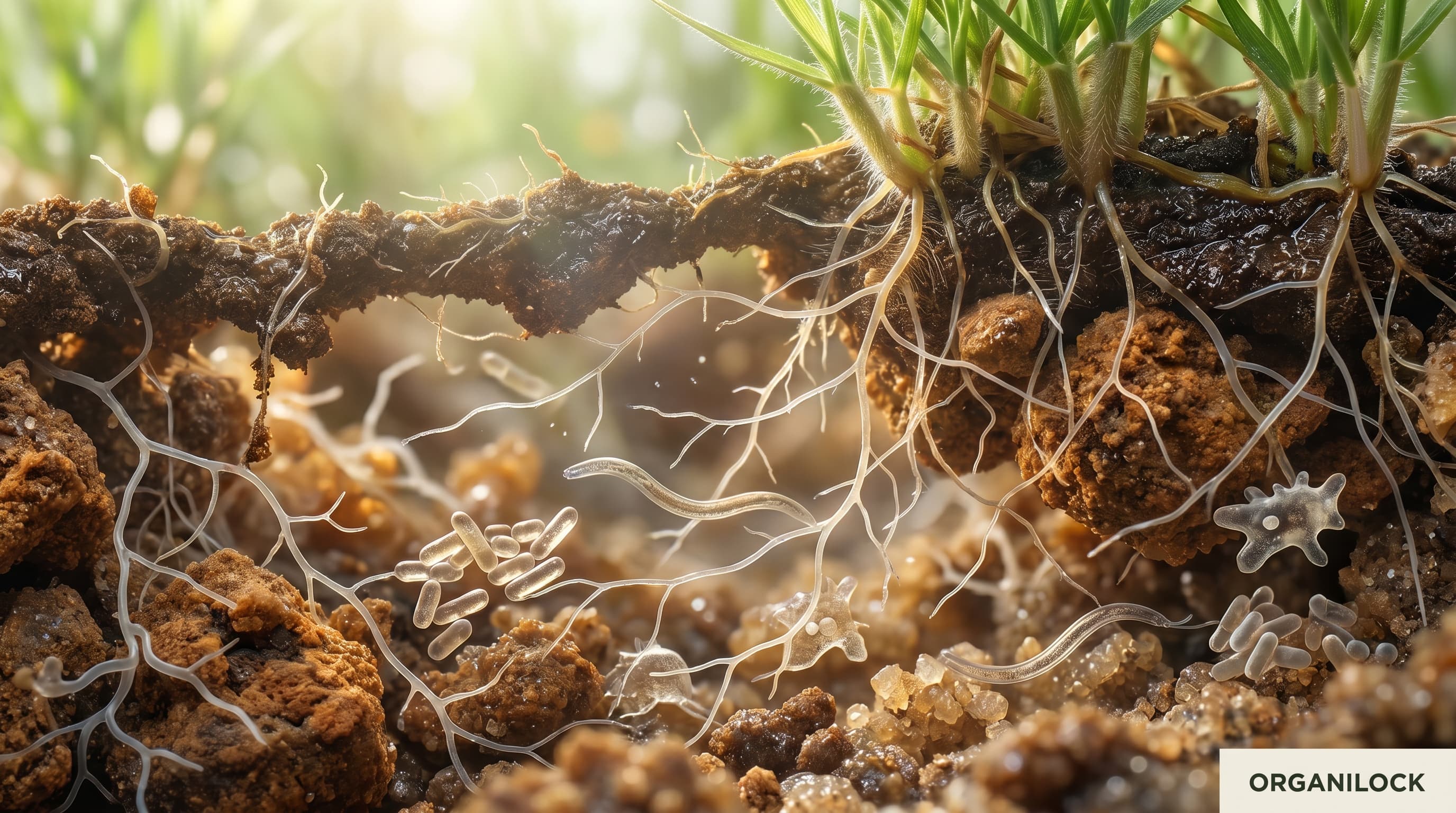
A single teaspoon of healthy soil holds billions of living things — far more than the number of people on Earth. Most of them are microbes: bacteria and fungi too small to see, along with protozoa, nematodes, and other tiny creatures. Together they form what scientists call the soil food web — the living engine that makes soil function.
Here is what that community does:
- Releases nutrients. Microbes break down organic matter and convert nutrients into forms plant roots can actually absorb. Without them, nutrients locked in soil stay locked.
- Builds soil structure. Fungal threads and microbial glues bind loose particles into stable crumbs, which helps soil hold water and air and resist erosion.
- Supports plant growth. Many microbes produce substances that stimulate root development and help plants take up water and food.
- Maintains balance. A busy, varied community keeps the whole system steady, because many organisms compete for space and resources.
The vast majority of soil microbes are helpful or harmless. A biology-first approach to soil health means supporting and feeding this community — not eliminating it.
The underground trade: how plants and microbes work together
One of the most surprising facts in soil science is that plants are not passive recipients of nutrients. They actively feed the microbes around their roots. A plant sends a significant share of the sugar it makes through photosynthesis down into its roots and out into the surrounding soil — on purpose — to attract and sustain the microbes nearby.
The zone of soil immediately surrounding the roots is called the rhizosphere. It is the most biologically active spot in any soil. Plants release a rich mix of sugars, amino acids, and chemical signals called exudates into this zone, deliberately recruiting beneficial organisms. Research shows that plants invest roughly 10–40% of everything they produce through photosynthesis in feeding the microbial community around their roots.
Why would a plant give away so much? Because it gets a great deal in return. Microbes deliver nutrients back to the plant — especially phosphorus, which barely moves through soil on its own — along with water access and growth-promoting substances. It is a continuous, negotiated trade: the plant pays in sugar, and the microbes pay in nutrients and services.
This trade has an important implication for how you feed your plants. When soil is flooded with fast-release synthetic nutrients, the plant can grab what it needs without trading, so the partnership weakens. Gentle, slow, biology-supporting nutrition keeps the trade going. Overwhelming the soil with synthetic inputs shuts it down.
Mycorrhizal fungi: nature's root extension
The word "mycorrhiza" simply means "fungus-root." It describes one of the oldest partnerships in nature — more than 400 million years old — and it helped the very first plants survive on land. Here is how it works: the fungus grows incredibly fine threads called hyphae far out into the surrounding soil, acting like a vast extension of the root system. It brings back water and nutrients and hands them to the plant. In return, the plant feeds the fungus sugar. Both win.
What the plant gains from this partnership:
- Much better uptake of phosphorus and certain trace nutrients.
- Better access to water and more tolerance of dry spells.
- Healthier soil structure — mycorrhizal fungi produce a sticky substance called glomalin that glues soil into crumbs, helping it hold water and resist erosion.
- A stronger, better-supplied root system overall.
Two types of mycorrhizal fungi
There are two main types, and knowing the difference tells you which plants they serve.
| Type | How it grows | Which plants it partners with |
|---|---|---|
| Endomycorrhizal (arbuscular) | Grows inside the root cells and sends hyphae out into the soil | Most vegetables, flowers, herbs, grasses, and fruit plants — the large majority of garden species |
| Ectomycorrhizal | Wraps around the outside of fine root tips and sends hyphae into the soil | Trees and woody shrubs — pines, oaks, birch, and many other forest species |
One honest note: some plants do not form mycorrhizal partnerships at all. The cabbage family (cabbage, broccoli, kale, etc.), beets, and spinach are the main examples. Those plants still benefit from bacteria and soil nutrition — they just do not use mycorrhizal fungi.
The endomycorrhizal fungi in OrganiLock Soil Food
Soil Food includes four endomycorrhizal species chosen because different fungi suit different plants and conditions. Including several raises the odds that an effective partner is present for whatever you are growing.
| Fungus | What it does, in plain terms |
|---|---|
| Glomus intraradices | The reliable workhorse — the most studied and most used of all, works with a very wide range of plants |
| Glomus mosseae | Very common and adaptable; dependable across many different soils and plants |
| Glomus etunicatum | A common partner especially good at helping plants get phosphorus |
| Glomus deserticola | A tough, dry-climate species that adds resilience in dry soils |
The ectomycorrhizal fungi in OrganiLock Soil Food
Soil Food also includes three ectomycorrhizal species, making it effective for trees and shrubs — something many competing products leave out entirely.
| Fungus | What it does, in plain terms |
|---|---|
| Pisolithus tinctorius | Extremely tough; works with a huge range of trees and thrives in hot, dry, poor, or disturbed soil — makes up most of this group in the mix |
| Scleroderma citrinum | A hardy partner for pines, oaks, and birch |
| Rhizopogon luteolus | A specialist for pines and evergreens, often used to help young conifers establish |
Beneficial bacteria: the fast workers in the soil
The second major group in a healthy soil food web is bacteria. While mycorrhizal fungi extend the reach of roots, bacteria do the fast, intensive work right in the soil: breaking down organic material, unlocking nutrients, driving nutrient cycles, and producing substances that stimulate root growth.
OrganiLock Soil Food includes five species from the Bacillus family. There is one fact about Bacillus worth knowing above all others: these bacteria form tough survival capsules called spores. Those spores shrug off drying, heat, and time — which is exactly why they can ride along in a dry bag for months and then wake up when you add water.
| Bacterium | What it does, in plain terms |
|---|---|
| Bacillus subtilis | The all-rounder and most abundant of the five; a strong root colonizer that helps break down material and cycle nutrients |
| Bacillus amyloliquefaciens | A close cousin of subtilis; a strong producer of growth-supporting substances |
| Bacillus licheniformis | A nutrient recycler that produces helpful enzymes and tolerates heat |
| Bacillus megaterium | A standout at freeing up phosphorus for plants, and a producer of growth factors |
| Bacillus pumilus | A root-supporting helper that contributes to plant vigor and a balanced soil community |
Why variety, food, and habitat matter more than raw numbers
You may see some products advertise enormous microbe counts on their labels. That number is far less meaningful than it appears — and here is why.
Living microbes are not like a dose of fertilizer. They colonize: they move into the roots and soil and then multiply on their own. A small number of the right living organisms, given food and a place to live, grows into a thriving community. A large number of the wrong organism — or the right organism with nothing to eat — does very little.
Three things matter far more than the starting count:
- Variety. Different microbes suit different plants, soils, and climates. A broad mix raises the odds that the right helper is present for your conditions, and makes the community more resilient: if one organism struggles, others pick up the slack.
- A food supply. Microbes need organic matter to eat. Dropping them into worn-out soil with nothing to feed on is like sending workers to a job site with no tools, food, or water.
- Stable habitat. Biochar — a stable, porous form of carbon — acts like permanent housing for microbes, sheltering them and holding water and nutrients right where the roots are. It gives the community a lasting home in your soil after you apply it.
OrganiLock Soil Food is designed around all three of these principles: it adds the microbes, the organic matter that feeds them, and the biochar that houses them — all in one product.
Keeping the biology alive: storage and activation
The living organisms in a biology-based soil product travel in a resting, dormant state. A few simple practices keep that biology viable:
- Keep the product dry and sealed. Water is the wake-up signal. If the product gets damp in storage, the microbes activate prematurely and exhaust themselves before reaching your soil.
- It wakes up quickly. Once mixed or watered into soil, the biology activates fast — new fungal growth can be visible as early as 24 to 48 hours after watering.
- Use it by the date on the package. After the best-used-by date, microbe populations may decline — though the nutrients and biochar remain useful. Always check the date.
- Store cool and dry, away from extreme heat.
When living soil biology helps most — and its honest limits
Being clear about this builds trust and sets realistic expectations.
It helps most in soils that have lost their biology: ground that has been heavily tilled, compacted, eroded, or is newly filled, and especially in bagged potting and container mixes, which often start out nearly lifeless. New plantings and disturbed soils give the biology room to establish itself.
It may help less in soil already rich in life, though the organic matter and biochar still improve conditions.
A few honest limits to keep in mind:
- Mycorrhizal fungi need living roots to partner with, so they establish as your plants grow — they are not an instant fix.
- Not every plant uses mycorrhizal fungi. The cabbage family, beets, and spinach are exceptions, though they still benefit from bacteria and nutrition.
- Living soil builds over time. Results depend on your soil, climate, and ongoing care.
- A biology-focused soil product supports plant and soil health — it is not a pest or disease treatment.
Common myths about soil biology
Several persistent misconceptions make it harder for growers to make good decisions. Here is the science on each one.
- Myth: "More microbes is always better." Whether the microbes are alive, how varied they are, and whether they have food and the right conditions matter far more than a large number on a label. Quantity without quality accomplishes little.
- Myth: "Mycorrhizal fungi work on every plant." The cabbage family, beets, and spinach do not form these partnerships. Those plants still benefit from bacteria and soil nutrition — they just do not use fungi.
- Myth: "Microbes can replace fertilizer." Microbes make nutrients available and help plants absorb them — but the nutrients still need to be present in the soil. Biology and nutrition work together; neither replaces the other.
- Myth: "You cannot keep microbes alive in a dry bag." You can. The spore-forming Bacillus bacteria are built to survive drying and revive when watered. That is precisely why these bacteria are used in shelf-stable products.
- Myth: "Compost does the same thing." Compost adds organic matter and some general microbes, but it typically does not add mycorrhizal fungi — those are depleted in most compost processes. A dedicated biology product adds those fungi specifically, along with a diverse bacterial community, food, and habitat.
Key takeaways
- Healthy soil is alive. A single teaspoon holds billions of microorganisms — bacteria, fungi, and more — that form the soil food web, the true engine of plant growth.
- Plants actively feed soil microbes through root exudates, investing 10–40% of their photosynthesis output in this underground trade. Microbes deliver nutrients and growth support in return. Flooding soil with synthetic inputs weakens this partnership.
- Mycorrhizal fungi act like an extension of the root system, reaching more soil for water and nutrients and producing glomalin that improves soil structure. Two types exist: endomycorrhizal (most garden plants) and ectomycorrhizal (trees and shrubs).
- Beneficial Bacillus bacteria unlock nutrients — especially phosphorus — promote root growth, and maintain a balanced soil community. Their spores survive drying and reactivate when watered in.
- Microbe count alone is a poor measure of quality. Variety, a food supply (organic matter), and stable habitat (such as biochar) matter more, because microbes colonize and multiply rather than working as a fixed dose.
- Some plants — notably the cabbage family, beets, and spinach — do not form mycorrhizal partnerships, though they still benefit from bacteria and soil nutrition.
- Keep biology-based soil products dry and sealed until use; activate by watering in. New fungal growth can be visible within 24–48 hours. Always use by the date on the package.
- Living soil biology is most valuable in depleted, disturbed, or container soils. It builds gradually — it is a long-term investment in soil health, not an overnight fix.