What Soil Food is
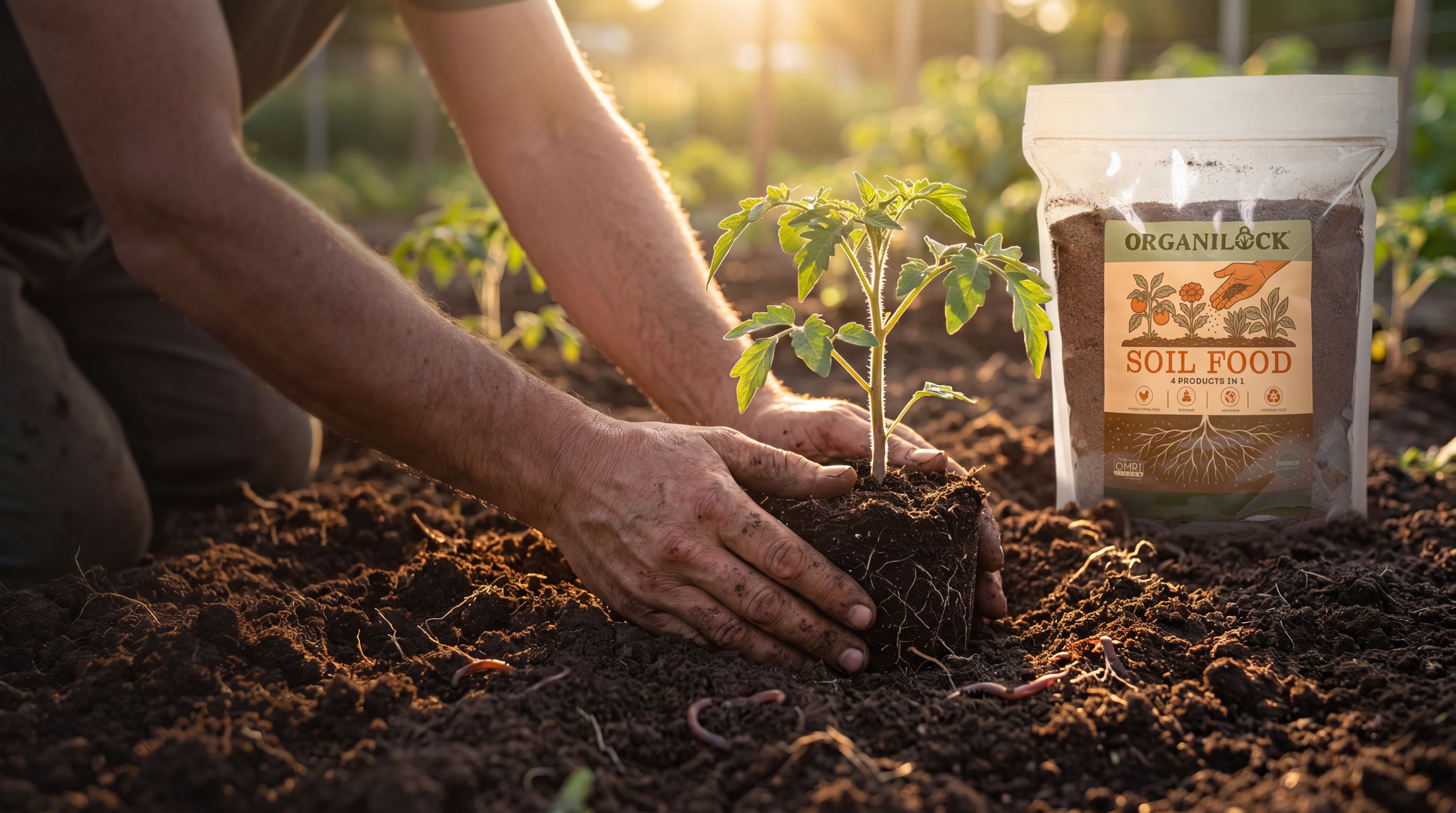
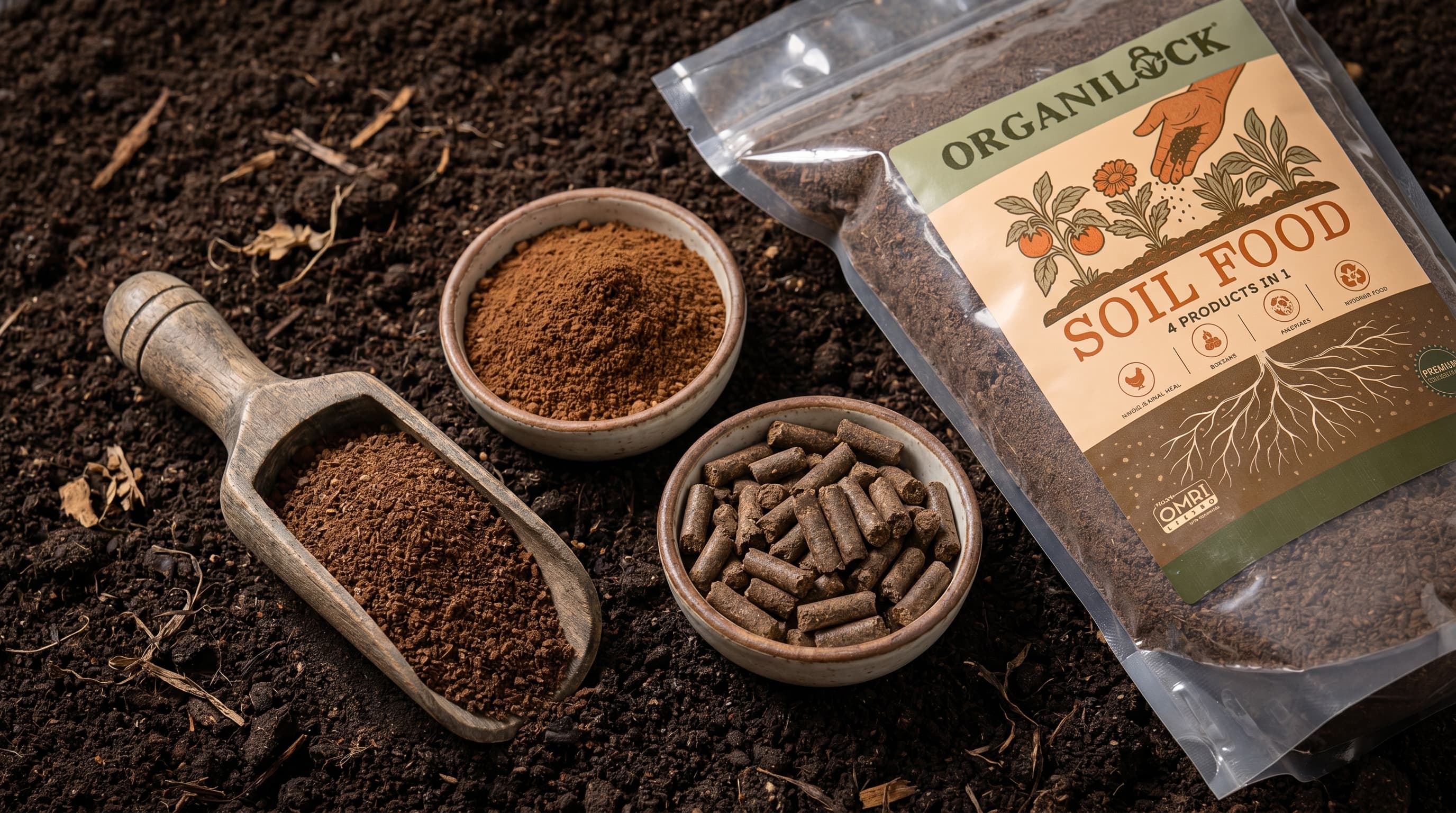
OrganiLock's flagship - a dry, whole-animal-based biological soil amendment and organic fertilizer (it works mixed into the soil or top-dressed on top). It is OMRI Listed for organic production. Applied and watered in, it activates a complete, self-sustaining microbial ecosystem in the soil. OrganiLock calls it "regenerative ag in a bag." Hold the noun steady: Soil Food is an amendment - not a potting soil, not a synthetic fertilizer, and not a simple inoculant.
Bottom line: it's the living-biology upgrade you mix into the soil you already have - and the only OrganiLock product that's OMRI Listed.
The label facts
- Guaranteed analysis: 4-2-1 - 4% nitrogen, 2% phosphate (P2O5), 1% potash (K2O), plus 2.2% calcium. Of that nitrogen, 3.6% is slow-release (water-insoluble) and only 0.4% is soluble - which is exactly why it feeds steadily and can't burn.
- In the bag: whole, pre-compost poultry (whole-animal nitrogen), woody biomass (the carbon that balances the carbon-to-nitrogen ratio), biochar (water retention, microbial habitat, and lasting carbon), and a full microbe package - all made through the patented N.I.S.T. process (patent granted April 2025).
Bottom line: low, balanced numbers on purpose. The NPK isn't the story - a living soil that keeps feeding the plant is. Lead with the biology; have 4-2-1 ready for when a label-reader asks.
The science: a living soil ecosystem
Soil Food carries full, label-level disclosure of its biology (a selling point in itself - most competitors disclose less, or none):
- Endomycorrhizal fungi - 4 species, 120 propagules per gram.
- Ectomycorrhizal fungi - 3 species.
- Beneficial bacteria - 5 Bacillus species.
Carrying both endo and ecto mycorrhizae is the technical reason one product serves vegetables, flowers, and trees. And because an organic food source is built in, the biology doesn't just get introduced - it stays alive and multiplies.
Bottom line: most "biology" products give you a sprinkle of spores. Soil Food gives the fungi, the bacteria, the biochar home, AND the food that keeps them alive - a whole living system, not a single ingredient.
What problems it solves
Depleted, "tired" soil that needs more inputs every year; dependence on synthetic fertilizers (and their runoff and burn risk); transplant shock and weak root establishment; and a complicated shelf of single-purpose products.
Who to sell it to - and how
Match the message to the buyer. OrganiLock serves five segments:
- Home gardener. Problem: wants healthier plants and bigger harvests without a chemistry lesson. Pitch: lead with the visible 24-48 hour activation and the yield numbers; keep the science as proof inside a benefit. Right-size with the small SKUs and the sample.
- Market gardener / small farm (a quarter-acre to 10+ acres; reads labels). Problem: yield, input-cost efficiency, and organic-certification compliance; often already stacking products. Pitch: lead with the trial data (especially the +29% soybean figure) and the simplification argument; bring cost-per-acre math; the pellet SKUs broadcast at scale.
- Professional landscaper. Problem: transplant shock and callbacks; wants a credible premium add-on. Pitch: transplant-shock elimination (endo + ecto colonization), biochar water retention, and the no-burn safety margin; Landscape Refresh for trees and shrubs.
- Garden center / nursery (retail buyer). Problem: margin, shelf differentiation, and a product that doesn't need heavy buyer education. Pitch: the patent and OMRI story as shelf differentiators, dual-function efficiency (fewer SKUs), and the no-burn story that reduces complaints. The additive frame: "this makes every bag of soil you already sell work better."
- The DIY-stack buyer (assembles compost + a nitrogen source + a separate inoculant + standalone biochar). Problem: complexity, cost, and inconsistency. Pitch (the highest-conversion target): show the stack, total its cost ($50-80+), and show what it still lacks versus one OrganiLock bag. "You're doing five steps; this is one."
Bottom line: visible results for the hobbyist, cost-per-acre and trial data for the grower, margin and differentiation for the retailer, and stack-collapse for the DIY buyer.
The competition - and why Soil Food stands out
Be honest first: OrganiLock is less known than Espoma or Dr. Earth, has fewer reviews, and its trial data is company-reported. So we win on the product, not the logo. Four advantages have no competitor parity: the patented N.I.S.T. process, whole-animal nitrogen, visible 24-48 hour activation, and a complete self-sustaining ecosystem.
- Espoma (Bio-tone / Plant-tone) - the biggest retail rival. No biochar, no patent, NPK-led messaging, fractionated meals; Bio-tone is a starter. Plant-tone buyers (no biology at all) are a natural upsell.
- Dr. Earth - real biology (TruBiotic) but primarily endo-focused, no biochar, no patent. Expect "it's half the price" and reframe to cost-per-coverage (Soil Food applies at 1 lb per 50 sq ft vs. their 2-4 lb).
- Jobe's Organics - strong on Amazon; Biozome is proprietary and undisclosed, and its Archaea inclusion is less evidenced than the mycorrhizae and Bacillus science.
- Down To Earth - the 4-4-4 carries no biology at all; Bio-Live is narrower than our full package; no biochar.
- Mycorrhizal inoculants (Mykos and others) - no nutrition, often a single species, and no food source. These buyers already believe in biology - they're the ideal convert.
The one-liner: "Competitors sell you a piece of the puzzle. OrganiLock delivers the whole living system - biology, habitat, and the food that keeps it alive - in one product."
It complements - it doesn't compete
This is the key to selling it through a dealer's or retailer's existing line:
- For retailers: it doesn't replace your shelf - it makes it work better. "This makes every bag of soil and box of fertilizer you already sell perform." A cross-sell, not a substitution.
- For inoculant users: "Mykos inoculates the soil. Soil Food feeds the microbes - the food source they need to survive and multiply. An inoculant without a food source is like hiring workers and giving them nothing to work with."
- With Plant Food: Soil Food feeds the soil; Plant Food feeds the plant directly. Together they're the complete two-product system.
- No burn risk and you can't over-apply - so it layers safely onto whatever a grower is already doing.
Bottom line: position Soil Food as the missing biology layer that upgrades a customer's existing setup - not a rip-and-replace.
How to use it
Before planting (in-ground): mix 1 lb per 50 sq ft into the top several inches. After planting: top-dress 1-2 tablespoons per sq ft around the base, monthly or as needed. No burn risk, so be generous - exact measuring isn't critical. It feeds the soil, so results compound: encourage repeat seasonal use. Forms: granular for hand application, pellet for broadcasting larger areas, and a small shaker for indoor use. Point customers to the OrganiLock calculator for amounts.
The proof, honestly
In OrganiLock's documented field trials: +17% on cucumbers and +65% on yellow squash vs. synthetic controls; an 8-acre soybean trial above the Kentucky and US average yields; a Hopkins County soybean trial +29% above the state average. The biology is visible too - hyphae bloom within 24-48 hours of watering in. These are OrganiLock's own, company-reported figures - strong and real, but never described as "peer-reviewed" or "scientifically proven."
Handling "it's cheaper elsewhere"
The bag can look pricier, but Soil Food applies at a much lower rate (1 lb per 50 sq ft vs. competitors' 2-4 lb), which closes most of the per-application gap - and because it builds a persistent ecosystem, it reduces future inputs. Move the conversation from price-per-bag to cost-per-coverage and cost-over-seasons. (Always quote live prices from the catalog, never from memory.)
Guardrails
- "OMRI Listed" is not "USDA Organic" - different programs. Only Soil Food is OMRI Listed today (Refresh is pending, Plant Food is not).
- NPK is 4-2-1 (label-verified) - you may state it; for anything beyond the guaranteed analysis, point to the label and Certificate of Analysis.
- Sizes and prices always come from the live catalog, never from memory.
- Trial figures are fixed - don't round or inflate, and always say they're OrganiLock's own trials.