Your plants are talking to you all the time. A yellow leaf, a purple stem, a scorched edge, a stunted tip - each is a signal, and once you learn to read them you can catch a problem early and respond to what is actually wrong instead of guessing. This first lesson teaches the single most useful diagnostic skill there is: a simple question that sorts most plant problems into the right half of the map before you do anything else. You will not become a plant doctor in one lesson, but you will learn to read the first and most important clue any plant gives you. And the payoff is real: catching a problem early, when it is one fading lower leaf rather than a struggling whole plant, is the difference between a quick correction and a lost crop. Observation is the cheapest and most powerful tool in the garden, and this lesson is about learning to use it well.
The one question that starts every diagnosis
When something looks wrong, ask one thing first: are the symptoms showing up on the old leaves or the new leaves? That single question narrows the field dramatically, because of how plants move nutrients around inside themselves. Some nutrients are mobile - the plant can pull them out of older tissue and ship them to new growth when supplies run short. Others are immobile - once they are built into a leaf, they stay put. Which kind is short changes where the symptom appears.
- Mobile nutrients (nitrogen, phosphorus, potassium, magnesium): when these run low, the plant cannibalizes its oldest, lowest leaves to feed the new growth at the top. So the symptoms show up on the old leaves first.
- Immobile nutrients (calcium, boron, iron, manganese, zinc, copper): the plant cannot relocate these, so when they run short the newest growth at the tips suffers first, while the old leaves stay fine.
That is the whole trick, and it is genuinely powerful. Old leaves affected first points you toward a mobile nutrient; new growth affected first points you toward an immobile one. Before you know anything else, you have already cut the possibilities in half.
What old-leaf problems look like
When the trouble starts low and old, you are usually looking at one of the mobile nutrients, and each has a fairly distinct signature:
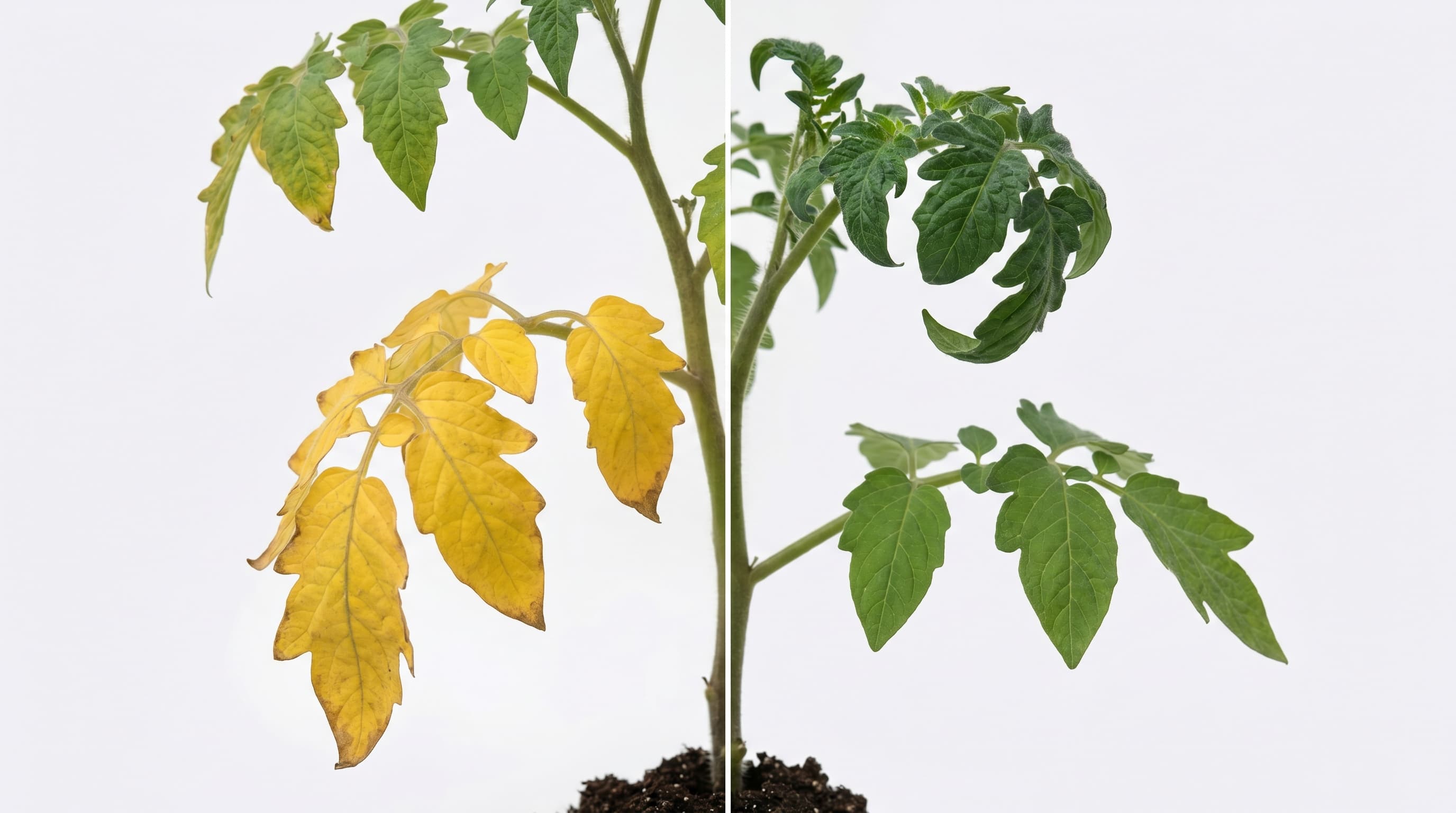
- Nitrogen: a uniform, even yellowing of the oldest leaves, along with a generally pale, stunted, slow-growing plant. Nitrogen drives leafy growth, so a shortage shows as an all-over fade starting at the bottom.
- Phosphorus: a dull, dark blue-green cast on the older leaves, often with purple or reddish tints on the stems and leaf undersides, plus stunting and poor flowering or fruiting. (Watch out: cold soil mimics this, because cold roots cannot take phosphorus up even when it is there - early-spring purpling often fixes itself as the soil warms.)
- Potassium: a classic scorching - yellowing and browning along the leaf margins (the outer edges) while the center stays green - on the older leaves, with weak stems and poor fruit quality.
- Magnesium: yellowing between the veins (the veins stay green) on the older leaves, a pattern called interveinal chlorosis.
What new-leaf problems look like
When the newest growth at the tips is the part in trouble while the old leaves look fine, suspect an immobile nutrient - and very often, suspect that the real cause is pH or water rather than a true shortage:
- Iron: yellowing between the veins on the youngest leaves, with the veins staying sharply green. This is the single most common micronutrient symptom, and it is almost always a high-pH lock-up or a waterlogged-root problem, not a soil that is actually short on iron.
- Calcium and boron: distorted, deformed, or dying growing points, and disorders like blossom-end rot on tomatoes. These hit the actively growing tips because the plant cannot move them there.
- Sulfur: a general yellowing of the newest leaves - the mirror image of nitrogen, which yellows the oldest leaves first. That pairing is a handy way to tell them apart.
- Zinc: stunted "little leaf," rosetting, and shortened stems - and notably, zinc shortage is often induced by too much phosphorus.
A pairing worth memorizing
If you remember only one comparison, make it this one: an even yellowing that starts on the oldest leaves points to nitrogen; an even yellowing that starts on the newest leaves points to sulfur. Same symptom, opposite ends of the plant, opposite causes. That single contrast captures the whole old-versus-new principle in one picture, and it is the kind of thing that makes you look like you know exactly what you are doing in the garden.
Look at the whole plant, not one leaf
A single odd leaf rarely tells you much - what matters is the pattern across the plant. Ask yourself a few framing questions before you settle on a culprit. Where on the plant is it concentrated: bottom, top, or all over? Is the yellowing uniform across the leaf, between the veins, or only at the margins? Did it come on suddenly (which points toward water, cold, or transplant shock) or build slowly over weeks (which points more toward a nutrient or soil issue)? Is one plant affected or the whole bed (one plant suggests roots, damage, or that individual's situation; the whole bed suggests soil or weather)? Reading the pattern, the location, and the timing together is what separates a confident read from a wild guess. The leaf is the message; the pattern is the meaning.
Not everything is a nutrient
Before you read every symptom as a nutrient story, rule out the common non-nutrient look-alikes, because they are everywhere and they fool people constantly. Crispy brown leaf edges can be simple drought or heat scorch, or salt from over-fertilizing, not a potassium problem. Pale, washed-out leaves can be too much harsh sun on a shade plant, or too little light on a sun lover. Sudden wilting is almost always water - either too little, or so much that the roots have drowned - not a feeding issue. Spots, holes, and chewed edges are pests or disease, not hunger. Distorted new growth can be herbicide drift from a neighbor's lawn treatment. And some yellowing is just normal aging, as a plant sheds its oldest leaves on schedule. A good diagnostician holds all of these in mind and asks "what else could explain this?" before landing on a nutrient. The leaf-reading method narrows the field; ruling out the look-alikes keeps you from confidently solving the wrong problem.
Putting it to work: a quick example
Say your tomato's lower, older leaves are turning evenly yellow and the plant looks generally pale and slow, while the new growth at the top is still green and fine. Walk it through: old leaves affected points to a mobile nutrient; an even, uniform yellowing (rather than scorched margins or interveinal striping) points specifically at nitrogen; and a pale, slow, leggy plant fits a nitrogen shortage. So your working hypothesis is "low available nitrogen." Notice what you have not done: you have not run to buy a high-nitrogen product. The next step is to consider whether the nitrogen is genuinely low or just unavailable (cold soil, soggy roots, a pH problem), and ultimately to confirm with a test - because, as the next lessons show, "looks like it needs nitrogen" and "is actually short on nitrogen" are not always the same thing. The reading gives you a smart, specific hypothesis to check, which is exactly what it is for.
The honest caveat
Here is the part that keeps you out of trouble: reading a plant this way is a starting point, not a diagnosis. Symptoms overlap, more than one thing can be wrong at once, and a great many leaf problems are caused not by a true nutrient shortage at all but by water, root damage, or soil pH - which the next lesson is entirely about. So use the old-versus-new question to form a hypothesis, not to reach straight for a bottle of something. The most common mistake gardeners make is to see a yellow leaf, decide it is "hungry," and pour on a nutrient that was never the problem. Read the plant, form a guess, and then confirm it - ideally with the soil test you will learn to read at the end of this course - before you act.
Plain-English takeaway: The first question in any plant diagnosis is "old leaves or new?" - old-leaf symptoms point to a mobile nutrient (nitrogen, phosphorus, potassium, magnesium) and new-growth symptoms to an immobile one (iron, calcium, boron, zinc), but treat it as a starting hypothesis to confirm, not a reason to reach for a product.