Here is the most useful and most counterintuitive idea in this whole course: when a plant looks hungry, it is often not actually short on the nutrient it appears to be missing. The nutrient is frequently right there in the soil - the plant just cannot reach it. Most fertilizer mistakes are balance mistakes, not deficiency mistakes, and pouring on more of a nutrient that is already present makes the problem worse, not better. This lesson is about the real causes hiding behind a hungry-looking plant, so you fix the cause instead of feeding a symptom.
The master gate: soil pH
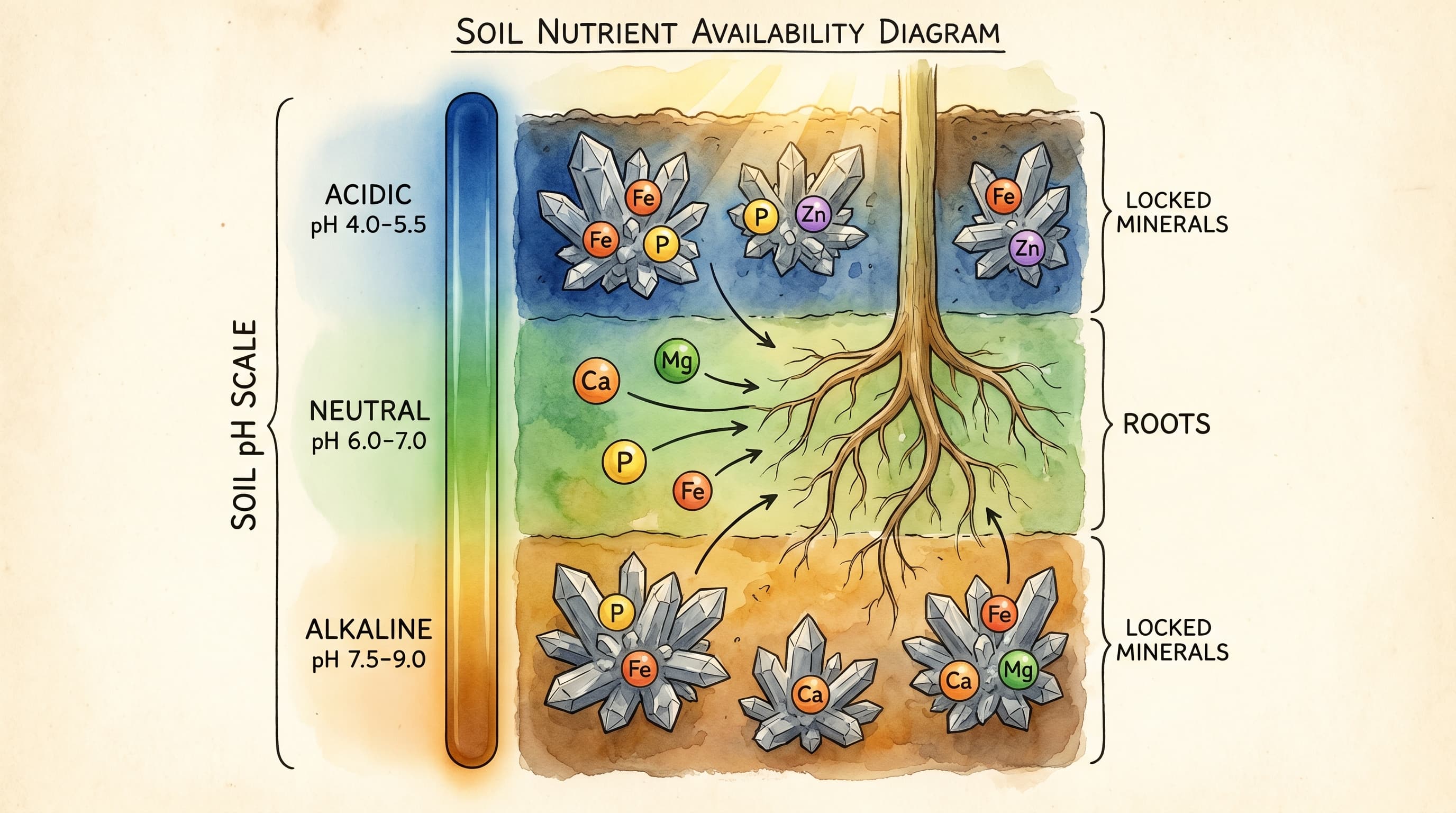
If you learn one new concept from this course, make it this one. Soil pH - how acidic or alkaline your soil is - does not feed the plant directly, but it decides how much of everything else the plant can actually reach. It is the master control on nutrient availability, which is exactly why the same fertilizer can work beautifully in one garden and do nothing in the one next door. Most nutrients are most available in a slightly acidic to neutral band, roughly pH 6.0 to 7.0, which is the target for most vegetables and ornamentals.
Step outside that band and nutrients start locking up even when they are abundant:
- In alkaline soil (high pH), phosphorus locks up with calcium, and iron, manganese, zinc, and copper become hard to reach. High-pH gardens commonly show iron yellowing on new growth despite plenty of iron in the ground.
- In acidic soil (low pH), phosphorus locks up with iron and aluminum, calcium and magnesium grow scarce, and aluminum and manganese can climb toward toxic levels.
The practical lesson is huge: before you add more of a nutrient, check whether pH is the real problem. Correcting pH - lime to raise it, sulfur or acidifying inputs to lower it - often releases nutrients that were already in the soil, which is cheaper and healthier than piling on more fertilizer. And because organic matter and biology buffer pH and keep it stable, building living soil makes pH swings far less punishing.
The balance problem: nutrients compete
Nutrients do not sit in the soil politely waiting their turn - they interact, and an excess of one can block another. The most common real-world example: too much potassium blocks the uptake of magnesium and calcium, so a soil that has been over-fed with potassium can show a magnesium deficiency even when magnesium is plentiful. Another: too much phosphorus suppresses the mycorrhizal fungi that help feed the plant and blocks the uptake of zinc and iron, inducing shortages in soils that are not actually short. This is why "the plant looks like it needs X, so I will add more X" so often backfires - the real issue was that something else was out of balance. A plant responds to the balance of all its nutrients together, not to a single number on a bag.
Water and roots
A surprising share of hungry-looking plants are really water-stressed or root-stressed plants. Overwatering drowns roots and starves them of oxygen, which produces the same yellowing you would blame on a nutrient - waterlogged roots are a classic cause of iron yellowing on new growth. Underwatering shuts down the flow of nutrients the plant can only take up dissolved in water. Compacted or damaged roots cannot reach what is there. And as you saw in the last lesson, cold soil mimics a phosphorus shortage. Before reaching for fertilizer, look honestly at how the plant is being watered and whether its roots are healthy - the fix is often free.
How to know your pH
Since pH controls so much, it is worth knowing where yours sits. You do not have to guess: an inexpensive pH meter or a simple test kit gives you a ballpark reading, and a proper soil test (the last lesson) gives you a reliable number along with everything else. A few clues also hint at it - chronically yellow new growth on plants in your area, or trouble growing things that like neutral soil, can suggest a high pH, while a region known for acidic soils and happy blueberries and azaleas suggests a low one. The point is not to obsess over a decimal, but to know roughly which side of neutral you are on, because that single fact reframes a lot of "deficiency" symptoms. A nutrient that reads present on a test but shows deficiency on the plant is very often a pH-availability story, not a quantity story.
Salt and over-fertilizing
One more real cause of hungry-looking, unhappy plants is, ironically, too much fertilizer - specifically, the salt buildup that comes from over-applying soluble products. Fertilizers are salts, and piling them on (or feeding heavily in a container where salts concentrate) can scorch leaf edges and roots and stress the plant in ways that mimic other problems. This is one place the product distinctions matter: a soluble feed like Plant Food has to be used to its label rate precisely because it behaves like any soluble salt and can burn if over-concentrated, whereas an insoluble, slow-release amendment like Soil Food releases gently through biology and does not create that salt spike. If a heavily-fed plant looks worse rather than better, the answer is usually less, not more - flush containers with plain water, ease off the soluble feeding, and let the soil settle. More is not better with soluble nutrition; balanced and steady is.
The bloom-booster myth
A quick myth worth puncturing, because it costs gardeners money and harms their soil. The "bloom booster" - a fertilizer with a big middle number - is sold on the promise of more flowers. But phosphorus does not work that way: adding more than the plant can use does not produce more blooms. Instead it suppresses the very mycorrhizae that build long-term fertility and blocks zinc and iron. And most established garden soils already test high in phosphorus from years of feeding. Potassium, which can leach from sandy soils and containers, is far more often the nutrient actually in short supply. The honest answer to "should I add phosphorus?" is almost always "test first," because feeding by habit is exactly how soils end up out of balance.
Temporary stresses that pass on their own
Some hungry-looking spells are not problems to fix at all - they are temporary stresses that resolve themselves once you recognize them, so it is worth not over-reacting. A just-transplanted seedling often sulks for a week or two, pale and slow, while its roots re-establish; that is transplant shock, not a deficiency, and the cure is patience and steady moisture, not fertilizer. A heat wave can make a thriving plant wilt and dull in the afternoon and recover by morning. Early spring routinely brings the cold-soil purpling you met in the last lesson, which fades as the ground warms. Even a heavy rain can briefly flush nutrients and yellow a plant that greens back up as things dry. The lesson is to factor in timing and weather before you diagnose: if a symptom appeared right after a transplant, a cold snap, a heat wave, or a downpour, give it a little time before concluding the soil is to blame. Reaching for a product to "fix" a passing stress usually does nothing but add to the imbalance.
The real fix
Put it together and a pattern emerges. When a plant looks hungry, the smart sequence is: check the water and roots, consider the pH, think about whether something is out of balance - and only then, if a test confirms it, add a targeted nutrient. Most of the time, the durable fix is not a single nutrient at all; it is building a balanced, living soil that holds nutrients, buffers pH, and delivers a broad spectrum in step with the plant. That is the quiet reason a biology-first, organic-matter-building approach makes everything else work better: it keeps the whole system in balance, so fewer of these false-alarm deficiencies happen in the first place. Feed the soil, and you spend a lot less time diagnosing hungry plants. The grower who reaches for a different bottle every time a leaf yellows is always firefighting; the grower who builds balanced living soil simply has fewer fires - and that, more than any single product, is what makes a garden easier year after year.
Plain-English takeaway: A hungry-looking plant is often not short on that nutrient at all - pH lock-up, nutrient imbalance (too much potassium blocks magnesium and calcium; too much phosphorus blocks zinc and iron), and water or root stress are the usual culprits, so check those and test before you add anything, and build balanced living soil to prevent the false alarms.