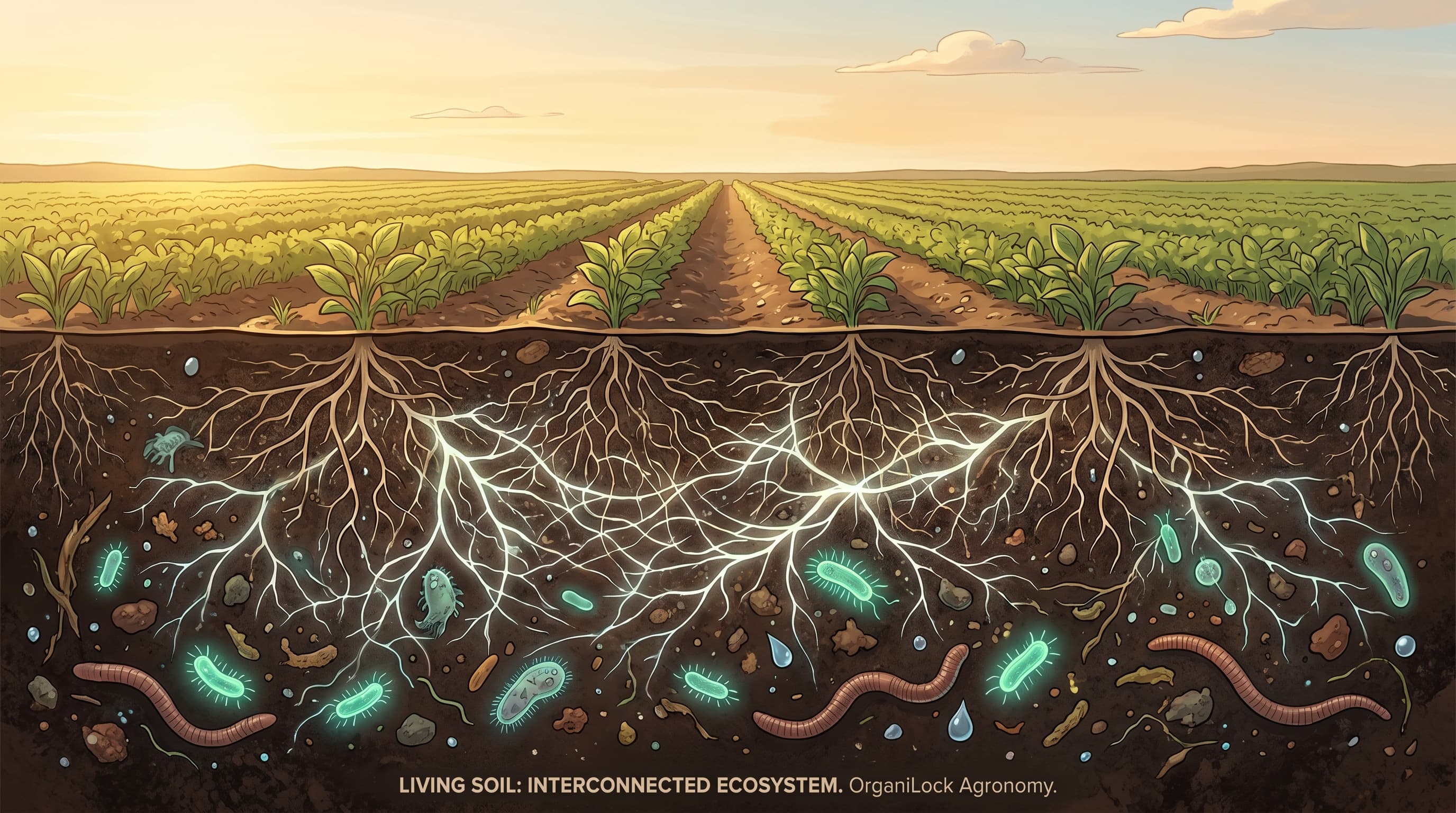
Sometimes the problem in your garden is not a nutrient at all - it is the physical home your plants are trying to live in. A perfectly fertilized plant will still struggle in soil that is hard as a brick, stays soggy for days, or has had its life slowly mined out of it. This lesson covers the three big structural problems - compaction, drainage, and low organic matter - and the single fix that improves all three at once. Get the soil right as a place to live, and a great deal of the nutrient drama takes care of itself.
Organic matter: the master lever
Start here, because it is the most powerful and most controllable thing you can change about your soil. Organic matter - decomposed plant and animal material, the dark, crumbly stuff that becomes humus - does an extraordinary amount of work. Humus holds onto nutrients (it has an enormous capacity to grip the positively charged nutrients like potassium, calcium, and magnesium, far more per pound than clay), it holds water, and it buffers pH so the soil resists swinging too acidic or too alkaline. In one move, building organic matter increases your soil's nutrient-holding capacity, its water-holding capacity, and its stability, all at the same time. Think of it as enlarging the pantry: more room to store what plants need, released slowly as they need it. This is the quiet reason a biology-first approach makes every other nutrient work better - it builds the pantry that holds them.
Compaction
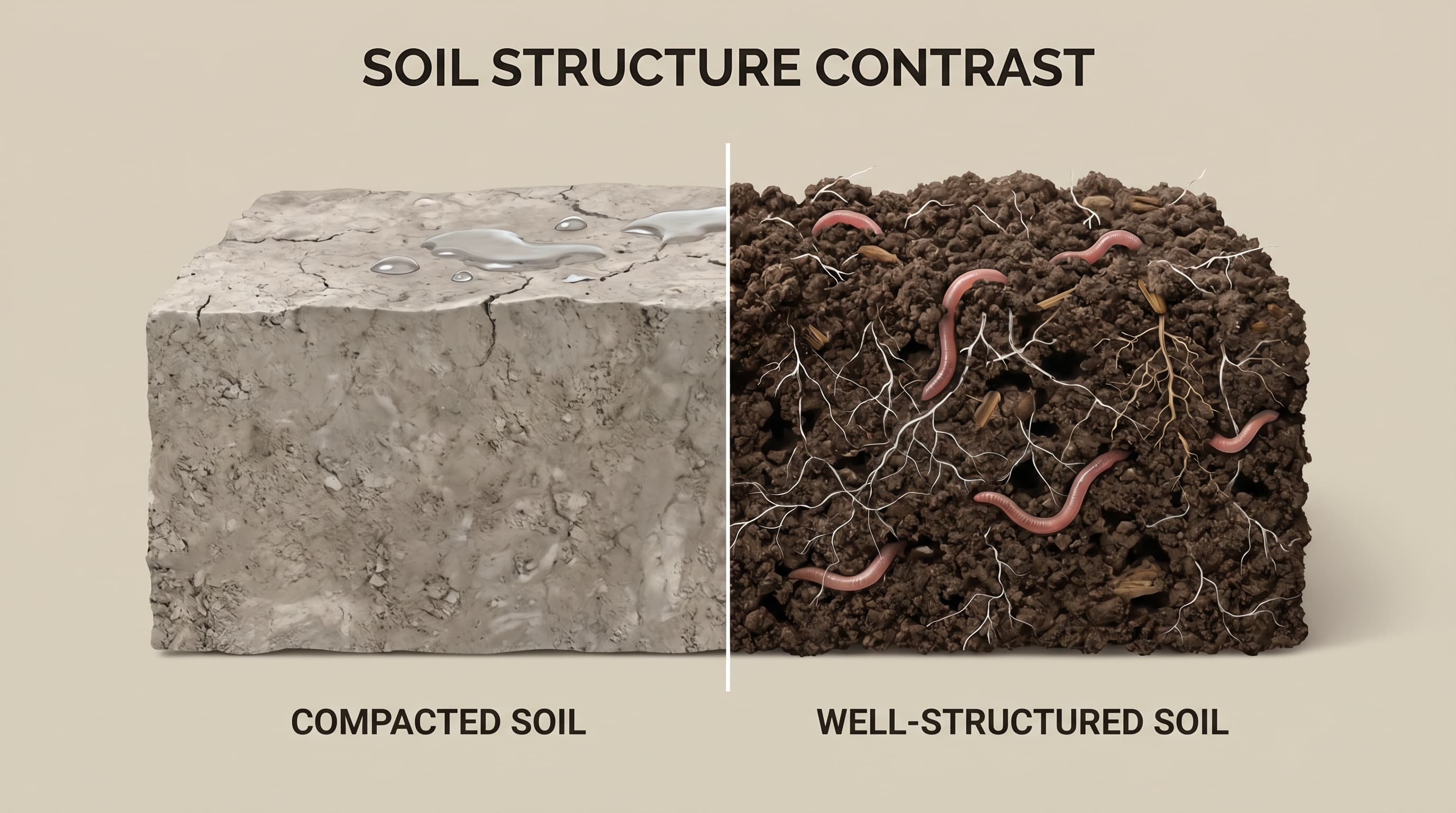
Compacted soil is squeezed so tight that roots cannot push through it, water cannot soak in, and air - which roots need to breathe - is driven out. You will recognize it: water puddles on the surface instead of soaking in, the ground is hard to dig, and roots come up shallow and stunted. Compaction comes from foot and equipment traffic, from working soil when it is wet, and from soils naturally low in organic matter and structure. The fixes are mostly about restoring structure rather than forcing it: avoid walking on growing beds, never work or till soil when it is wet (that smears and compacts it further), and above all add organic matter, which - together with the roots and biology it feeds - gradually opens the soil back up into a crumbly structure that water and roots can move through. Living soil does its own tilling over time.
Drainage: too slow and too fast
Drainage problems come in two opposite flavors, and interestingly the cure is the same for both. Too slow is waterlogging: the soil stays soggy, roots suffocate from lack of oxygen, iron yellowing shows up on new growth, and root diseases get their opening. Too fast is the sandy-soil problem: water (and the nutrients dissolved in it, especially potassium) runs straight through before the plant can use it, leaving the plant prone to drought and the soil prone to leaching - which is also why containers, where everything washes through quickly, need more attentive feeding. The unifying fix for both extremes is organic matter: in heavy, slow-draining soil it opens up structure so water can move; in fast-draining sandy soil it acts like a sponge that holds water and nutrients in the root zone. The same amendment that drains a swamp also waters a desert, because it is fixing the soil's ability to manage water either way.
Low organic matter: the depleted-soil spiral
Low organic matter is the underlying condition behind a lot of the trouble above, and it tends to feed on itself. A soil thin on organic matter holds little water and few nutrients, supports a weak and hungry biology, and runs short on the nutrients - like nitrogen and sulfur - that come largely from organic matter breaking down. So the plants underperform, the gardener reaches for more soluble fertilizer to compensate, the biology gets even less to work with, and the soil drifts further from health. This is the input treadmill from a soil-structure angle: the problem is not that you are not feeding enough, it is that the soil has lost its capacity to hold and deliver what you feed it.
Two simple tests you can do yourself
You do not need a lab to learn a lot about your soil's structure - two quick, free tests tell you most of what you need:
- The squeeze test: take a handful of moist (not wet) soil and squeeze it. If it forms a hard, slick ball that will not crumble, you are heavy on clay and prone to compaction and slow drainage. If it will not hold together at all and falls apart instantly, you are sandy and prone to fast drainage and leaching. If it forms a ball that crumbles when you poke it, you have good structure - the goal.
- The percolation test: dig a hole about a foot deep, fill it with water, let it drain, then fill it again and time how long the second filling takes to drain. Draining in a few hours is healthy; water still standing many hours later signals a drainage problem; water vanishing almost immediately signals soil too fast and thirsty. Either extreme points to the same fix.
A jar test (shaking soil in water and letting the sand, silt, and clay settle into layers) is a third easy one if you want to know your soil's texture. None of these are precise science, but they turn "my soil seems off" into a concrete read you can act on.
What good soil feels like, and how long it takes
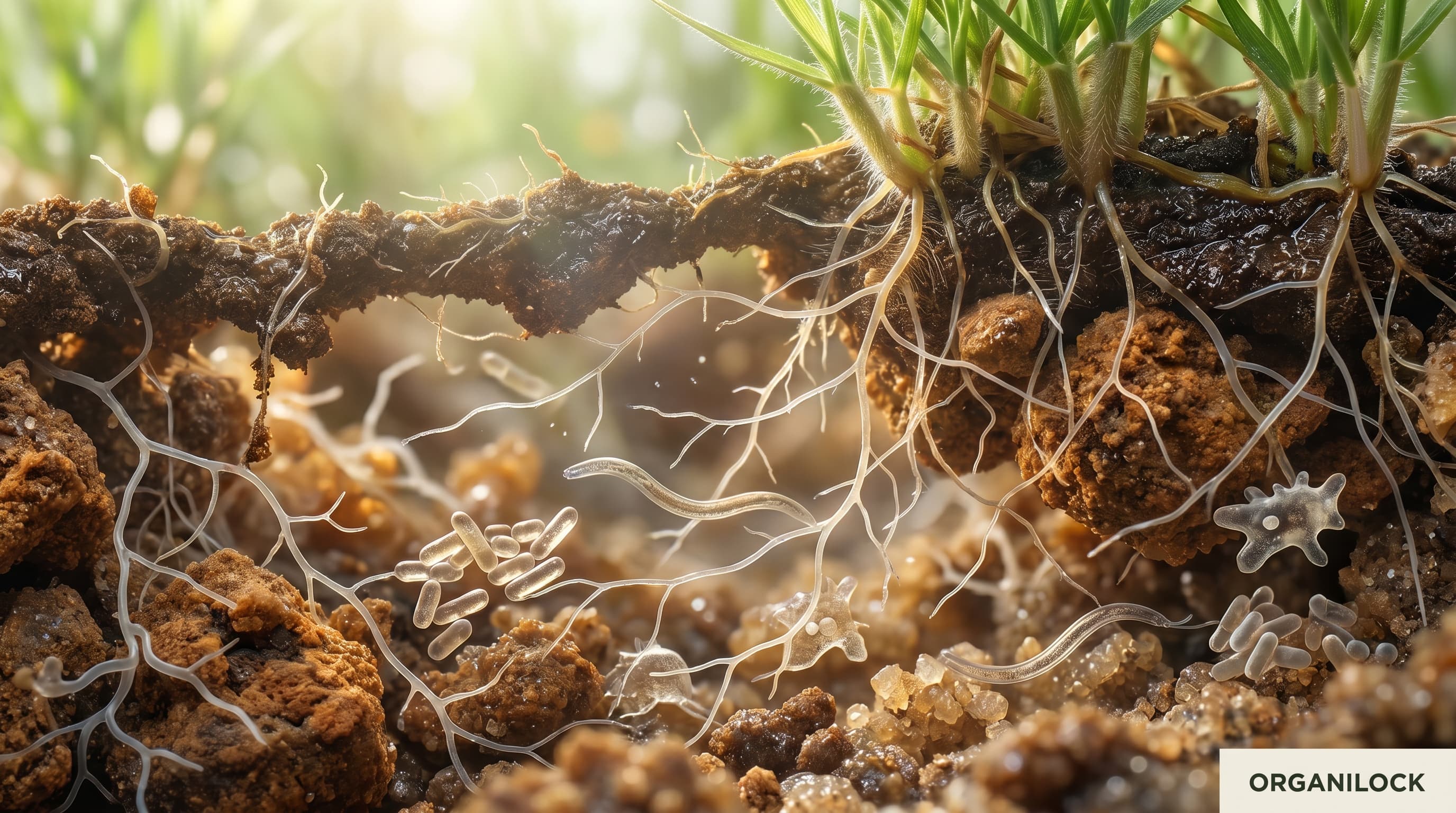
It helps to know what you are aiming for, because the goal is something you can feel in your hands. Healthy soil is dark, crumbly, and slightly springy; it holds together when squeezed but breaks apart easily; it smells fresh and earthy; it is easy to dig and full of life, from earthworms to fine white roots and fungal threads. Water soaks into it rather than puddling or vanishing. That crumbly, living condition is the target for every structural fix in this lesson. The honest caveat is that building it takes time - soil is rebuilt over seasons, not overnight. Adding organic matter and biology starts working immediately below the surface, but the visible payoff in structure and plant health compounds over a year or two of consistent practice. That is not a reason for impatience; it is a reason to start now and keep at it, because unlike a quick soluble feed that is gone in weeks, soil you build this way keeps paying you back season after season.
The one fix that addresses all three
Notice that the same answer keeps coming up: build organic matter and the biology that lives in it. There are several complementary ways to do it, and the best gardeners use a few together: spread compost (the classic, and you can make your own); mulch with materials that break down (straw, shredded leaves, wood chips) so they feed the soil as they decompose; grow cover crops in the off-season and turn them in or cut them down to add organic matter and, with legumes, nitrogen; disturb the soil as little as possible, since heavy tilling burns through organic matter and wrecks structure; and add biological soil amendments that bring concentrated organic matter and living biology in one step. Compost, mulch, cover crops, and biological soil amendments all add organic matter and feed the soil life that turns it into stable, crumbly, water-managing, nutrient-holding structure. This is exactly the niche OrganiLock's products are built for - Soil Food and the Refresh line are dry amendments that add whole-food organic matter, beneficial biology, and biochar (a porous carbon that holds water and houses microbes) to rebuild a tired soil into a living one. They are an amendment you work into the soil you already have, not a replacement for it. For how much to use and which product fits your setting, the OrganiLock calculator and product label are your guides - and the next lesson and the Choosing & Using course go deeper. The point of this lesson is the principle: fix the soil as a place to live, mostly by building organic matter, and the plants that live in it get healthier on their own. So much of what looks like a plant problem is really a home problem - and a good home is something you build, not something you spray on.
Plain-English takeaway: Many "plant problems" are really soil-structure problems - compaction, poor drainage, and low organic matter - and the single most powerful fix for all three is building organic matter and biology, which holds nutrients and water, buffers pH, and rebuilds crumbly structure; feed the soil as a home and the plants follow.