Because containers deplete and leach so quickly, feeding them well is one of the most important skills in container growing - and because the soil volume is so small, it is also the easiest place to overdo it. The art of feeding pots and houseplants is steady and gentle, not big and occasional. This lesson lays out how to feed containers and houseplants the way that keeps them lush without burning or salting them, using the right product for each job.
Steady and gentle beats big and infrequent
The single most important principle for feeding containers: little and often, gently, beats a big infrequent dose. In a small soil volume, a heavy slug of soluble fertilizer can spike the salt concentration fast and scorch roots, while letting a pot run completely empty of nutrients between rare feedings starves the plant. The sweet spot is a steady supply - which is exactly what a slow-release, soil-building approach provides on its own. Rather than trying to time strong doses, you keep the container's small soil alive and topped up so it feeds the plant continuously. That is gentler on the plant, more forgiving of your schedule, and far less likely to cause the salt and burn problems that plague over-eager container feeders.
The refresh approach: maintaining the soil
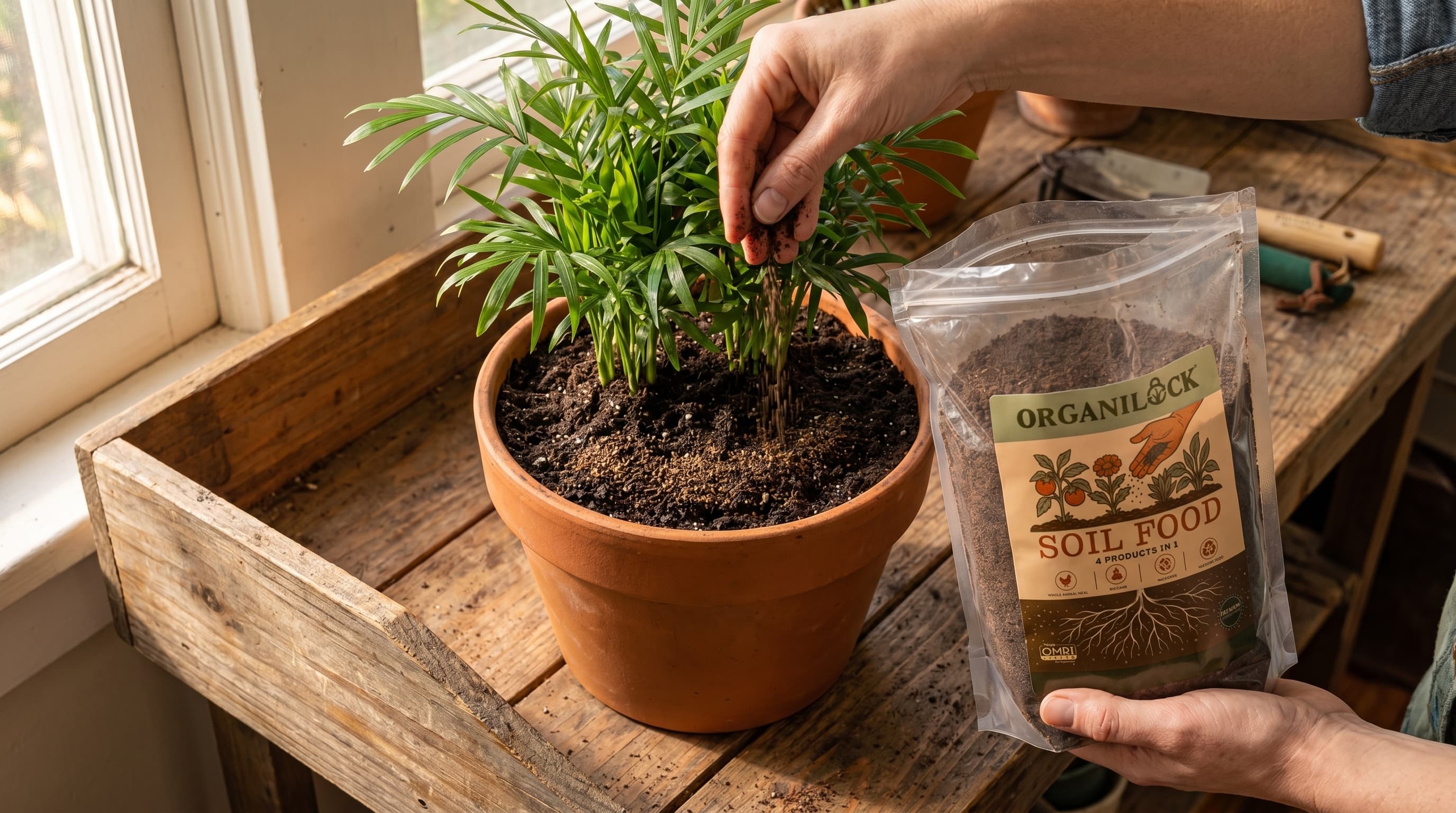
The backbone of feeding a container is maintaining its soil with the matched Refresh amendment - Flower Pot Refresh for outdoor pots, planters, and containers, and House Plant Refresh for indoor houseplants. These are dry granular amendments you simply top-dress onto the existing soil around the plant (roughly one to two tablespoons per square foot of surface, about monthly), or mix in when you happen to be repotting. They re-feed the soil with organic matter and a complete package of beneficial biology, rebuilding the tired potting mix back toward living soil without disturbing the plant's roots. This is the "refresh, don't replace" idea made practical: a light, regular top-dress keeps the soil in the pot alive and feeding, season after season. For a customer who just wants their container plants to keep thriving without fuss, this monthly top-dress is the whole routine.
How often, and matching it to the season
A practical question every container grower asks: how often should I feed? The honest answer is that it depends on the plant, the pot, and especially the season - which is why "read the plant" beats any rigid schedule. As a general rhythm, a monthly top-dress of the matched Refresh keeps the soil maintained through the growing season, with a Plant Food boost layered in only when a plant is actively growing and clearly wants more. The season is the big modifier: a plant in active spring and summer growth, in good light, uses nutrients and can take regular feeding, while a plant resting in the low light of fall and winter - which most houseplants do - needs little or no feeding, because it simply cannot use it and over-feeding a dormant plant only builds up salts. The mistake to avoid is feeding on autopilot year-round. Feed more when the plant is growing and the days are long; back off sharply when it slows and the light fades. Let the plant's growth, not the calendar alone, set the pace.
The boost: fast feeding with Plant Food
When a container plant wants a faster feed - a heavy bloomer in peak season, or a plant that needs a quick pick-up - Plant Food is the fast, direct option: a liquid you dilute (about half an ounce per gallon of water) and either spray on the leaves or pour at the roots, weekly or as needed. It suits containers well because the dilute liquid reaches the small root zone evenly. But containers are exactly where Plant Food's honest boundaries matter most. It is not organic-certified, and unlike the soil-building amendments, it can burn if over-concentrated - and a small pot concentrates everything, so it is especially important to follow the label rate and not pour it on stronger in hopes of faster results. Use it at rate, as an occasional boost on top of the soil-building routine, and it is a great tool; over-use it in a small pot and you invite the salt and burn problems this lesson keeps warning about.
The number-one container feeding mistake: over-feeding
If there is one mistake to avoid above all in container feeding, it is over-feeding - and it is far more common than under-feeding. The logic seems sound ("my plant looks hungry, so I will feed it more"), but in a small pot, piling on soluble fertilizer builds up salts that scorch roots and leaf edges and stress the plant in ways that look like other problems. The tell-tale signs are a crusty white residue on the soil surface or pot rim, browning leaf tips and edges, and a plant that gets worse rather than better the more you feed it. The fix is counterintuitive but reliable: less, not more. Flush the pot with plenty of plain water to wash the excess salts down and out, ease off the soluble feeding, and lean on the gentle, slow-release refresh routine instead. When a fed container plant is struggling, your first question should be "am I feeding it too much?" - because in pots, the answer often is.
Hungry or over-fed? Reading the pot
Because over-feeding and under-feeding can look alike at a glance, it helps to read the pot before you decide which is happening. A genuinely under-fed container plant tends to be uniformly pale or yellowing (often starting with the older, lower leaves), generally slow and lackluster, in soil that has been watered a lot and not fed in a long while - the picture of a depleted, leached pot. An over-fed plant tells a different story: a white salt crust on the soil surface or pot rim, scorched or browned leaf tips and edges, and a plant that has gotten worse since you started feeding it more. When the signs point to depletion, a gentle refresh and a return to steady feeding fixes it; when they point to over-feeding, the cure is to flush and ease off. And as the Diagnose and Fix course taught, hold a third possibility in mind: the plant may be neither hungry nor over-fed but over-watered or root-bound, which is the real cause more often than people expect. Read the whole picture - the leaves, the soil surface, and the watering - before you reach for fertilizer.
Safe to keep in your home
For houseplants especially, growers want to know what they are bringing into their living space, so here is the honest picture. House Plant Refresh is made to be a comfortable indoor product: it is low-odor once watered in and dry (it is a processed, stabilized amendment, not raw material), it contains no synthetic chemistry, and its gentle, slow-release nature makes it a sensible choice around pets and children. Note what this guide does not claim: the Refresh products are not OMRI Listed, so the reassurance comes from the low-odor, no-synthetic, gentle nature of the product, not from an organic-certification badge. (If you do use Soil Food in a larger container, that one is OMRI Listed and no-burn.) The takeaway for an indoor grower: you can feed your houseplants the soil-first way and feel good about what is in the pot on your windowsill - just lean on the honest reasons it is comfortable indoors rather than a certification it does not carry.
Pulled together, the feeding routine for containers is reassuringly simple. Keep the soil maintained with a gentle monthly top-dress of the matched Refresh, scaled to how actively the plant is growing. Add an occasional Plant Food boost at label rate when a plant is in vigorous growth and wants more. Feed generously in the bright growing season and back off hard when plants rest in low light. And whenever a fed plant looks stressed, suspect over-feeding first and reach for water, not more fertilizer. That is the whole approach: a small, living soil kept gently topped up feeds your container plants far more reliably than heavy, anxious feeding ever could.
Plain-English takeaway: Feed containers steady and gentle, not big and infrequent: maintain the soil with a monthly top-dress of the matched Refresh (Flower Pot outdoors, House Plant indoors), boost with Plant Food at label rate when wanted (not organic, can burn - and a small pot concentrates everything), and avoid the number-one mistake of over-feeding, whose fix is to flush with water and feed less.