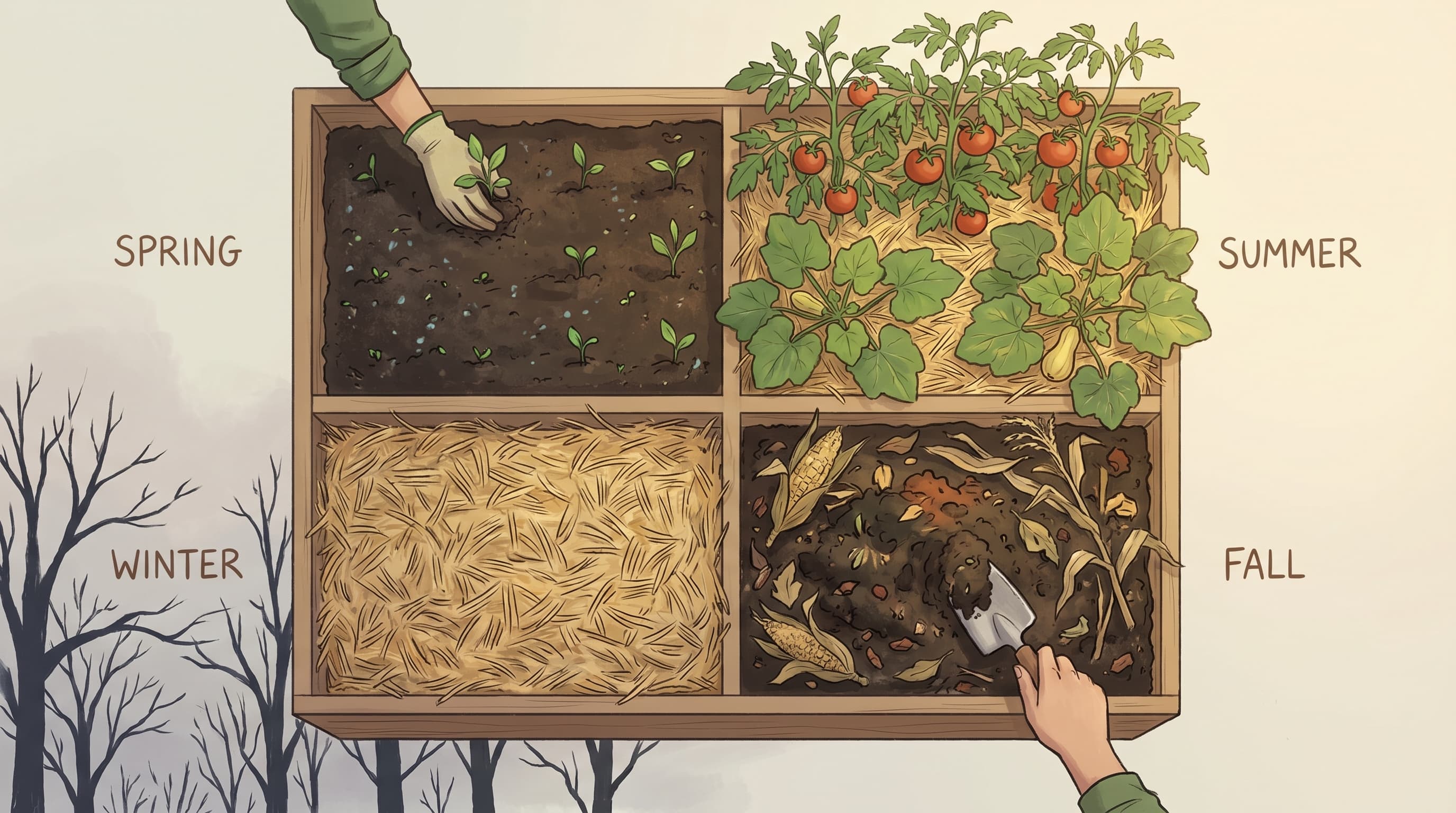
Great beds are not built in a weekend - they are tended across a year, in a rhythm that works with the seasons. Once you know that rhythm, raised-bed gardening becomes far less guesswork and far more satisfying, because each season has a clear job. This final lesson walks the raised-bed year, season by season, and ends with the payoff: a bed that genuinely gets better every year instead of needing to be started over.
Spring - wake and build
Spring is when the bed comes back to life, and your job is to wake the soil and set it up for the season. As the soil warms, work a soil-building amendment into the top few inches - Soil Food for a bed you are establishing or rebuilding, Raised Bed Refresh for ongoing maintenance of an established bed - and water it in to activate the biology. This is also the moment the living soil pays off visibly: the fungi and microbes wake up fast once watered and warmed, and they are ready to feed your plants as you set out transplants and sow seeds. Do not rush to plant into cold, soggy soil; let the bed warm and the biology stir, then plant into living, ready soil. A good spring start carries the whole season.
Summer - feed and maintain
Summer is peak production, when your heavy feeders are working hardest and the bed is under the most demand. The living soil you built in spring does most of the feeding, but this is the season to support it: keep the soil covered with mulch to hold moisture and feed the soil life as it breaks down, water deeply and consistently (at the base, in the morning), and reach for a Plant Food boost when a heavy producer like tomatoes or squash wants a faster feed - remembering it is a soluble feed used at label rate. Watch your plants and let them tell you what they need, but resist the urge to over-feed; a balanced, well-watered bed in living soil largely takes care of itself through the heat.
Fall - feed the soil for next year
Fall is the most overlooked and arguably the most valuable step in the whole raised-bed year, and getting it right is what separates gardeners whose beds improve from those whose beds decline. After the harvest winds down, do not leave the bed bare and depleted to sit through winter. Instead, give back what the season took: work in organic matter and a soil-building amendment like Raised Bed Refresh, or sow a cover crop, so the soil's biology has something to work on through the cooler months and the bed is rebuilt and ready by spring. Feeding the soil in fall means the organic matter has time to break down and integrate, the biology stays alive, and you start next spring with a richer bed rather than a tired one. This single habit - feed the soil in fall, not just the plant in summer - is the quiet secret of beds that get better every year.
Every bed has its own rhythm
The seasons above are the general framework, but your own garden will fine-tune it, and part of becoming a confident raised-bed gardener is learning your beds' particular rhythm. Your climate shifts the timing - a long, warm-winter region plants and feeds on a different calendar than a short-season northern one, and may grow straight through what others call winter. Your crops shift it too: a bed of cool-season greens has a different arc than one of summer tomatoes, and succession planting (sowing a new crop as one finishes) keeps a bed working longer and asks for a light feeding to support the follow-on crop. Pay attention to when your soil warms, when your plants slow, and when your harvests finish, and adjust the build-maintain-boost-and-reset rhythm to fit. The framework holds everywhere; the dates are yours to learn. A gardener who knows their own beds' timing barely has to think about feeding at all - it becomes second nature.
Winter - protect and plan
Winter is the rest season, but the soil is still alive beneath the surface, and a little care protects it. Keep the bed covered - with mulch, leaves, or a cover crop - rather than leaving bare soil exposed to erosion and the freeze-thaw that breaks down structure. The covering protects the soil life and the organic matter you worked in during fall. Winter is also planning season: review how the past year went, decide what to grow and where (remembering crop rotation), and if a bed gave you persistent trouble, this is a good time to send off a soil test so you start spring with facts rather than guesses. Little is demanded of you in winter, but protecting the soil and planning the year are quiet investments that pay off when spring comes.
Crop rotation, the simple version
One seasonal habit deserves its own mention because it quietly prevents a lot of trouble: crop rotation. The idea is simple - do not grow the same crop (or the same family of crops) in the same spot year after year. Different plants draw down different nutrients and host different pests and diseases, so planting tomatoes in the same square every season steadily depletes what tomatoes need and lets tomato-specific problems build up in that soil. Rotating where families grow - moving the tomatoes and peppers to where the beans or greens were, and so on - spreads the nutrient demand around and breaks pest and disease cycles before they establish. You do not need a complicated chart; even a loose habit of "not here again this year" helps enormously, especially across a few beds. Combined with feeding the soil each season, rotation keeps a bed both fertile and healthy over the long run. Winter planning is the natural time to map it out.
The compost habit
If there is one free, year-round habit that supports everything in this guide, it is composting. A simple compost pile turns kitchen scraps and garden trimmings into exactly what your beds want most - rich organic matter teeming with biology - and returning that compost to your beds closes the loop, feeding the soil with what your own garden produced. Compost is not a competitor to amendments like Soil Food and Raised Bed Refresh; it works alongside them, and the best beds are built with both - homemade compost for steady bulk organic matter, and a concentrated biological amendment to add the mycorrhizal fungi, biochar, and whole-food nutrition that compost alone does not provide. Starting a compost habit is one of the highest-value things a raised-bed gardener can do, because it gives you a renewable, free source of the one thing every season demands: more living organic matter to feed back into the soil.
The payoff: a bed that gets better every year
It helps to know what that trajectory actually looks like, so you can be patient with a young bed and recognize the payoff as it comes. In year one, a freshly built bed can be good but is still finding its footing - the biology is establishing, the organic matter is fresh, and the soil is learning to hold and release nutrients. By year two, a bed that has been fed each season and reset in fall is noticeably richer, holds water better, and asks less of you. By year three and beyond, a well-tended bed is in its stride: deep, dark, crumbly soil full of life, steady production, fewer problems, and forgiving of the occasional missed watering or busy week. The lesson is to think in seasons, not weekends. A living soil is built over time, and the gardener who keeps feeding the soil is rewarded with a bed that quietly becomes one of the best growing spots they have - the opposite of the annual scramble to revive a tired, depleted box. Patience and a seasonal habit are the whole recipe.
Here is the reward for tending the full cycle. A raised bed managed this way - built with living soil, maintained with seasonal amendments, fed in fall, and protected in winter - does not just hold steady; it compounds. Each year the organic matter deepens, the biology strengthens, the structure improves, and the bed grows more productive and more forgiving while needing less troubleshooting. That is the opposite of the all-too-common experience of a bed that declines until the gardener gives up and replaces the soil. Feed the soil through the seasons, and the soil rewards you with a garden that is genuinely better next year than it is this year - which, in the end, is the whole point of growing in living soil.
Plain-English takeaway: The raised-bed year has a rhythm: spring wakes and builds the soil, summer feeds and maintains under peak demand, fall feeds the soil for next year (the overlooked, most valuable step), and winter protects and plans - tend the full cycle and the bed compounds, getting richer and more productive every year instead of declining.