"Organic" might be the most used and most misunderstood word in all of gardening. It is on bags, in marketing, and in conversation constantly, and it means different things to different people - which is exactly how shoppers end up confused or, worse, misled. This lesson clears it up for good. Once you understand the two meanings of "organic" and the two certification programs behind it, you will read garden labels with confidence and never be fooled by a vague claim again.
The two meanings of "organic"
The first thing to know is that "organic" means two completely different things depending on who is using it:
- The chemistry meaning. To a chemist, "organic" simply describes carbon-based compounds. In this technical sense, the word is just describing molecules, and it has nothing to do with how something was grown. This is almost never what a gardener means.
- The everyday and certification meaning. To most people, "organic" means "produced under organic rules" - grown without synthetic pesticides and fertilizers, the way the organic food at the grocery store is grown. This is what you almost always mean when you ask whether something is organic.
Because the same word covers both, marketers can lean on the fuzzy overlap, and shoppers can be left guessing. The key is to know which meaning matters to you - the "grown under organic rules" one - and then to look for the specific, real credentials that actually back it up. That is where the two programs come in.
OMRI versus USDA Organic - two different programs
Two real, official programs govern the word in the growing world, and they are not the same thing - confusing them is the single most common organic-gardening mix-up:
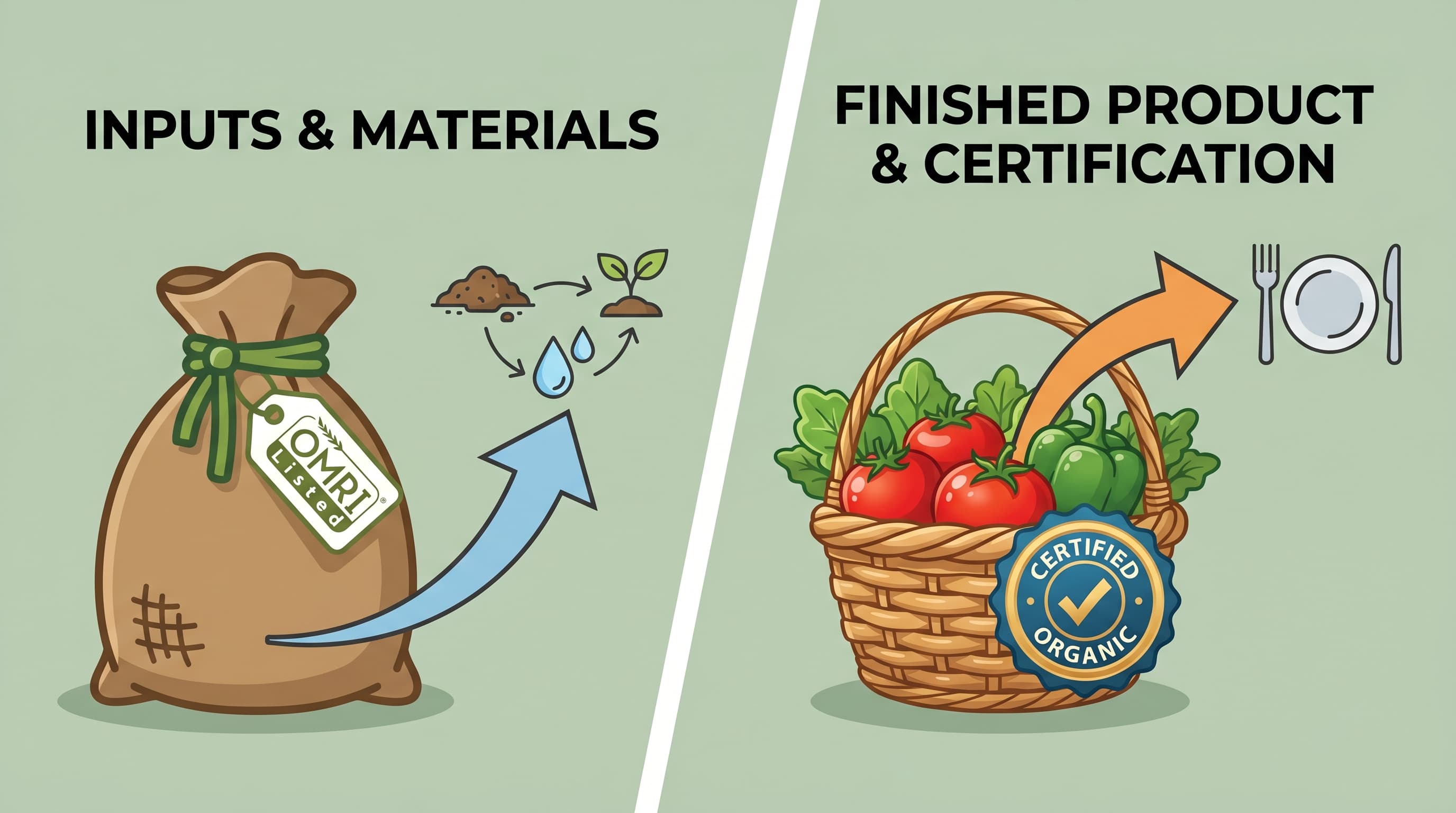
- OMRI - the Organic Materials Review Institute - reviews inputs. These are the products that go into growing: fertilizers, amendments, and the like. When a product is "OMRI Listed," it means that input has been independently reviewed and approved for use in certified-organic production. It is a credential for the bag in your hand.
- USDA Organic certifies the finished result - the farm, the operation, and the food it produces. The "USDA Organic" seal you see on produce or packaged food means that end product was grown and handled under the federal organic standards. It is a certification of the food, not of an input.
So the two programs sit at different points in the chain: OMRI says "this input is allowed in organic growing," and USDA Organic says "this finished food was produced organically." A soil amendment or fertilizer earns an OMRI Listing; a tomato or a box of cereal earns the USDA Organic seal. You would never see an amendment carry a "USDA Organic" seal, because you do not certify a bag of soil food as organic food - and that mismatch is exactly the kind of thing a careful shopper learns to notice.
Where OrganiLock fits, honestly
This is a good place to be precise about OrganiLock, because the company holds itself to the honest version of these terms. Soil Food is OMRI Listed - meaning it is an input independently approved for use in certified-organic growing, the genuine credential for a soil amendment. It is not, and would never be called, "USDA Organic," because that seal is for finished food, not for an input. And the distinction stays specific within the line: the Refresh products are built on a Soil Food base but are not themselves OMRI Listed, and Plant Food is not OMRI Listed or certified organic either. So if a certified credential matters to you, the precise, honest fact is that Soil Food carries the OMRI Listing - and a company willing to draw those lines clearly is one worth trusting, because the vague alternative ("it is all organic!") is exactly what this lesson teaches you to be wary of.
The confusion, in action
It helps to see how the two-meanings problem actually trips people up. Picture a shopper who wants to grow organically and grabs a bag because it says "organic" in big letters on the front. That word might mean the product is OMRI Listed and genuinely approved for organic growing - or it might be using "organic" loosely, leaning on the chemistry sense or simply as a feel-good marketing term with no certification behind it. Without knowing the difference, the shopper cannot tell, and may pay a premium for a word rather than a credential. The same trap runs the other way: a customer sees a soil amendment is not labeled "USDA Organic" and wrongly assumes it is therefore not fit for organic growing - not realizing that an amendment carries an OMRI Listing, never the USDA Organic food seal, so the absence of that seal is exactly what you would expect. Knowing which credential belongs on which kind of product saves you from both mistakes: chasing a vague word, and dismissing a genuine credential because you were looking for the wrong one.
What the credentials actually involve
It is worth knowing, briefly, that these credentials are not self-applied stickers - they involve real, independent review, which is why they carry weight. An OMRI Listing means the product was submitted to the Organic Materials Review Institute, an independent organization, which examined its ingredients and manufacturing against the organic standards and determined it is allowed as an input in certified-organic production. USDA Organic certification involves an accredited certifier inspecting a farm or operation against the federal organic regulations. In both cases, an outside party is checking the claim - which is exactly why a real certification means more than a word a company chose to print on its own bag. You do not have to investigate the details yourself; you just have to recognize that "OMRI Listed" and "USDA Organic" reflect an outside review, while "natural" reflects only a marketing decision. That is the whole reason to look for the certification rather than the adjective.
Why this matters for you as a shopper
Knowing all this turns you from a shopper who can be swayed by a word into one who reads for the real thing. When a product says "organic," you now know to ask: organic in which sense, and backed by what? A genuine certification - "OMRI Listed" for an input, "USDA Organic" for food - is a real, independently verified credential. A loose "natural" or "organic-based" with no certification behind it might mean a great deal or almost nothing. You do not have to be cynical; you just have to be specific. Look for the actual credential that fits what you are buying, and you will spend your money on substance rather than on a reassuring-sounding word. That clarity is the foundation for everything else in this short course - and it is genuinely empowering, because once you can read past the marketing, you are in control of your choices rather than at the mercy of whoever printed the biggest word on the bag.
Plain-English takeaway: "Organic" has two meanings - the chemistry sense (carbon-based) and the everyday "grown under organic rules" sense you actually care about - backed by two different programs: OMRI Listed approves an input for organic growing, while USDA Organic certifies finished food. Soil Food is OMRI Listed (an approved input, never "USDA Organic"); shop for the specific real credential, not a vague word.