The garden-products aisle is full of confident claims - "natural," "organic-based," "with beneficial microbes," "feeds for months." Some of those claims are meaningful and backed by real substance; others are clever marketing that says very little. This final lesson makes you a savvy buyer: you will learn to read a label for what it actually tells you, tell a real credential from a vague one, and spot the difference between substance and spin. The reward is that you will buy good products with confidence and quietly pass over the ones coasting on a reassuring word.
Amendment versus fertilizer: know what you are buying
The first distinction to get straight is what kind of product you are even looking at, because two very different things share the shelf. A fertilizer's job is to feed the plant, and it carries a guaranteed analysis - the three N-P-K numbers (nitrogen, phosphate, potash) - that tells you its nutrient content. A soil amendment's job is to improve the soil itself - its biology, organic matter, and structure - rather than simply to feed the plant a dose of nutrients. Some products, like Soil Food, are genuinely dual-use (an amendment that also carries a guaranteed analysis and feeds), but in general it pays to know which you are buying: a bag of "soil" that fills a pot is a growing medium, a box of N-P-K numbers is a fertilizer, and a product sold to build the living soil is an amendment. Knowing the category tells you what to expect and what questions to ask - you would not judge an amendment by its N-P-K alone any more than you would judge a fertilizer by its biology.
How to read a label
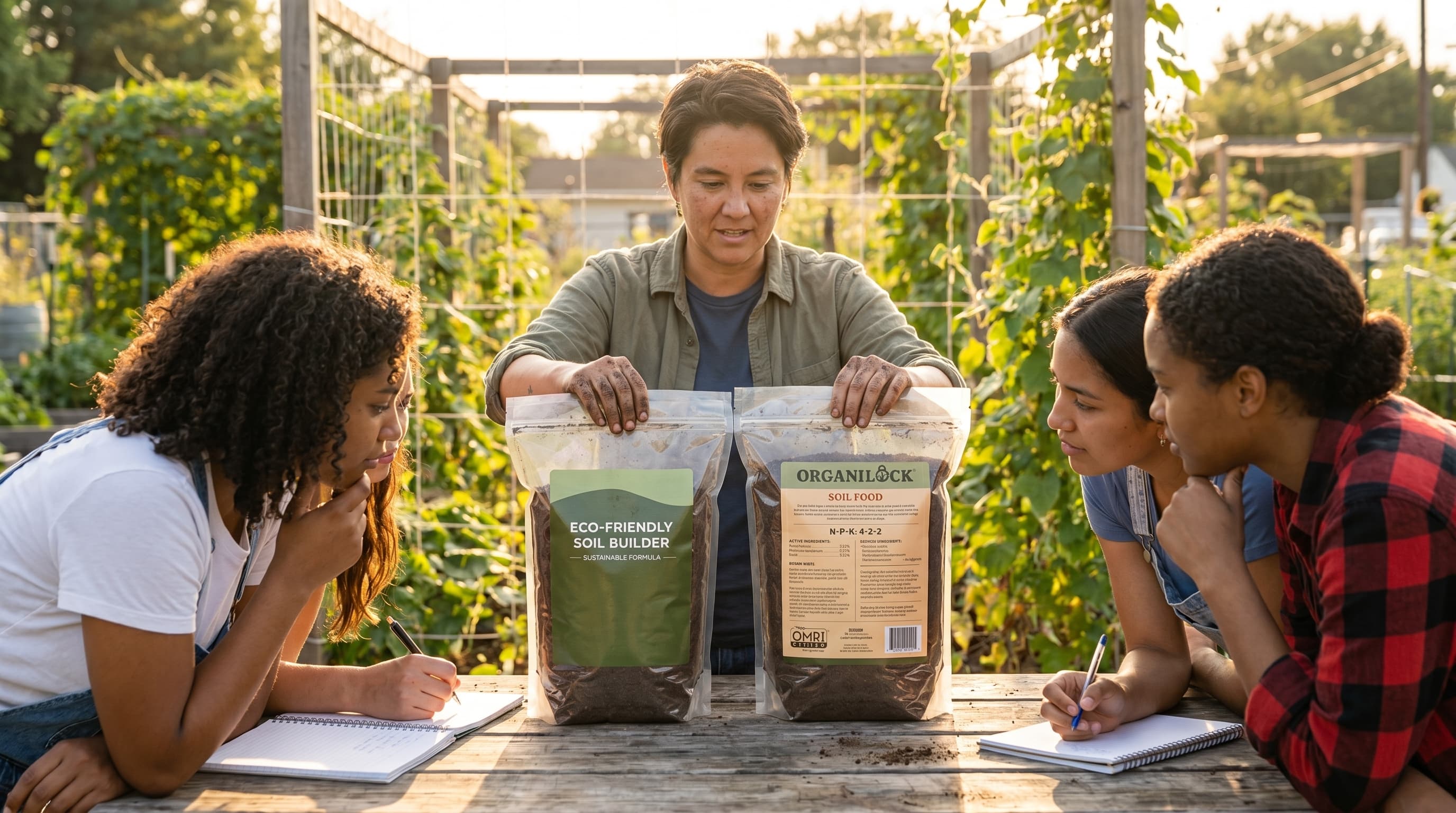
A product label, read properly, is the most honest thing on the package - far more reliable than the marketing on the front. A few things to look for:
- The guaranteed analysis - the N-P-K numbers and any secondary nutrients (like calcium). These are label-verified figures a company must stand behind, so they are real information.
- The ingredients - what the product is actually made of. A specific, disclosed ingredient list is a good sign; a vague one is a question mark.
- Any legitimate certification seal - an OMRI Listed mark on an input, for example, which you can trust because it reflects an independent review.
- Disclosure of what is inside - especially for a biological product, whether it names its microbe species and counts. Full, specific disclosure is a quality signal; "contains beneficial microbes" with no specifics tells you almost nothing.
The habit to build is simple: when the front of the bag makes a claim, turn it over and see whether the label backs it up with specifics. The companies confident in their product tend to disclose the most, because the details are their selling point.
Decoding marketing claims
Now the fun part - telling real claims from spin. A few translations every savvy buyer should carry:
- "OMRI Listed" / "USDA Organic" - these are real, independently verified certifications. They mean something specific and checkable.
- "Natural," "organic-based," "eco-friendly," "earth-friendly" - these are mostly unregulated marketing words. They may describe a genuinely good product, or they may describe very little; on their own they are not a certification, so look for what backs them up.
- "Contains mycorrhizae / beneficial microbes" - a promising claim, but ask the follow-ups: which species, how many, and is there a food source to keep them alive? A product that names its species and discloses counts is telling you something; a vague mention is not.
- "Feeds for months" / dramatic before-and-after claims - treat performance promises with healthy skepticism, and look for whether the claim is specific and substantiated or just impressive-sounding.
None of this means every product with a "natural" label is bad - many are excellent. It means you do not take the front-of-bag word as proof. You look past it to the label, the certifications, and the disclosure, and you let the substance decide.
Full disclosure as a quality signal
Here is a principle that will serve you well across the whole garden aisle: the more a company discloses, the more confident you can usually be. A product that lists its exact ingredients, states its guaranteed analysis, names its microbe species, and carries a legitimate certification is showing its work - and companies generally only show their work when the work holds up. Vagueness, by contrast, is often where weak products hide. This is precisely why a product like Soil Food leans on specifics - its OMRI Listing, its stated 4-2-1 analysis, its named biology disclosed on the label - rather than on a vague "all natural." As a buyer, you can reward that transparency by looking for it: prefer the products that tell you exactly what you are getting, and you will reliably end up with the better ones.
A quick label-decoder you can carry
To make all this portable, here is a quick mental decoder for the next time you are standing in the aisle with a bag in your hand. Front of the bag says "organic"? Flip it over and look for an actual certification - OMRI Listed for an amendment or fertilizer, USDA Organic for food - rather than taking the word at face value. See "natural," "eco," or "earth-friendly"? Treat those as marketing, not proof, and look for what backs them up. Promised "beneficial microbes"? Check whether it names the species and discloses a food source, or just gestures at biology. Curious how much it really feeds? Read the guaranteed analysis and the ingredients, the figures the company has to stand behind. And generally, lean toward the products that disclose the most, because transparency tracks with quality. That handful of checks - certification, specifics, disclosure - is enough to sort the substance from the spin in about thirty seconds, which is all most purchases deserve. Carry that decoder and the garden aisle stops being a guessing game.
Shopping smart, in short
Pull it together and savvy shopping comes down to a few habits. Know whether you are buying a fertilizer, an amendment, or a soil. Read the label, not just the front of the bag. Trust real certifications (OMRI Listed for inputs, USDA Organic for food) and be appropriately skeptical of unregulated buzzwords. Reward full disclosure - specific ingredients, named biology, stated analysis - over vague reassurance. And when a claim sounds too good or too vague to be true, turn the bag over and let the label settle it. Do that, and you will navigate the garden aisle like an expert, spending your money on genuine substance and growing a better garden for it. That savvy, honest eye is the perfect companion to the soil-first approach this Academy is all about.
Plain-English takeaway: Be a savvy buyer: know whether you are buying a fertilizer (feeds the plant, has N-P-K), an amendment (builds the soil), or a soil; read the label not the front of the bag; trust real certifications (OMRI Listed, USDA Organic) over unregulated words like "natural"; reward full disclosure (specific ingredients, named biology, stated analysis) as a quality signal; and let the label, not the marketing, decide.