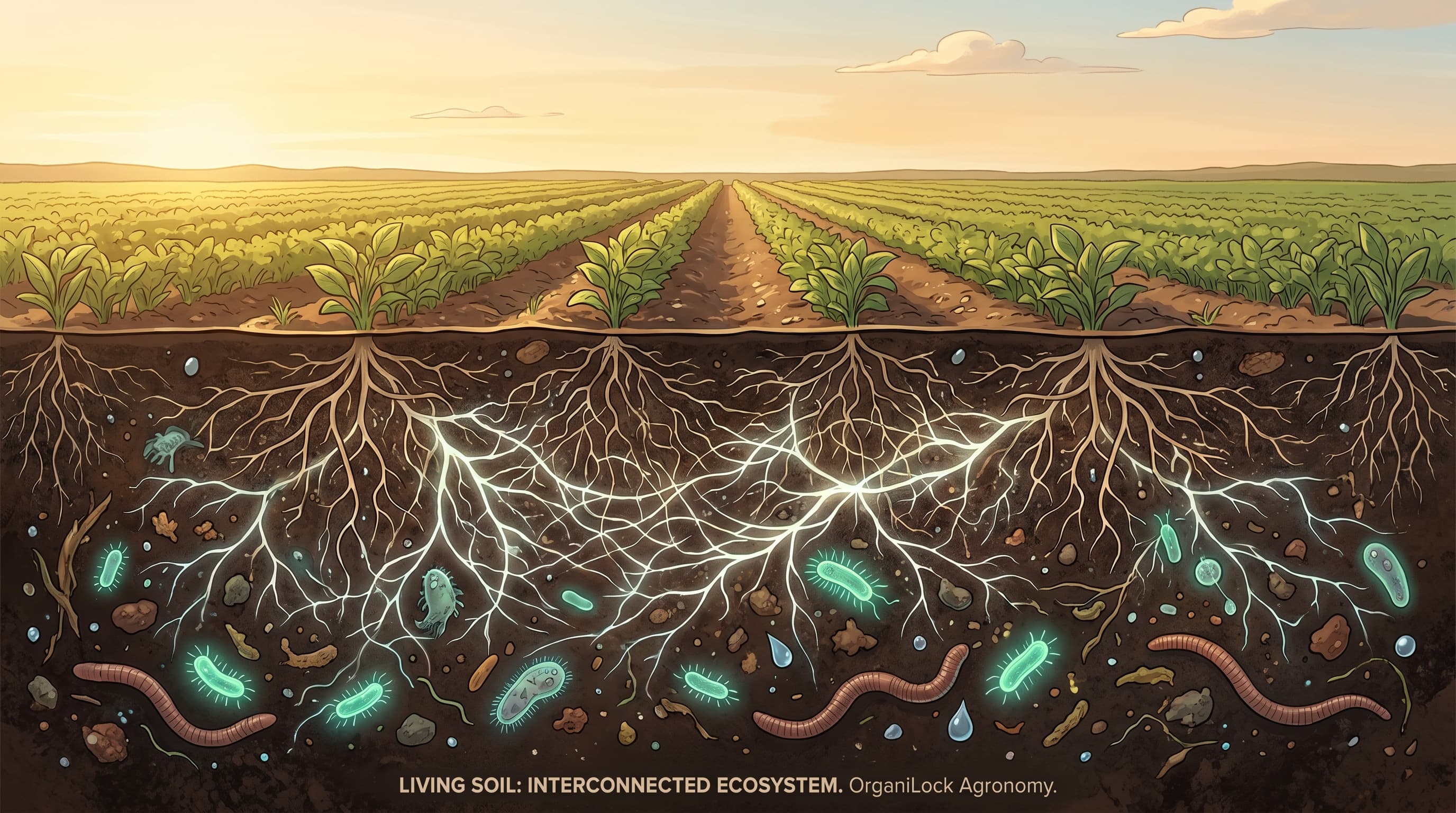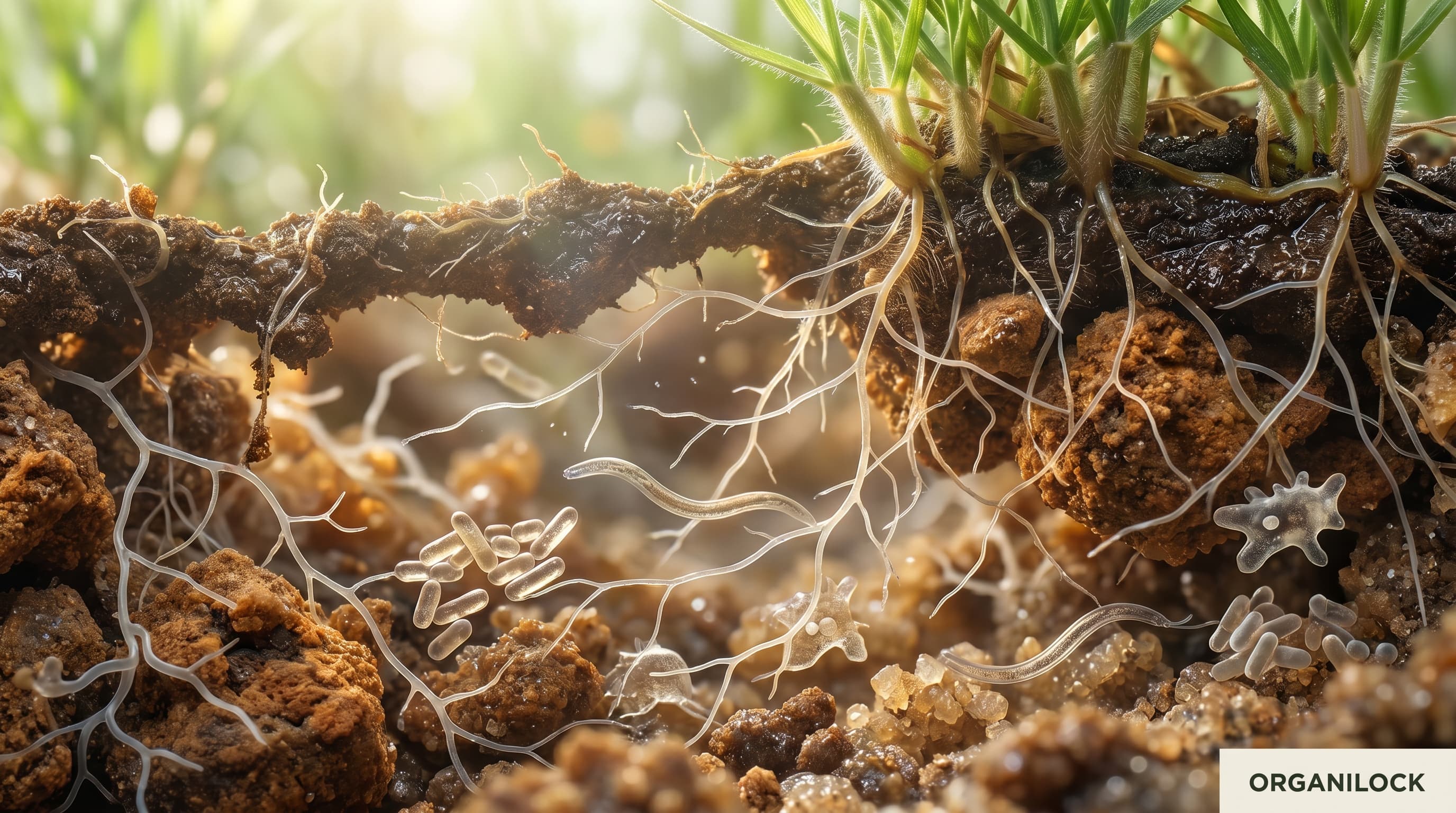
Most people picture soil as dirt: inert brown stuff that holds plants upright. That picture is wrong in a way that changes everything about growing. Soil is a living, structured system - by some measures the most biologically diverse material on Earth - and almost everything that makes a plant thrive or struggle happens in the parts of it you cannot see. This lesson takes soil apart, hands you a few tests you can run yourself this week, and builds the foundation the rest of the course stands on.
The four ingredients of soil
A healthy topsoil is roughly half solid and half empty space, and the empty space matters as much as the solid. By volume, a good topsoil is about 45% mineral particles, about 25% water, about 25% air, and around 5% organic matter and living organisms. That last 5% is tiny by weight and runs the entire system.
- Minerals - ground-up rock (sand, silt, and clay) that gives soil its body and most of its mineral nutrients.
- Water - held in the pore spaces, carrying dissolved nutrients to roots.
- Air - in the larger pores; roots breathe, and so do the microbes. A soil with no air is a dead soil.
- Organic matter and life - decaying residues, humus, and billions of living organisms. The smallest fraction, the largest influence.
Plain-English takeaway: Half of healthy soil is empty space. Roots need air and water and room - not just nutrients - so the structure of that empty space is as important as what is in the solid part.
Texture: the hand you are dealt
Texture is the mix of particle sizes in your soil, set by three players defined purely by size: sand (largest), silt (medium), and clay (smallest, by far - a clay particle is thousands of times smaller than a grain of sand). The proportions decide how your soil behaves.
- Sand - large particles with large gaps. Drains fast, warms early, easy to work, but holds little water and few nutrients.
- Clay - tiny particles packed tight, with enormous surface area. Holds water and nutrients superbly, but drains slowly, compacts easily, and can suffocate roots when wet.
- Silt - in between: smooth, fertile, but prone to crusting.
- Loam - the prized balance of all three. It drains yet holds moisture, holds nutrients yet stays open. Most garden advice is really aimed at getting loam-like behavior.
Texture is the hand you are dealt. You cannot practically change the particle sizes in your soil - you are not going to turn clay into sand by the truckload. What you can change is structure, and that is where the real work happens. But first it helps to know which hand you hold.
Find your own texture: two tests you can run this week
You do not need a lab to learn your soil's texture. Two classic tests tell you most of what you need.
- The jar test. Fill a clear, straight-sided jar about one-third with soil, top it off with water and a pinch of dish soap, shake hard for a few minutes, and set it down. Sand drops out in seconds, silt settles over a few hours, and clay can take a day or more, leaving visible layers you can measure with a ruler. The relative thickness of the bands is your rough sand-silt-clay mix.
- The ribbon test. Moisten a walnut-sized lump and squeeze it between thumb and forefinger into a ribbon. Sandy soil feels gritty and will not ribbon; silty soil feels smooth or floury; clay soil feels sticky and forms a long, bendable ribbon. The longer the ribbon, the more clay.
Knowing your texture tells you how your soil will behave before you plant: a sandy soil needs more frequent, lighter watering and feeding, while a clay soil holds more but demands care with drainage and timing.
Plain-English takeaway: You can read your own soil's texture in a jar of water or a squeeze between your fingers - it tells you how the soil drains, holds water, and holds nutrients before you plant a thing.
Structure: the part you actually build
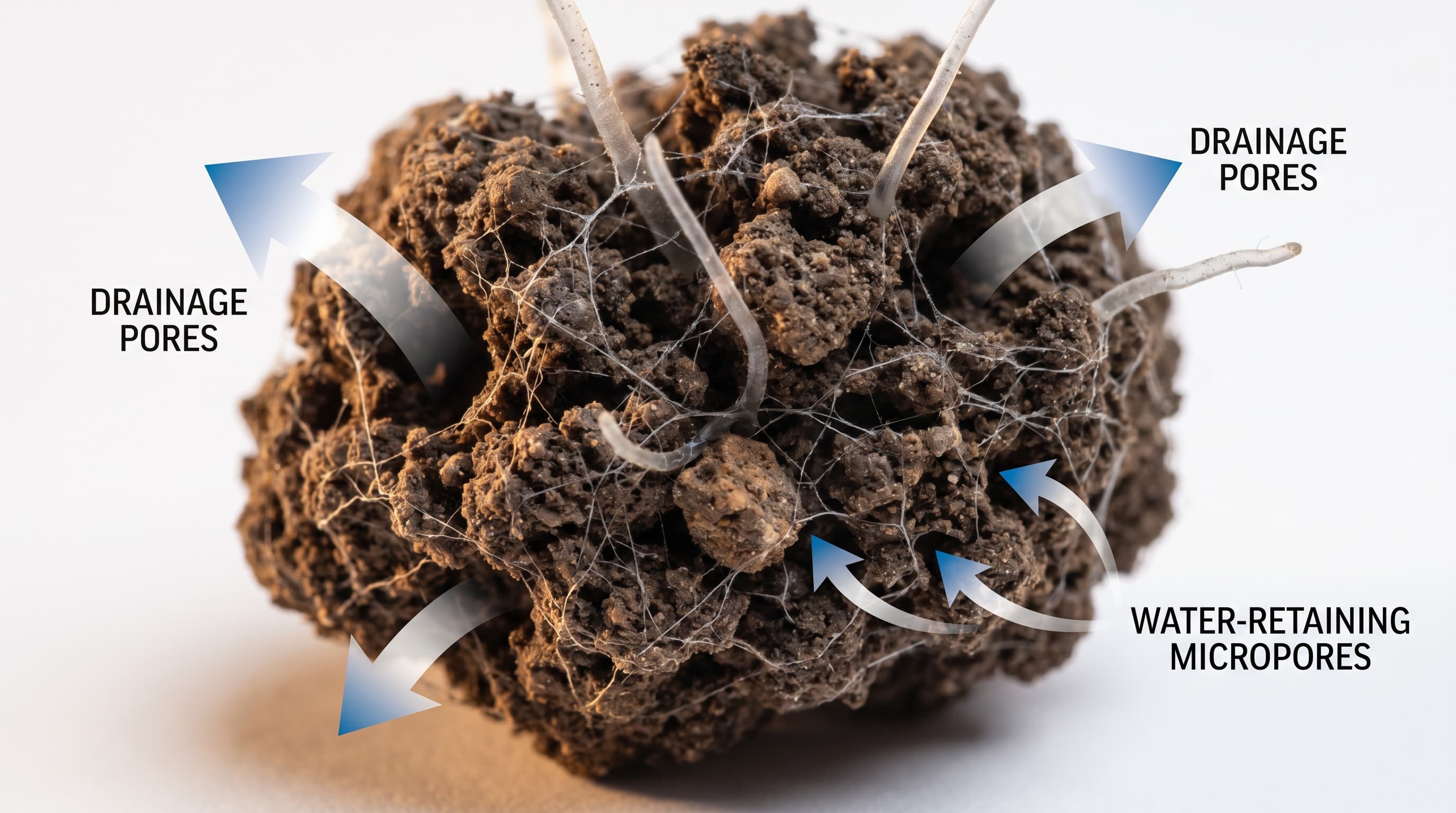
Structure is how individual particles clump together into crumbs, called aggregates. Loose particles pack down into a dense mass; aggregated particles form a crumbly, porous network full of channels for air, water, and roots. The difference between hard, lifeless ground and dark, crumbly, living soil is almost entirely structure.
And here is the key: structure is built by life. Fungal threads physically bind particles together; a sticky protein called glomalin, produced by certain root fungi, glues crumbs into water-stable aggregates; bacterial secretions act as cement; roots and earthworms open channels. Aggregates are, quite literally, made by biology. This is why "building soil" and "feeding the life in your soil" turn out to be the same project - a point this course keeps returning to.
Plain-English takeaway: Texture you inherit; structure you build. When you improve your soil, what you are really improving is structure - and living biology is the thing that builds it.
Pore space and why it decides everything
Good structure creates two kinds of pore space, and you need both. Large pores drain excess water and let air in; small pores hold water against gravity so roots can drink between rains. A soil with only large pores (pure sand) dries out; a soil with only small pores (compacted clay) stays waterlogged and airless. The crumbly middle holds the balance, and it is also why the same good structure both drains better and stores more water - a contradiction that puzzles a lot of gardeners.
This is why compaction is so damaging. Foot traffic, heavy equipment, and working soil while it is wet crush the large pores, and once the air is gone, both roots and the oxygen-needing beneficial microbes begin to fail - sometimes forming a hard layer (a hardpan or plow pan) that roots cannot push through. The crumbly, easy-to-work feel of a well-structured soil even has a name, tilth, and it is the single best at-a-glance sign of soil health.
Plain-English takeaway: Roots and beneficial microbes both need to breathe. Protect structure - stay off wet soil, avoid needless compaction - and you protect the air supply the whole system runs on.
The soil profile: why topsoil is the precious layer
Dig down and soil reveals itself in layers, called horizons, that together make a soil profile. Near the surface sits a thin layer of decomposing residue (the O horizon), then the dark, life-rich topsoil (the A horizon) where almost all the organic matter, biology, and feeder roots live. Below that is the paler subsoil (the B horizon), where minerals and clay accumulate but life is sparse, and beneath that the weathered parent rock (the C horizon).
The lesson of the profile is simple and important: the topsoil is where the action is. It is usually only a few inches to a foot or two deep, and it holds the organic matter and the biology that everything in this course is about. When topsoil is lost to erosion or burned away by abuse, what is left underneath is far less fertile and takes a very long time to rebuild - which is the subject of the next section.
How soil forms, and how slowly
Soil is not manufactured; it is grown, over timescales that put a single growing season in perspective. Five factors shape it: the parent rock it forms from, the climate, the living organisms working it, the slope of the land, and - above all - time. Weathering breaks rock into mineral particles while biology builds organic matter on top, and the two slowly knit into living soil.
How slowly? By common estimates it takes on the order of 500 years to form a single inch of topsoil under natural conditions. That number reframes the whole enterprise: topsoil is, on a human timescale, effectively non-renewable. It can be degraded in a few careless seasons and is rebuilt only over generations. Good growing is not just this year's harvest; it is leaving the soil better - or at least no worse - than you found it. That stewardship idea runs underneath everything OrganiLock makes.
Plain-English takeaway: Topsoil forms about an inch every 500 years but can be lost in a few seasons. Treating it as the precious, slow-to-rebuild resource it is changes how you grow.
Reading your soil by eye, nose, and worm
Once you know what soil is, you can read its health on the spot, no lab required.
- Color. Dark brown or black usually means rich organic matter; pale tan or gray means little. Gray, blue, or mottled patches signal poor drainage and airless conditions; rusty red and orange come from iron and usually mean good aeration.
- Smell. Healthy soil has a clean, sweet, earthy smell - that aroma comes largely from actinomycetes, a group of beneficial microbes. A sour, rotten-egg, or swampy smell means waterlogged, airless soil where the wrong organisms have taken over.
- Worms. Earthworms are the headline indicator. Turn a spadeful in spring or fall: several worms is a good sign of a living, well-fed soil; none, season after season, suggests low organic matter or a damaged food web.
- Crumb. Squeeze a moist handful and let go. Good soil breaks into rounded crumbs; poor soil either falls to loose grains (no structure) or holds in a slick, dense clod (compacted).
None of these replaces a soil test for nutrients (Module 3 covers that), but together they tell you fast whether your soil is alive and structured or tired and compacted.
How soil holds and releases water
Watering makes more sense once you see where the water goes. When you irrigate or it rains, water first fills the large pores and drains away under gravity within a day or so; what stays behind, clinging in the small pores, is the water plants actually live on. The amount a soil holds after that drainage is its field capacity, and the point where the remaining water is gripped too tightly for roots to pull is the wilting point. The usable water between those two marks is what carries your plants from one watering to the next.
This is why texture drives your watering schedule. Sandy soils are mostly large pores, so they drain fast and hold little usable water - they need light, frequent watering. Clay soils hold a great deal but release it slowly and can stay soggy. It also explains the paradox from earlier: building organic matter and structure raises both how fast a soil drains and how much water it stores, because it adds large channels and sponge-like small pores at the same time. A quick field check is the drainage test - dig a hole about a foot deep, fill it with water, let it drain, fill it again, and time the second drain. Draining within a few hours is healthy; water still standing many hours later points to compaction or a drainage problem.
Working with the soil you have
Knowing your texture and structure turns into a plan. You cannot change texture, but you can manage around it and steadily improve structure and life on any soil. On sandy ground, the priority is adding organic matter to hold the water and nutrients that would otherwise wash straight through. On heavy clay, the priority is building aggregates and protecting drainage - adding organic matter, staying off it when wet, and never working it into a smeared, airless mass. In both cases the lever is the same one this course keeps returning to: feed the biology and build organic matter, and the soil you have gets measurably better to grow in. Raised beds and containers are simply a way to start with a built soil when the native ground is too poor or compacted to fix quickly - a theme the Refresh lessons pick up later.
Where this is heading
So soil is not dirt. It is a living, structured system whose performance depends on biology you cannot see, sitting in a precious topsoil layer that took centuries to build. Over the next lessons we will meet that biology, learn how it feeds your plants, and see why building organic matter is the master move that improves drainage, structure, water-holding, and nutrients all at once. That is the foundation everything else in this course is built on.