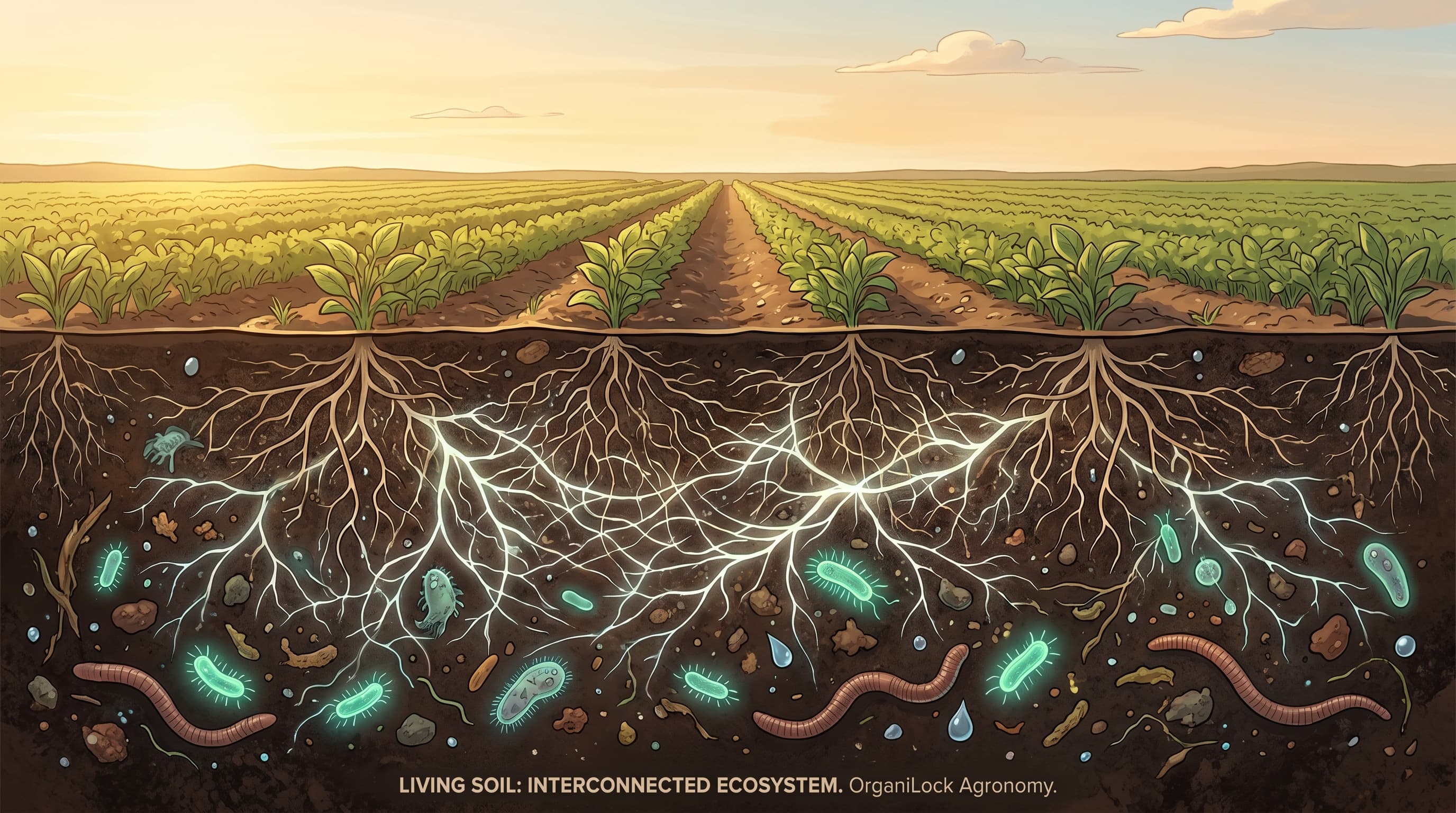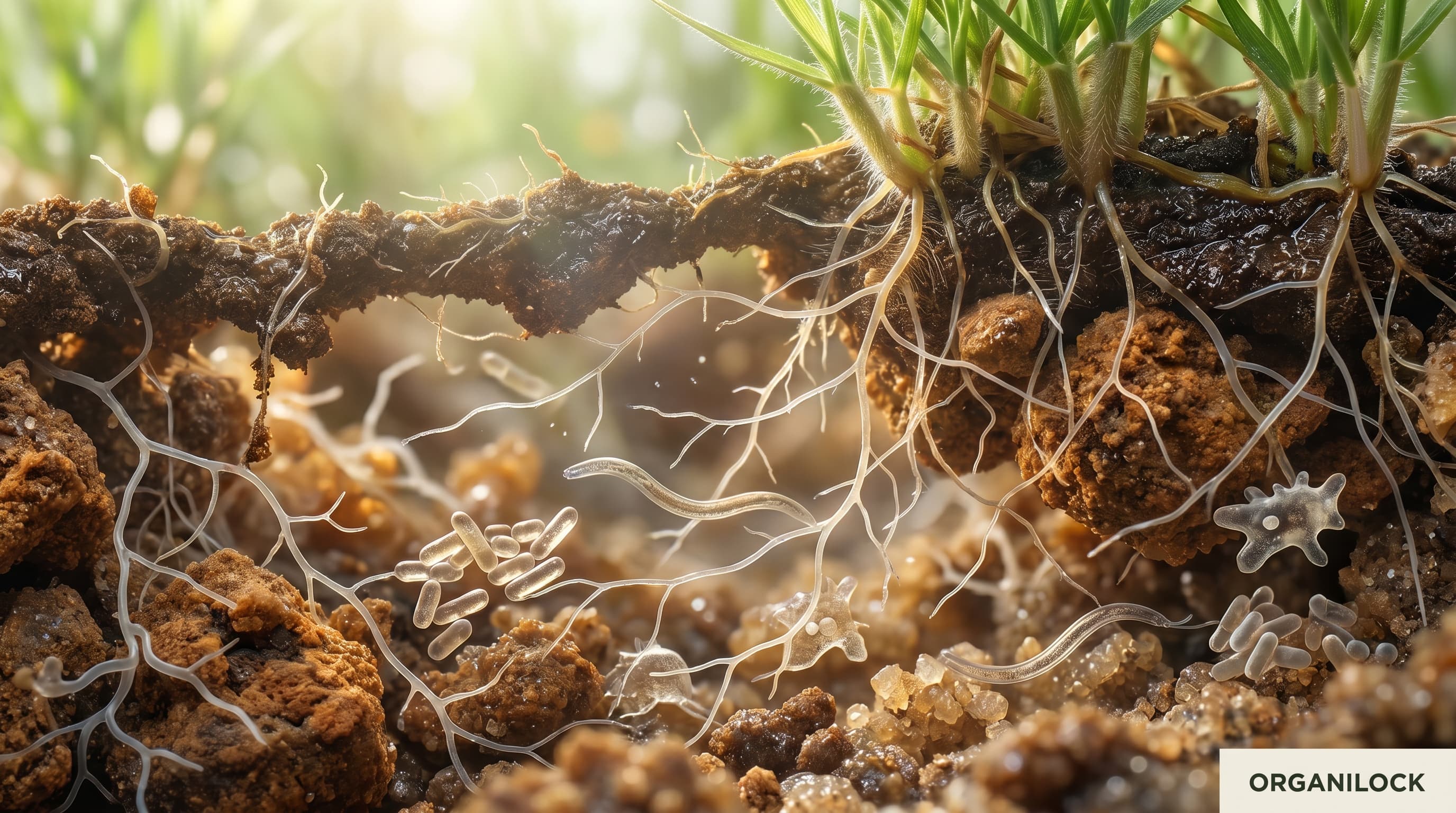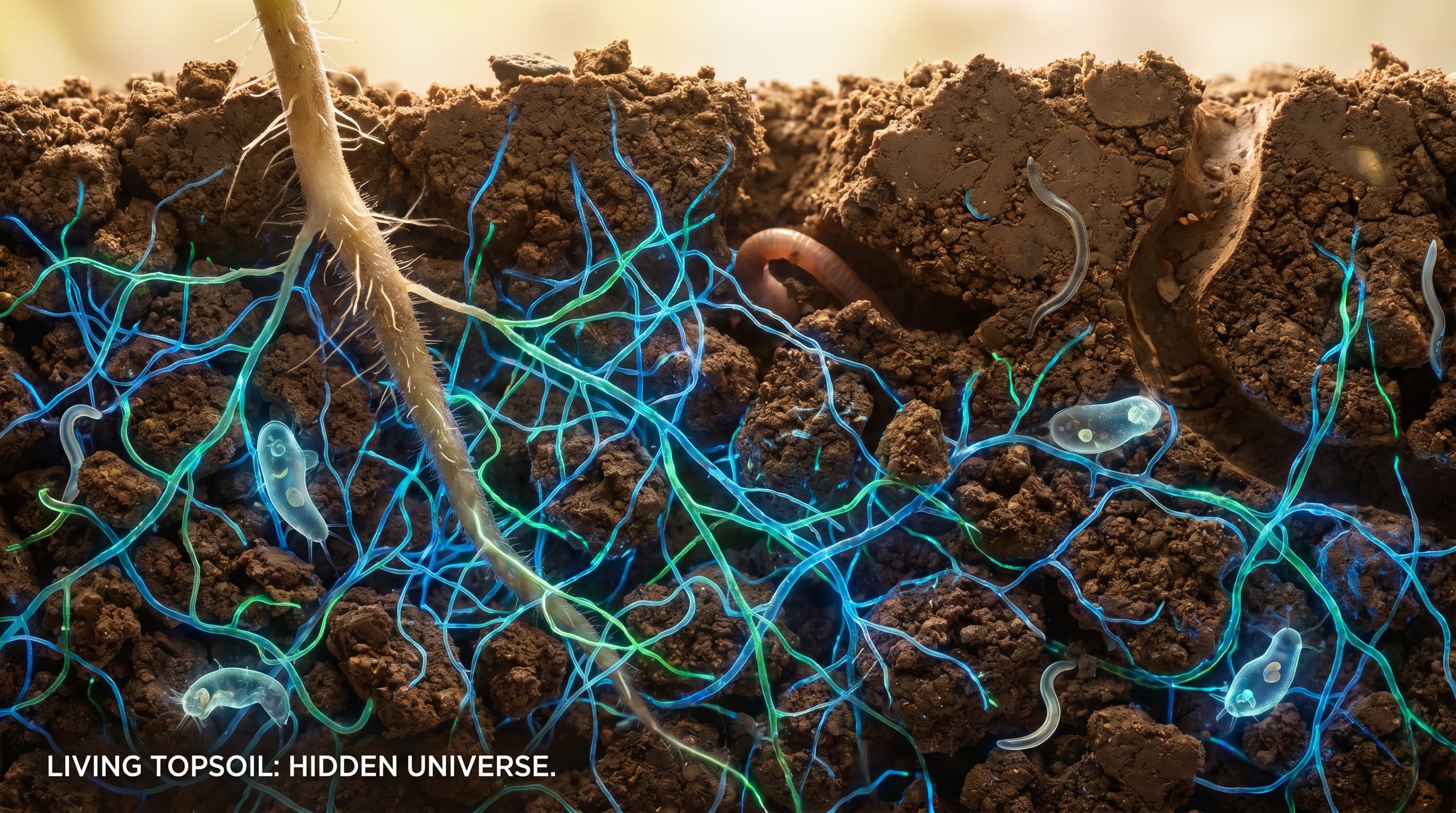
A single teaspoon of healthy soil can hold more living organisms than there are people on Earth - billions of bacteria, yards of fungal thread, and a whole food chain of larger creatures. This hidden community is the soil food web, and it is the part of soil that actually feeds your plants. Once you understand it, fertilizer stops looking like the main event and starts looking like one input among many.
The scale of life underground
The numbers are hard to believe. A single gram of healthy soil - about a quarter teaspoon - can contain billions of bacteria, thousands of protozoa, dozens of nematodes, and many yards of fungal thread. Stretch out the fungal hyphae from a small handful of forest soil and they can run for miles. By weight, the living organisms beneath a single acre of good pasture can rival the weight of the animals grazing on top of it. This is not background scenery; it is a workforce, and it is doing the chemistry that feeds your plants every hour of the growing season.
The cast of characters
The soil food web is a food chain that runs on dead organic matter and plant sugars. Each level feeds the next, and nutrients are released along the way. Meet the main players.
- Bacteria - the base of the web. Astronomically numerous, they decompose organic matter, some pull nitrogen straight from the air, and they hold nutrients locked in their bodies. They are the foundation almost everything else eats.
- Fungi - the network builders. Their thread-like hyphae decompose tougher material than bacteria can reach, bind soil into aggregates, and - in the mycorrhizal fungi - partner directly with plant roots.
- Actinomycetes - a group that bridges bacteria and fungi. They break down the toughest residues (woody material, chitin) and produce that clean, earthy smell of good soil. Many natural antibiotics were first found among them, a hint at how the web polices itself.
- Protozoa and nematodes - the predators. They graze on bacteria and fungi and, in doing so, release plant-available nutrients (the key step, explained next). Most nematodes are beneficial; only a few types, like root-knot nematodes, damage plants, and a balanced web keeps those in check.
- Earthworms and arthropods - the shredders and engineers. Earthworms eat through soil and residue and leave behind castings far richer in available nutrients than the soil they started with, while their burrows open channels for air, water, and roots. Tiny arthropods like springtails and mites shred litter into pieces the microbes can finish.
How the web actually feeds a plant
Here is the part most people never learn. Nutrients in soil are not mostly sitting around as free, plant-ready chemicals waiting to be absorbed. A great deal of the supply is locked inside the bodies of living microbes. The release happens through predation: when a protozoan eats a bacterium, it takes in more nitrogen than it needs and excretes the surplus right at the root zone, in a form plants take up immediately. Multiply that by billions of meals a day and you have a steady, biology-paced nutrient supply no single dose of fertilizer can imitate.
This is the literal meaning of "feed the soil and the soil feeds the plant." You are not feeding the plant directly; you are feeding a living system that meters nutrients out to the plant on demand, in balance, and in sync with the weather and the season. A bag of soluble salt skips that system; a living soil runs on it.
Plain-English takeaway: Much of your soil's nutrient supply is stored inside living microbes and released when predators eat them, right at the roots. Feed the biology, and it feeds your plants steadily and in balance.
Bacterial soils and fungal soils
Not all healthy soils look alike. The balance between bacteria and fungi shifts depending on what grows there, and matching the two is part of good growing.
- Bacteria-dominated soils suit fast-growing annuals - most vegetables, grains, and lawns - which thrive on the quick nutrient turnover bacteria provide.
- Fungi-dominated soils suit perennials, shrubs, and trees, which evolved alongside the slower, fungal-rich soils of grasslands and forests.
Disturbance is what tips the balance. Tillage and bare soil shred fungal networks and push a soil toward bacterial dominance, which is one reason heavily worked vegetable beds can struggle to support perennials and trees. Building organic matter and disturbing the soil less lets the fungal side recover. We will see in Module 3 that different plants genuinely want different soils - this is the first reason why.
Plain-English takeaway: Annual vegetables and lawns favor bacterial soils; perennials and trees favor fungal soils. Tillage pushes soil "bacterial," so less disturbance helps tree and shrub plantings thrive.
The plant is the farmer
The biggest shift in soil science over the last few decades is the realization that the plant is not a passive recipient - it is in charge. Plants pour a remarkable share of the sugar they make in photosynthesis down through their roots and out into the soil as root exudates. These sugars are bait and wages: they recruit and feed exactly the microbes the plant wants near its roots. The thin zone of intensely active soil right around the roots, the rhizosphere, is a garden the plant cultivates on purpose.
Plants can even adjust what they spend on, paying more sugar to recruit microbes that fetch a nutrient currently in short supply. It is less a static chemistry set than a living economy, with the plant as the buyer.
The underground network: mycorrhizae
The most important deal the plant strikes is with mycorrhizal fungi. The plant trades sugar; the fungi extend a vast web of threads far beyond the root and deliver back water and nutrients - especially phosphorus - that the roots could never reach alone. A plant with healthy mycorrhizae effectively has a root system many times larger than the one it grew.
There are two broad types, and the difference matters: endomycorrhizae (which grow into the root cells) partner with most vegetables, flowers, and grasses, while ectomycorrhizae (which sheathe the root) partner with many trees and shrubs. The same fungal threads also link neighboring plants into a shared network - sometimes called the "wood wide web" - through which water, nutrients, and even chemical warning signals can pass. We go deep on this when we reach phosphorus in Module 3; for now, the point is that a healthy plant is constantly hiring living help.
How common is this partnership? The great majority of plant families - by most estimates around 90% - form mycorrhizal relationships, so it is the rule in nature, not the exception. That also tells you what to protect, because the fungal networks are fragile. Tillage tears them apart, and a flood of soluble phosphorus signals the plant that it no longer needs the fungi, so the partnership fades. Two of the most common growing habits - working the soil hard and feeding heavy soluble fertilizer - are exactly the two that switch off the plant's most valuable underground ally. We come back to this when we cover phosphorus.
Plain-English takeaway: Plants spend sugar to recruit microbes and partner with fungi that extend their reach for water and phosphorus. A thriving soil community is something the plant actively builds - your job is to supply the raw materials.
Plants that grow their own fertilizer
One partnership is worth previewing now because it reappears throughout the course: nitrogen fixation. The air is 78% nitrogen gas, but plants cannot use it in that form. Certain bacteria can. Some live freely in the soil; the most famous, rhizobia, form nodules on the roots of legumes - beans, peas, clover, vetch - and convert atmospheric nitrogen into a form the plant can use, in exchange for sugar. In effect, legumes grow their own nitrogen fertilizer, and a cover crop of clover or vetch can leave that nitrogen behind for the next crop. This is one of the oldest tools in regenerative growing, and Module 2 explains the nitrogen behind it.
Disease-suppressive soils
A diverse, well-fed food web does something a bag of fertilizer cannot: it defends the plant. In a crowded, competitive soil, beneficial microbes occupy the space and consume the resources that disease organisms would otherwise use, predators eat would-be pathogens, and some microbes produce natural compounds that hold problem organisms in check. Soils rich in life and organic matter are measurably more disease-suppressive than sterile or abused ones. This is a property of healthy soil biology in general, not a promise about any single product - but it is one more reason the living soil is worth building.
Who does what: the soil's nutrient services
Different members of the web specialize in different nutrients, and together they run the soil's nutrient cycles - the free services a living soil provides that a bag of fertilizer cannot.
- Nitrogen: some bacteria fix it from the air, others convert it between forms, and the predator-driven release described above delivers it to roots. Module 2 is devoted to it.
- Phosphorus: mycorrhizal fungi mine it and trade it to roots, while bacteria and fungal enzymes free it from organic matter and from mineral lock-up.
- Sulfur and micronutrients: microbes release these from organic matter and change their chemical form so roots can take them up.
- Carbon and structure: decomposers turn residues into humus and into the glues that build aggregates, closing the loop back to Lesson 1.
The point is that fertility is a process, not an inventory. A soil test counts what is present at one moment; the food web is the engine that keeps converting, releasing, and delivering nutrients all season long. Feed the engine and much of the fertility takes care of itself.
A thriving web versus a tired one
You can picture the two extremes. In a thriving soil, a diverse web of bacteria, fungi, protozoa, and larger creatures cycles nutrients steadily, builds crumb structure, holds water, and crowds out disease, all powered by organic matter and living roots. In a tired soil - bare, tilled, and fed only soluble salts - that web thins out: fungal networks are broken, predators are few, structure collapses, and the soil grows dependent on outside inputs because it can no longer feed itself. Most soils sit somewhere on that spectrum, and every choice you make about disturbance, cover, and organic matter nudges them one way or the other.
What helps the web, and what hurts it
Because the food web is alive, it responds to how you treat it - and the practices that help map closely onto the difference between depleting and regenerative growing.
- Feeds the web: organic matter and mulch, living roots in the ground as much of the year as possible, minimal disturbance, and a steady carbon supply.
- Starves or damages the web: bare, exposed soil; frequent tillage, which shreds fungal networks and burns up organic matter; and heavy doses of soluble salts, which can stress the very microbes that build fertility.
A few practical moves follow directly: keep the soil covered with mulch or living plants so the web never bakes in the sun or starves; disturb it as little as you can, since every pass of a tiller resets the fungal networks; and lean on biology-friendly inputs rather than dumping concentrated salts that stress the microbes you are trying to grow. None of this is about purity - it is about not unplugging the engine that does most of the work for free.
None of this means nutrients do not matter, or that you can never reach for a quick feed. It means the living soil is the engine, and the smartest growing works with it rather than around it. In the next lesson we look at the fuel that engine runs on: organic matter and carbon.