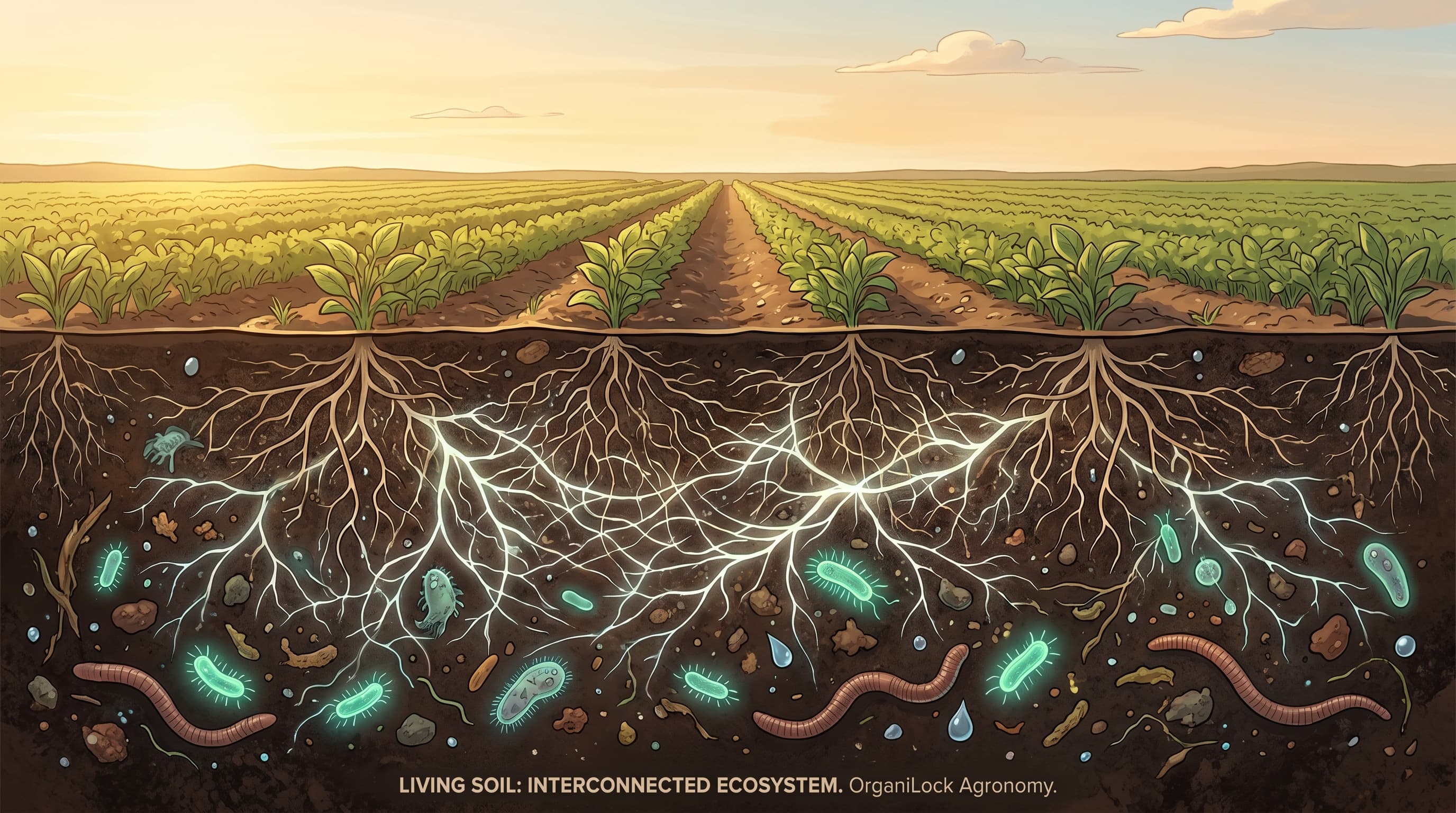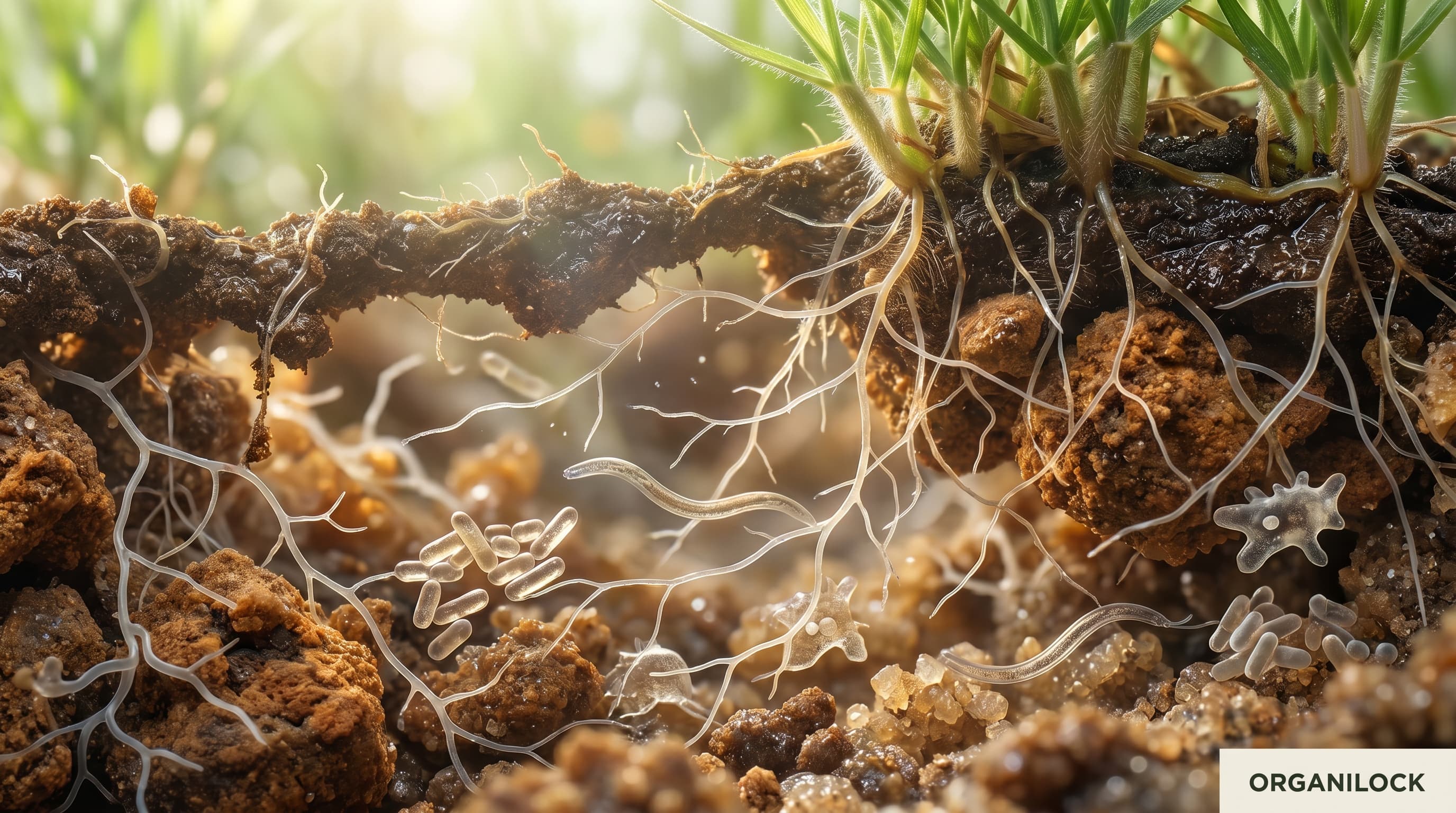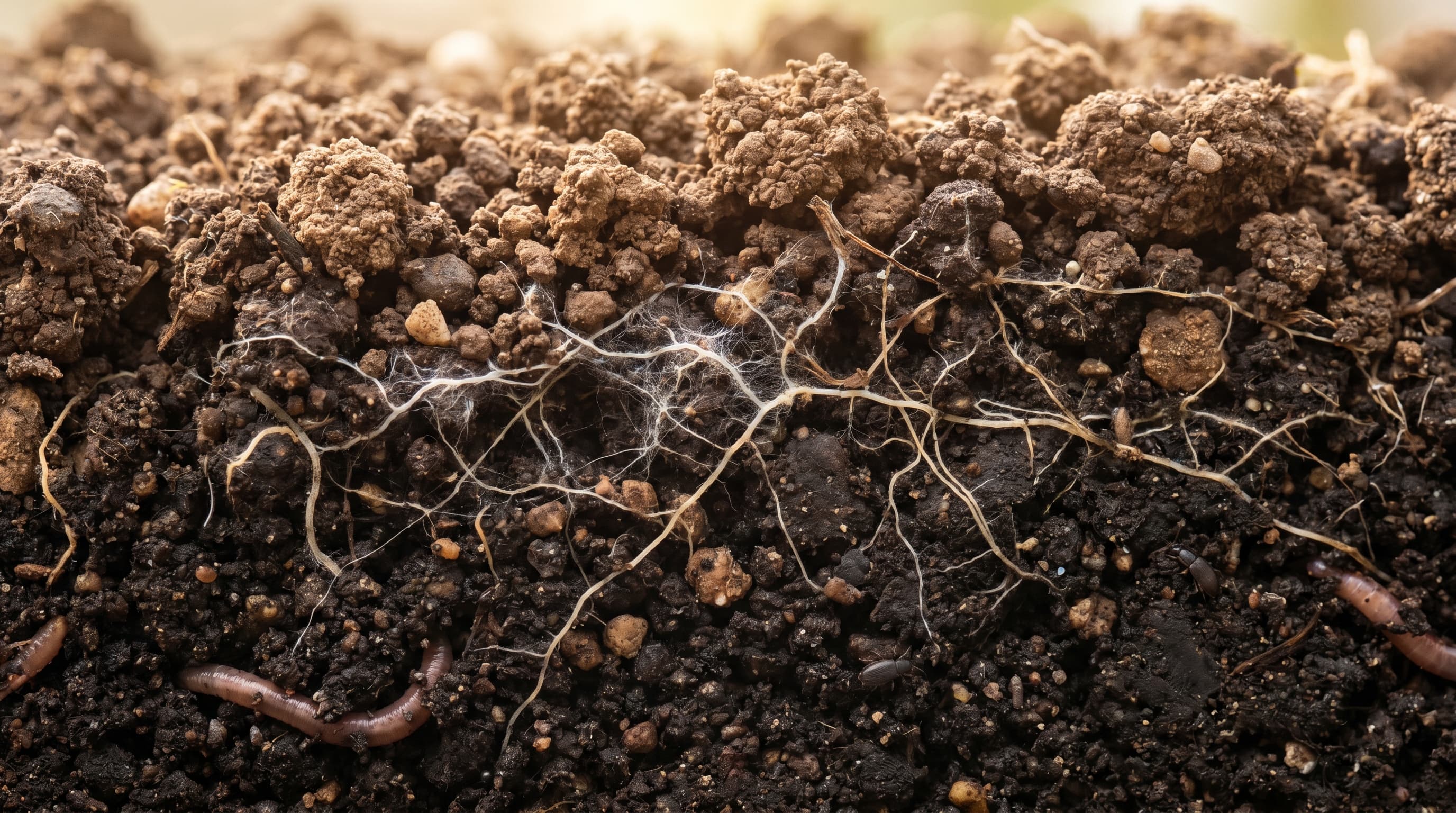
In Lesson 1 we said organic matter is only about 5% of a healthy soil by volume, yet it runs the other 95%. This lesson is about why. If there is one number to watch on a soil test and one thing to build over a lifetime of growing, it is organic matter - because it improves almost everything about a soil at once.
What organic matter actually is
Soil organic matter is everything in the soil that is or was alive: the living organisms themselves, fresh residues like roots and leaves partway through decomposition, and - the prize - humus, the stable, dark, long-lived material that remains after biology has finished its work. Humus can persist for decades to centuries, and it does most of the heavy lifting.
Organic matter is mostly carbon, which ties it to the larger carbon cycle: plants pull carbon from the air as carbon dioxide, build it into leaves, roots, and sugars, and a portion of that carbon ends up stored in the soil as organic matter. Building soil organic matter is, in a real sense, moving carbon out of the air and into the ground, where it goes to work.
Two kinds of organic matter: active and stable
It helps to split organic matter into two pools that do different jobs. The active fraction - fresh residues and the bodies of living things - cycles quickly and is the day-to-day food for the soil food web; it is what releases nutrients this season. The stable fraction - humus - cycles slowly over years to centuries and is the long-term bank that holds water, grips nutrients, and gives soil its dark color and structure.
Good soil care feeds both: steady inputs of fresh material to fuel the biology now, and the patient accumulation of humus that raises the soil's baseline for good. A soil with only fast inputs and no stable reserve is like an account you spend as fast as it fills.
The five jobs organic matter does
Organic matter is a multi-tool. A soil rich in it gets all of these at once, which is why it is the master lever of fertility.
- Feeds the biology. Organic matter is the carbon and energy the entire soil food web runs on. No organic matter, no living soil.
- Holds water. Humus acts like a sponge, holding many times its weight in water - so soils high in organic matter resist both drought and waterlogging.
- Holds nutrients. Organic matter grips nutrient ions and hands them to roots instead of letting them wash away. (Soil scientists call this cation exchange capacity, or CEC - the soil's pantry, covered in Module 3.)
- Builds structure. The biology that organic matter feeds is what glues particles into the crumbly aggregates from Lesson 1, opening pore space for air and water.
- Buffers and protects. It steadies soil pH against swings and binds soil together so it resists erosion by wind and water.
Plain-English takeaway: Organic matter feeds the biology, holds water, holds nutrients, builds structure, and buffers pH - all at once. It is the single most powerful thing you can build in a soil.
The most useful idea in composting: the carbon-to-nitrogen ratio
To work with organic matter, you need one concept that explains composting, mulching, and a surprising number of plant problems: the carbon-to-nitrogen ratio, or C:N. Every organic material carries both carbon (energy) and nitrogen (building block), in a ratio. Gardeners sort materials into two buckets.
- "Browns" are high-carbon, low-nitrogen materials: dry leaves, straw, wood chips, cardboard, sawdust. Energy-rich but nitrogen-poor.
- "Greens" are lower-carbon, higher-nitrogen materials: fresh grass clippings, kitchen scraps, manure, green plant trimmings. Nitrogen-rich.
Here is why it matters in the ground. When you add a lot of high-carbon material, the microbes that rush in to decompose it need nitrogen to do the work - and they will pull it out of the surrounding soil, temporarily starving your plants. This is called nitrogen immobilization, and it is why fresh wood chips or sawdust dug into a bed can yellow the plants for a while. The nitrogen is not gone; it is on loan to the microbes, and it returns as they finish and die. Nitrogen-rich greens do the opposite - they release nitrogen as they break down. Balancing browns and greens (a mix weighted toward browns) is the whole secret to a compost pile that heats up and breaks down instead of going slimy or stalling.
Plain-English takeaway: High-carbon "browns" can briefly tie up soil nitrogen as microbes borrow it to decompose them; nitrogen-rich "greens" release it. Balancing the two is the core skill behind composting and mulching.
Composting: biology you can run yourself
Composting is just decomposition managed on purpose, and the C:N ratio is the dial. Decomposer microbes work best at a blend of roughly 25 to 30 parts carbon to 1 part nitrogen - in practice, a pile built of more browns than greens by volume, kept about as damp as a wrung-out sponge, and turned now and then for air. Get that balance right and the pile heats up as billions of microbes go to work, breaking down in weeks to months into dark, sweet-smelling compost. Finished compost is the single best amendment there is, because it delivers both pools of organic matter - active biology and stable humus - in one shovelful.
The common failures are easy to read once you know the dial. A pile that smells sour or like ammonia has too much nitrogen or too little air - add browns and turn it. A pile that never heats up and just sits there is too dry, too small, or too heavy on browns - add water, bulk, or greens. Hot composting (a big, balanced, turned pile) is fast and kills weed seeds; cold composting (just piling material and waiting) is slower but needs almost no work. Either way, you are not really making fertilizer - you are growing biology and humus to feed your soil.
The compounding cycle
The reason experienced growers obsess over organic matter is that its benefits compound. More organic matter feeds more biology; more biology builds more structure; better structure holds more water and air; healthier soil grows healthier plants; healthier plants drop more residue and feed more sugar to the soil - which becomes more organic matter. It is a virtuous cycle, and it is the engine underneath the word regenerative: a system that builds itself up over time instead of running itself down.
The opposite cycle is just as real. Bare soil, constant tillage, and removing every scrap of residue burn organic matter away faster than it forms, and the soil slowly hardens, loses its sponge, and leaks nutrients. Most degraded soils are not short on minerals - they are short on organic matter and the life it supports.
This is the case for disturbing soil as little as possible. Every time soil is turned, it is flushed with oxygen, and the resident microbes burn through organic matter in a feeding frenzy - which is why repeatedly tilled ground loses its dark color and crumb over the years. Reducing tillage, keeping the surface covered, and feeding the soil from the top down, the way nature does, all slow that burn and let organic matter accumulate.
How you build it, for real
You build organic matter by returning carbon to the soil and disturbing it as little as possible. Four practices do most of the work.
- Compost. Decomposed organic matter, made by balancing browns and greens, kept moist, and turned for air. Finished compost is biology and stable organic matter in one - the most reliable way to add both pools at once.
- Mulch. A blanket of straw, leaves, bark, or wood chips on the surface. It moderates soil temperature, holds moisture, smothers weeds, and feeds the food web from the top down as it slowly breaks down - the way a forest floor feeds itself.
- Cover crops and green manures. Plants grown to feed the soil rather than to harvest: legumes that fix nitrogen, deep-rooted plants that break up compaction, and any living root that keeps sugars flowing to the biology through the off-season. Cut down and left in place, they become organic matter.
- Carbon-rich amendments. Feeding the soil with materials that carry carbon - not just carbon-free soluble salts - adds raw material to the engine. The best soil products bring carbon and biology together, not nutrients alone.
The payoff is slow but durable: organic matter built over years keeps paying back in water, nutrients, and resilience.
Biochar: carbon that lasts for centuries
One carbon input deserves special mention because it behaves unlike the rest: biochar. Made by heating organic material with little oxygen, biochar is a stable, porous form of carbon that resists decomposition for centuries rather than years. Two things make it valuable in soil: its vast internal surface area holds water and nutrients, and its honeycomb of pores gives soil microbes a protected place to live - microbial housing that does not break down. It is an ancient idea (the famously fertile "dark earths" of the Amazon were built with charcoal) and a modern ingredient in soil products built to last, including OrganiLock's.
Carbon, climate, and the bigger picture
Because soil organic matter is mostly carbon pulled from the air, soils are one of the planet's great carbon stores, holding more carbon than the atmosphere and all the world's plants combined. When soils are tilled bare and their organic matter burns away, that carbon returns to the air; when growers build organic matter instead, some of it is held in the ground. The scale of what any one garden can do is modest, and it would be overpromising to call backyard composting a climate solution. But the direction is real and worth knowing: the same practices that build fertile, water-holding, erosion-resistant soil also keep carbon in the ground rather than the sky. Good soil care and good stewardship point the same way.
How much, and how fast
To set expectations: many tired or sandy soils test around 1 to 2% organic matter, while a healthy, well-tended garden soil often runs 4 to 6% or more. Moving that number is slow - typically a fraction of a percent per year even with good practice - because building stable humus takes time. That is not discouraging; it is the point. Organic matter is the slowest improvement you can make and the most valuable one you will ever bank, and unlike a dose of fertilizer it does not wash away at the end of the season.
You can often spot a low-organic-matter soil without a test: it is pale rather than dark, crusts over and sheds water instead of soaking it in, dries out quickly, and works up cloddy or powdery rather than crumbly. Raising the number pays back in water above all - estimates commonly suggest that each one percent of organic matter lets an acre of soil hold roughly twenty thousand additional gallons of water, the difference between a garden that wilts in a dry week and one that rides it out. That gain, compounding season over season, is why patient soil-building beats chasing quick fixes.
Plain-English takeaway: Aim to raise organic matter over years, not weeks. It is the slowest and most durable investment in a soil - and it pays back every season after.
The bridge to the rest of the course
Now the foundation is in place. Soil is a living, structured system in a precious topsoil layer (Lesson 1); a vast food web feeds your plants from it (Lesson 2); and organic matter and carbon are the fuel that runs the whole engine (Lesson 3). With that understood, we can do something most growing advice skips: actually explain the nutrients - starting with the one that drives more growth, and more confusion, than any other. That is Module 2: nitrogen.