Nitrogen drives more plant growth - and causes more confusion, waste, and water pollution - than any other nutrient. It is the element behind lush green leaves, the one most fertilizers are really selling, and the one most often misused. This lesson explains what nitrogen is and why plants need so much of it, tells the honest story of how humanity learned to make it, and sets up the question the rest of this module answers: if a nitrogen molecule is a nitrogen molecule, why would the source matter at all?
The great paradox: surrounded by nitrogen, starving for it
Here is the strange thing about nitrogen. The air around you is about 78% nitrogen gas - your lungs are full of it right now - and yet nitrogen is the nutrient plants most often run short of. How can a plant starve for an element that makes up most of the atmosphere?
The answer is in the chemistry. Atmospheric nitrogen exists as two nitrogen atoms locked together by one of the strongest bonds in nature, and plants simply cannot break that bond to use it. To a plant, the nitrogen in the air might as well be on the moon. Nitrogen becomes usable only once that bond is broken and the nitrogen is "fixed" into other forms - a job done in nature by certain bacteria (and a little by lightning), and done industrially by the process we will meet later in this lesson. Until it is fixed, all that atmospheric nitrogen is locked away.
What nitrogen does in a plant
Nitrogen earns its "master nutrient" reputation because it is built into the machinery of life. It is a core component of proteins and enzymes, which run every process in the plant; of chlorophyll, the green pigment that captures sunlight; and of DNA itself. Because it is so central to building new tissue, nitrogen is above all the engine of leafy, vegetative growth.
That is why a nitrogen-fed plant is large and deep green, and a nitrogen-starved one is small and pale, yellowing from its oldest leaves first as it scavenges nitrogen out of old growth to feed the new. It is also why nitrogen is so easy to overdo: pour it on and you get lush green leaves, sometimes at the expense of flowers, fruit, roots, and toughness - a theme we will return to more than once. For now, hold the simple version: nitrogen is for green growth.
Plain-English takeaway: Nitrogen builds proteins, chlorophyll, and DNA, so it is the engine of green, leafy growth. Too little and plants are pale and stunted; too much and they run to soft leaf at the expense of fruit and strength.
Reading nitrogen: too little and too much
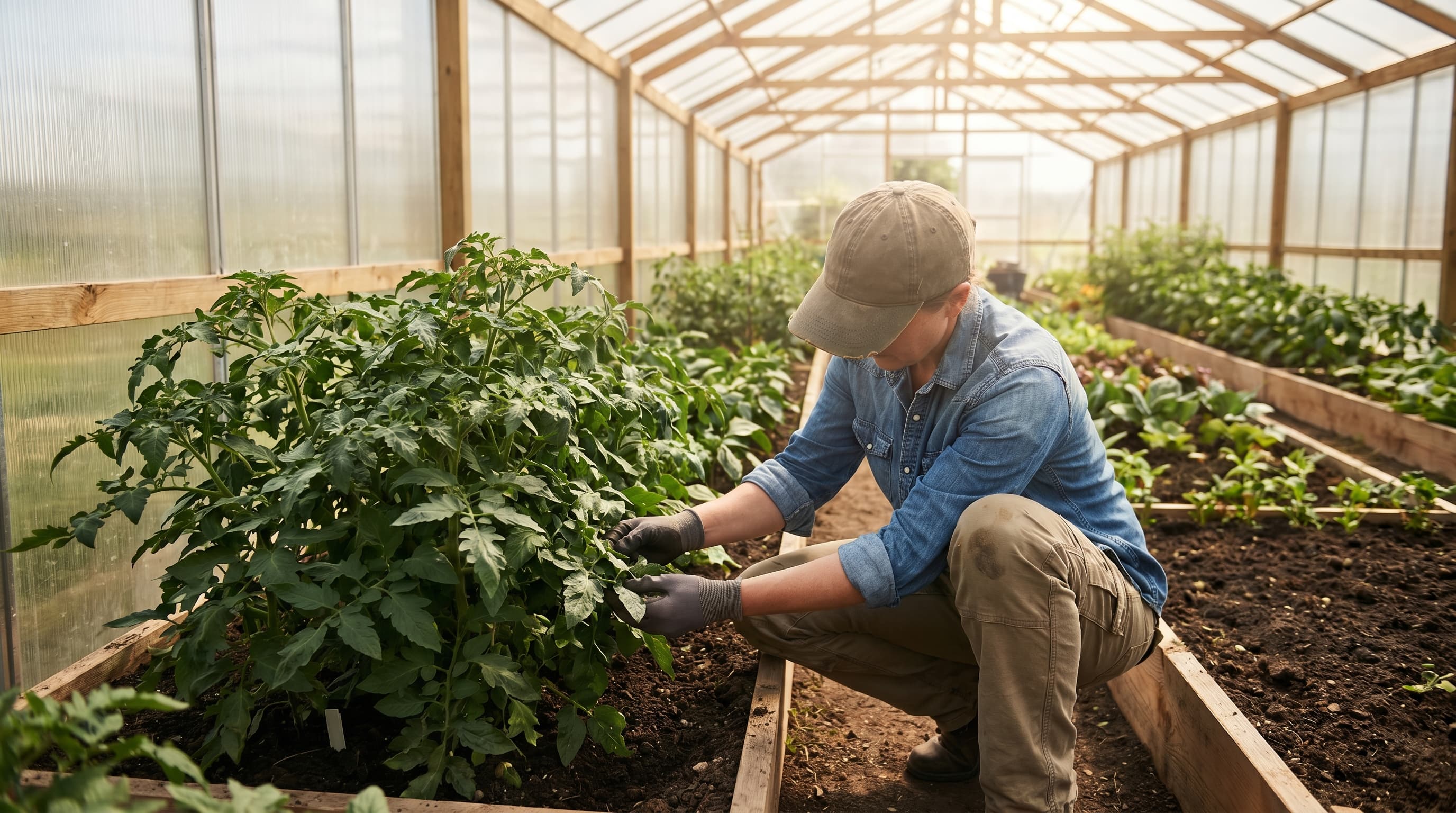
Because nitrogen drives green growth, plants wear their nitrogen status on their leaves, and learning to read it is one of the most useful skills a grower can have. Too little nitrogen shows as a uniform paling and yellowing that starts on the oldest, lowest leaves and creeps upward, along with slow, stunted, spindly growth - the plant is rationing a scarce resource, pulling it out of old leaves to keep the new ones going. A soil test or a balanced feeding usually turns it around.
Too much nitrogen is the mistake people make trying to be generous, and it has its own signature: dark, lush, almost floppy growth, with lots of soft leaf and few flowers or fruit. That soft tissue is weak tissue - more prone to pests, disease, and lodging (falling over) - and a tomato or pepper drowning in nitrogen will grow into a beautiful green bush that never sets a crop. Excess nitrogen also delays maturity and, as the next lesson shows, is the form most likely to burn and to pollute. The takeaway is that nitrogen is the easiest nutrient to overdo, and that "more" is rarely the answer.
Plain-English takeaway: Pale, stunted growth starting on the oldest leaves means too little nitrogen; dark, soft, floppy growth with few flowers or fruit means too much. Nitrogen is the easiest nutrient to overdo, so "more" is rarely the fix.
The three forms of nitrogen
To understand everything that follows, you need to know that plants take up nitrogen in a few specific forms, and those forms behave very differently in the soil. This one idea unlocks the whole nitrogen story.
- Nitrate - the fast form. Immediately available to plants, but it carries a negative charge, so the soil cannot hold onto it. That makes nitrate highly mobile: it moves with water, which is convenient for the plant but means it washes away easily. It is the source of most nitrogen pollution, as the next lesson shows.
- Ammonium - the held form. Also plant-available, but it carries a positive charge, so the soil grips it on its exchange sites and it stays put better than nitrate. Over time, soil microbes convert ammonium into nitrate.
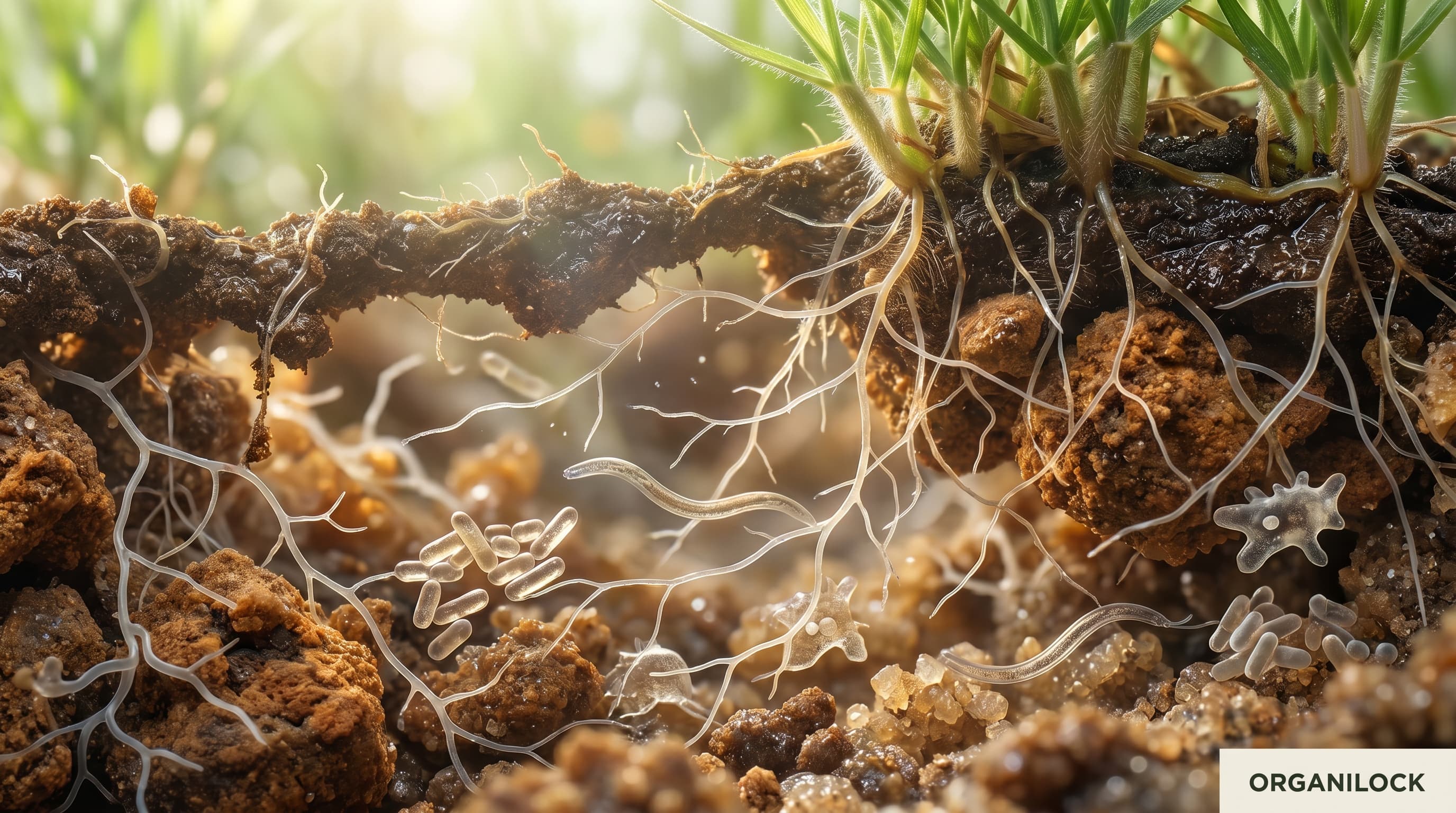
- Organic nitrogen - the stored form. This is nitrogen bound up inside organic matter: proteins and the remains of living things. Plants cannot take it up directly. Instead, soil microbes slowly break it down and release it as ammonium and then nitrate, a process called mineralization. Organic nitrogen is a slow-release reservoir rather than an instant meal.
Keep these three straight and the rest is easy: fast, mobile nitrate; held ammonium; and slow-release organic nitrogen that biology unlocks over time. The entire difference between a soluble fertilizer and a biological one comes down to which form dominates and how fast it is delivered.
One small detail explains a great deal of what follows: electric charge. Nitrate carries a negative charge, and soil particles are negatively charged too, so they repel it - nitrate floats free in the soil water and washes away. Ammonium carries a positive charge, so it clings to those same soil particles and stays put. This is why the same rain that barely touches ammonium can flush nitrate straight past the roots, and it is the quiet reason fast soluble nitrogen is so easily lost.
Plain-English takeaway: Plants use nitrogen as fast, leachable nitrate; as held ammonium; or from a slow-release organic reservoir that microbes unlock over time. Which form dominates is what separates a soluble feed from a biological one.
The nitrogen cycle, in brief
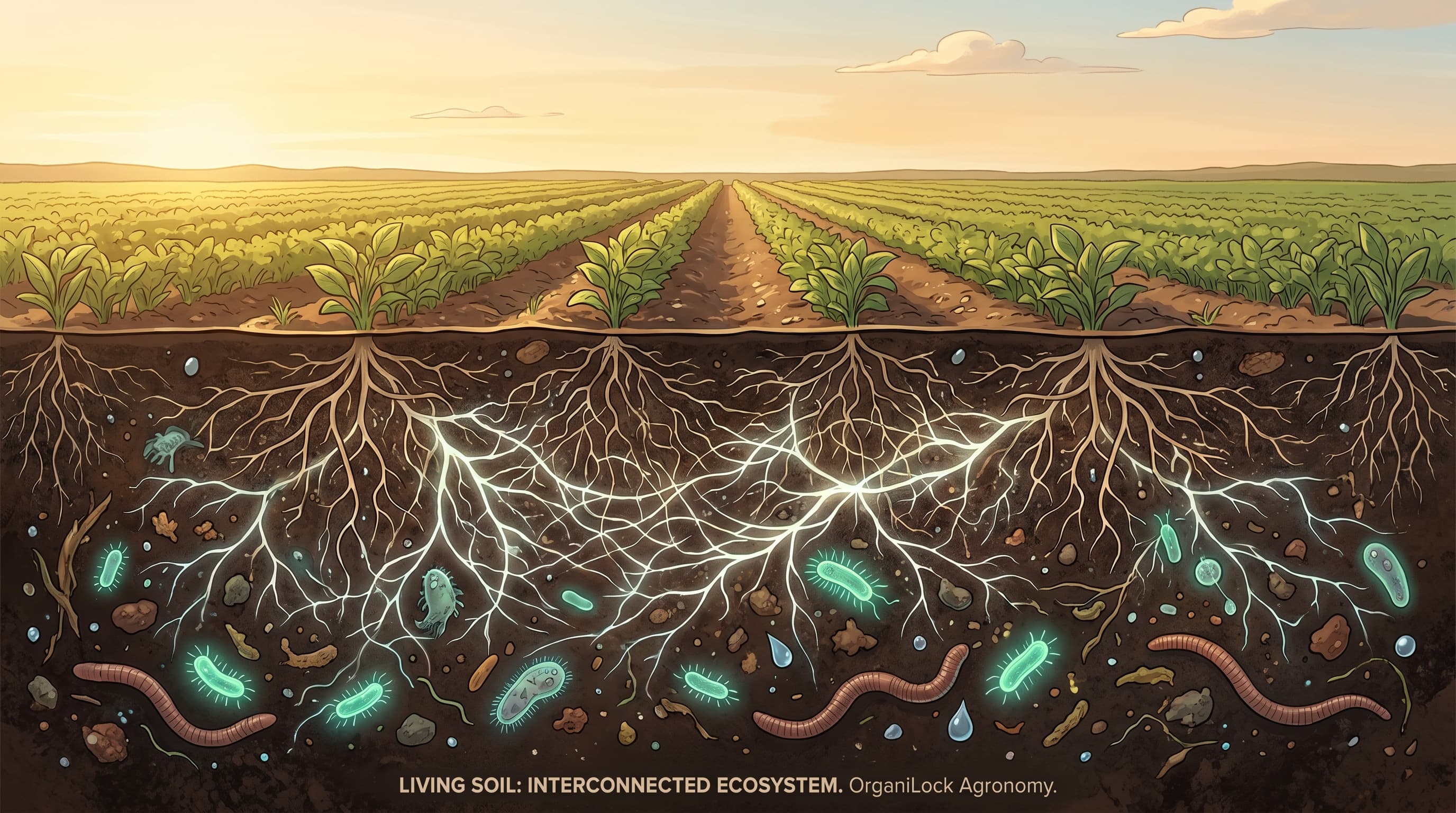
In a natural system, nitrogen moves in a cycle, and biology runs nearly every step. Bacteria fix nitrogen from the air into living tissue; when things die, other microbes mineralize that organic nitrogen back into ammonium; still others convert ammonium into nitrate; plants take up ammonium and nitrate to build new tissue; and under wet, airless conditions a final group of microbes turns nitrate back into nitrogen gas that returns to the air. Nitrogen is constantly passed from hand to hand by living things.
The practical lesson is that in a healthy soil, nitrogen supply is a biological process, not a static amount sitting in the ground waiting to be used. Feed and protect the biology, and the cycle keeps delivering.
Temperature is part of this. The microbes that release and convert nitrogen slow down in cold soil and speed up as it warms, so early in spring even a well-supplied soil can look briefly nitrogen-short until biology wakes up - a cold-soil effect that mimics deficiency and usually corrects itself as the season warms. It is one more reason to read the whole situation, not the color of a single leaf.
How much nitrogen is enough?
Different plants want wildly different amounts of nitrogen, which is why there is no single right answer to "how much should I feed." Heavy feeders - corn, tomatoes, squash, and leafy greens whose whole value is green growth - have a real and ongoing nitrogen demand. Light feeders - herbs, root crops, and many native plants - want much less and resent being pushed. And legumes such as beans, peas, and clover need almost no added nitrogen at all, because they partner with bacteria that fix their own from the air, as Module 1 described; feeding a legume heavy nitrogen actually makes it lazy and shuts that partnership down.
The best guide is the plant in front of you and a soil test, not a fixed schedule. Watch the leaves, test the soil every couple of years, and feed to the crop rather than by habit. Module 3 returns to this in detail, matching nutrition to plant type and stage; for now, the headline is that nitrogen demand is specific, not universal.
How humanity broke the nitrogen ceiling
For most of history, nitrogen was the hard limit on how much food the world could grow. Farmers stretched it however they could - manure, composts, rotating in nitrogen-fixing legumes, and later mined deposits of guano and Chilean nitrate - but nitrogen was scarce, and famine was a real and recurring fear. Then, in the early twentieth century, that ceiling was lifted.
The breakthrough was the Haber-Bosch process. Fritz Haber worked out the chemistry around 1909, and Carl Bosch scaled it into industry at BASF in the years that followed. It does what no plant can: it takes nitrogen straight from the air and combines it with hydrogen under intense heat and pressure to make ammonia - the building block of urea, ammonium nitrate, and the other synthetic fertilizers. For the first time, humanity could manufacture nitrogen fertilizer at will.
It is hard to overstate what this meant. Synthetic nitrogen removed the ancient ceiling on food production, and by common estimates it now underpins the food supply of roughly half the world's population. Any honest account of nitrogen has to begin by giving the Haber-Bosch process its due: it is one of the most consequential inventions in human history, and it has fed billions. This course treats synthetic nitrogen fairly, as a genuine and effective tool, even as it makes the case for a different approach.
To feel the scale of the change, consider that a large share of the nitrogen in your own body was, at some point, fixed in a factory rather than by nature. A world fed only on natural nitrogen sources - manure, legumes, and the rest - could likely support far fewer people than are alive today without major changes in land and diet. That is the honest backdrop for everything that follows. The point of this course is not that the world should abandon synthetic nitrogen, which would be neither possible nor wise. It is that there is a better way to feed a garden, a farm, or a landscape - one that builds the soil instead of spending it.
Plain-English takeaway: Synthetic nitrogen from the Haber-Bosch process lifted the age-old limit on food and helps feed roughly half the world. It is genuinely effective, and this course treats it fairly throughout.
So why would the source matter?
Here is the puzzle that sets up the rest of this module. A plant root absorbs nitrogen as nitrate or ammonium, and a nitrate ion from a synthetic bag is chemically identical to a nitrate ion released by soil microbes. At that final step, the plant cannot tell the difference. So if the molecule is the same, why would it matter whether your nitrogen comes from a soluble fertilizer or from biology?
It matters because of everything around that molecule: how fast it is delivered, the salt it brings with it, how much is lost to air and water before a plant ever uses it, whether it arrives alongside the carbon that feeds soil life, and what it does to soil structure and biology over the years. "The same molecule" is true and almost beside the point - and untangling why is the subject of the next lesson.