Lesson 4 ended on a puzzle: if a nitrate ion is a nitrate ion no matter where it came from, why would the source of nitrogen matter? This lesson is the answer, and it is the heart of the whole course. The honest starting point is a concession - at the level of the single ion a root absorbs, there really is no difference. The difference lives in everything that surrounds that ion, and once you see it, you cannot unsee it.
Same molecule, different system
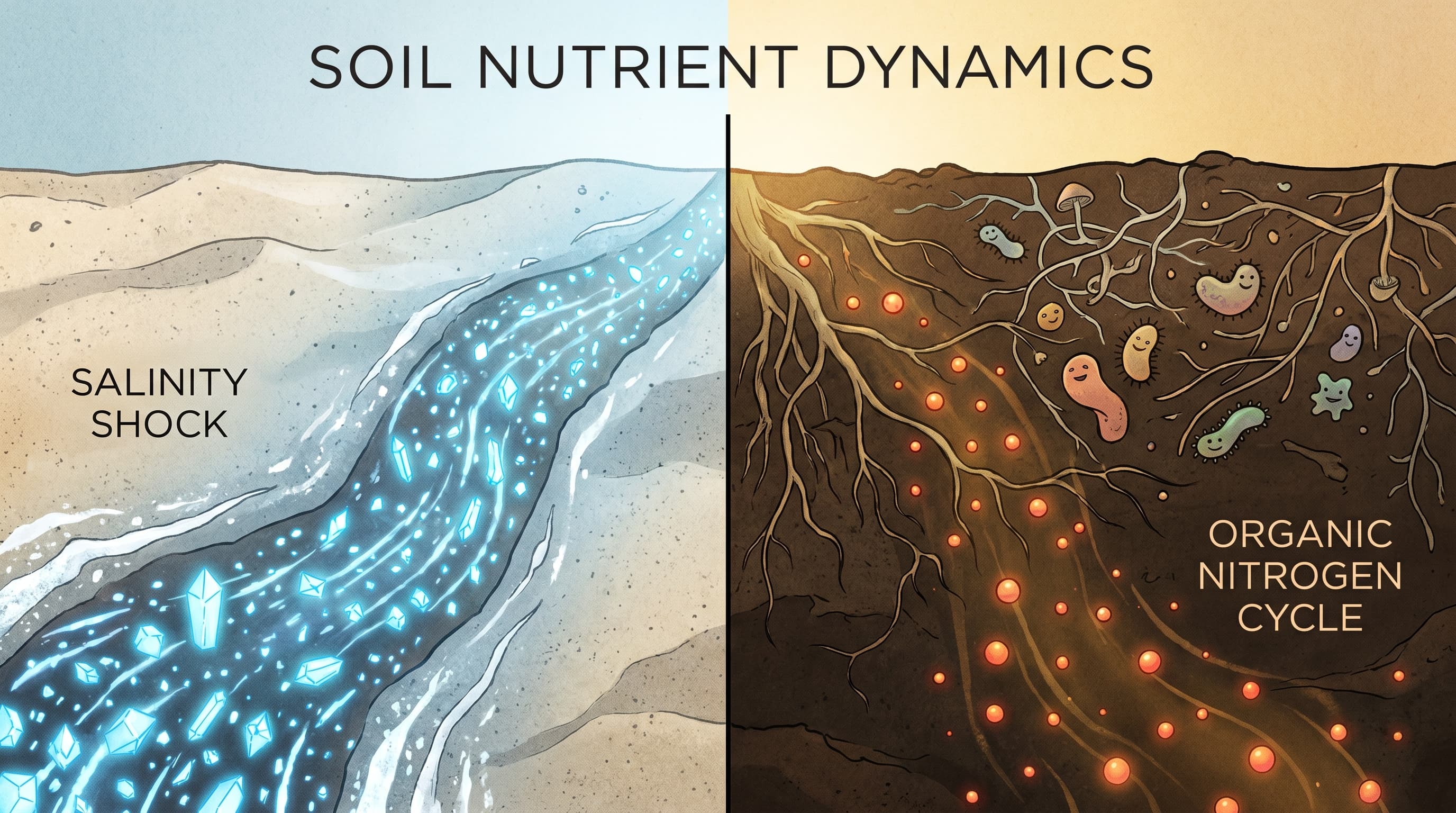
Picture two ways of delivering the same nitrate ion to a plant. One is a soluble synthetic fertilizer: nitrogen as instantly available salts, dissolved the moment they touch water. The other is biology: organic nitrogen released slowly by soil microbes as they break down organic matter. The plant ends up absorbing the same ion either way. But five things around that ion are completely different.
- Speed. Soluble nitrogen floods the soil all at once; biological nitrogen trickles out as microbes work, roughly in step with the season and the plant's demand.
- Salt. Soluble nitrogen is a salt, and it raises the salt concentration of the soil water sharply; insoluble organic nitrogen does not.
- Loss. Soluble nitrogen, sitting in the soil water as fast nitrate, is easily washed or gassed away before a plant uses it; biological nitrogen is held in organic matter until released.
- Carbon. Biological nitrogen arrives bound up with carbon, which feeds the soil's living community; soluble nitrogen arrives alone.
- The long game. Over years, the two leave the soil in very different condition - its structure, its organic matter, and its fungal partnerships.
So "it is the same molecule" is true and almost beside the point. The story of nitrogen is a story of systems, not molecules. The rest of this lesson walks through what the soluble-only system costs - not to demonize it, but because understanding the costs is the whole case for doing it differently.
Plain-English takeaway: A nitrate ion is the same wherever it comes from - but the speed, the salt, the losses, the carbon, and the long-term effect on the soil are completely different. Nitrogen is a system, not just a molecule.
Hidden cost #1: fertilizer burn
The first cost is the most visible: burn. Soluble nitrogen is a salt, and salts pull water toward themselves by osmosis. When too much soluble fertilizer concentrates around roots, it actually draws water out of the plant's cells, dehydrating and scorching the very tissue it was meant to feed. That is fertilizer burn - brown, crispy leaf edges, or a killed seedling - and it is a salt effect, not a nutrient effect.
Here is the crucial detail, because it is widely misunderstood. The protection against burn is not the word "organic" - it is insolubility. Nitrogen locked in an insoluble organic form never creates that salt spike, so it does not burn even if you apply a little extra. But a soluble concentrate can burn whether it is synthetic or organic. This distinction matters: a product's gentleness comes from its insoluble, slow-release nature, and any product that contains a fast, soluble nitrogen fraction follows the normal rules - dilute it, follow the rates, and do not over-apply. We will be precise about which OrganiLock products are which in the next lesson.
In practice, burn shows up as scorched, brown leaf margins, wilting despite moist soil, or seedlings that simply collapse - and it is worst in containers and on young plants, where roots are confined and salts concentrate fast. Fertilizers even carry a "salt index" that rates how sharply they spike the soil-water salt concentration, and the high-salt-index products are the concentrated soluble ones. A slow, biological release sidesteps the whole problem because the salt spike never happens.
Plain-English takeaway: Fertilizer burn is a salt effect: concentrated soluble nitrogen pulls water out of plant cells. What prevents it is insolubility, not the label word "organic" - so any soluble feed still has to be used with rate discipline.
Hidden cost #2: the nitrogen that never feeds a plant
The second cost is invisible and enormous: most applied nitrogen never feeds a plant at all. Because fast nitrate is so mobile, a large share - by common estimates roughly half of what is applied worldwide - is lost before the crop can take it up. It leaves by several doors.
- Leaching: nitrate dissolves and washes down through the soil into groundwater.
- Runoff: it flows off the surface into streams, ponds, and lakes.
- Volatilization: surface-applied urea and ammonium can escape into the air as ammonia gas.
- Denitrification: in wet, airless soil, microbes turn nitrate into nitrogen gases, including nitrous oxide, a potent greenhouse gas.
This is a staggering inefficiency - half the nitrogen, and the money and energy behind it, gone - and it is the source of nitrogen's environmental problems. Nitrogen held in organic matter and released by biology is far less prone to these losses, because it is not sitting in the soil water as dissolved salt waiting for the next rain. It is released on biological demand and largely used where it is made.
This inefficiency is exactly what modern agriculture is racing to fix - through precision application, slow-release and enhanced-efficiency products, and biology-based approaches that hold nitrogen in the soil. All of them chase the same prize: getting more of the nitrogen into the plant and less of it into the water and air. A biology-first system goes after that prize from the soil-health side.
Hidden cost #3: switching off the soil's own fertility
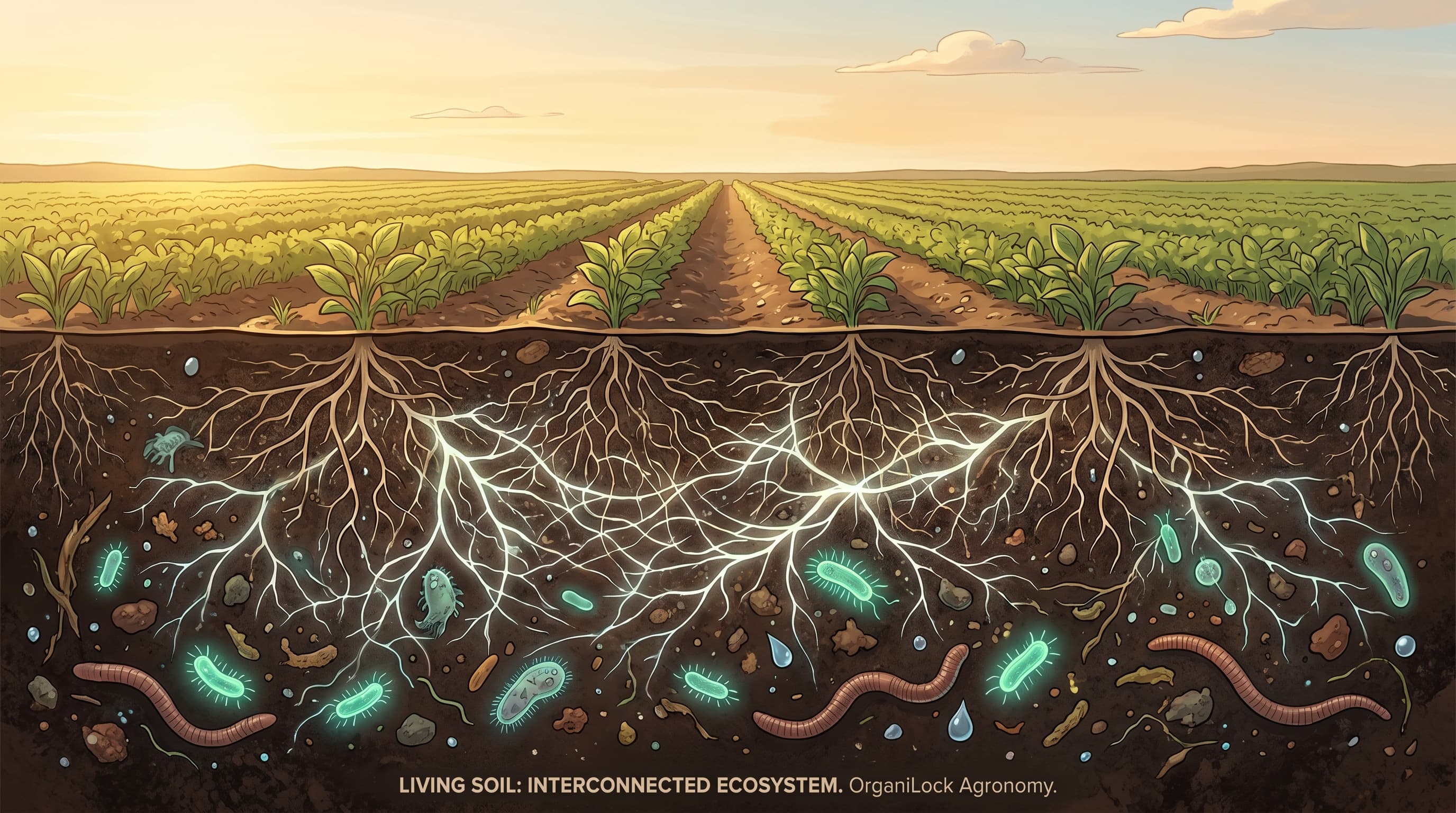
The third cost is the most important for the long run, and it ties straight back to Module 1. Recall that plants partner with mycorrhizal fungi to reach water and nutrients, and that they form that partnership when nutrients are scarce. When soluble nitrogen (and soluble phosphorus) are abundant, the plant gets the signal that it no longer needs the fungi, and the partnership fades. Heavy soluble feeding, in other words, switches off the very biology that builds long-term fertility and structure.
This is the quiet trap of the soluble-only approach: it can deliver a green crop this season while running down the living soil underneath, so that next season needs a little more input, and the season after that more still. The soil becomes dependent. A biology-first approach aims for the opposite - feeding the soil so the soil feeds the plant, so it grows richer rather than poorer over time.
Plain-English takeaway: Abundant soluble nitrogen signals plants to drop their fungal partnerships, so heavy soluble feeding can quietly run down the living soil - greener this year, more dependent next year.
Down the watershed: nitrogen, water, and health
The nitrogen that leaches and runs off has to go somewhere, and where it goes is the water. This is general public-health and environmental knowledge worth understanding, stated plainly and without alarm.
- Drinking water. The U.S. EPA sets a maximum of 10 milligrams per liter of nitrate (measured as nitrogen) in public drinking water. The limit exists mainly to protect infants from "blue baby syndrome" (methemoglobinemia), in which nitrate interferes with the blood's ability to carry oxygen. Private wells are not federally regulated, so households near intensively fertilized land are advised to test their water periodically.
- Lakes and coasts. When nitrogen (and phosphorus) reach surface water, they feed explosive algae growth; when the algae die and decompose, they strip the oxygen from the water, creating "dead zones" where aquatic life cannot survive.
None of this is a claim that any product cleans water or prevents contamination. It is simply why the form of nitrogen, and how much escapes the field, is not only an agronomic question but a water-quality one.
The bigger picture: a cycle out of balance
Step back from the single field and the scale becomes striking. Human activity now fixes more nitrogen - through fertilizer factories and nitrogen-fixing crops - than all of nature's processes combined, and because so much of it escapes as that mobile nitrate, a great deal leaks into the air and water. Scientists count the nitrogen cycle among the planetary systems humanity has pushed furthest out of its natural balance, alongside the climate. The nitrous oxide released when soil microbes work on excess nitrate is itself a potent greenhouse gas, so wasted nitrogen is not only a local water problem but a global one.
This is not cause for guilt at the garden scale; one gardener's beds are a drop in that ocean. It is a reason to understand that using nitrogen efficiently - applying what plants can actually use, holding it in living soil, and not over-applying - is quietly one of the more responsible things a grower can do.
The honest truth about nitrogen and the soil itself
It is tempting to blame soluble nitrogen for eroding topsoil, but that would be inaccurate, and this course will not say it. Erosion and the loss of topsoil are driven by bare, tilled, low-organic-matter ground exposed to wind and water - not directly by the form of nitrogen. The connection is real but indirect: soluble nitrogen makes it possible to keep propping up yields on bare, intensively worked soil even as the organic matter and structure beneath quietly decline, masking the loss. Organic nitrogen, by contrast, arrives with the carbon that feeds the fungi and microbes whose threads and glues bind soil into erosion-resistant crumbs. Building biology and organic matter is what actually holds topsoil in place.
So the honest framing is not "synthetic nitrogen destroys soil." It is that a soluble-only, bare-soil system tends to run the soil down, while a biology-first system tends to build it up - and the kind of nitrogen you use is part of which path you are on.
Three stubborn myths about nitrogen
A few half-truths about nitrogen do a lot of damage, and they are worth clearing up directly.
- "More is better." This is the costliest myth in growing. Past what a plant can use, extra nitrogen does not add growth - it adds soft, weak tissue, pest and disease problems, burn, and pollution, while wasting money. Balance beats maximum, every time.
- "Organic nitrogen can never burn." Mostly true, but for the right reason. It is the insolubility of nitrogen like Soil Food's that prevents burn, not the word "organic." A soluble organic concentrate can still scorch if overdone. The protective factor is the slow-release form - which is exactly why the no-burn property does not automatically carry to a product with a soluble fraction.
- "Synthetic and organic nitrogen are identical, so the source makes no difference." This is the strongest argument for synthetic, and it deserves an honest answer. At the level of the single ion, it is true. But as this whole lesson has shown, the system around that ion - speed, salt, loss, carbon, and the long-term effect on soil life and structure - differs substantially. "Same molecule" is true and not the whole story.
Keeping it fair
It would be easy to read this lesson as an attack on synthetic nitrogen. It is not. Synthetic nitrogen is genuinely cheap, effective, and responsible for feeding much of the world, and there are times and places where a fast, soluble feed is exactly the right tool. The real problem in this lesson is not synthetic nitrogen; it is excess and imbalance - the assumption that more is always better and that the soil is just a substrate to be dosed. The case for the biology-first approach is not that the molecule is different. It is that the system is healthier, more efficient, and more durable over time. That is the approach the next lesson puts into practice.
If it helps, hold both truths at once. Synthetic nitrogen is fast, cheap, predictable, and has fed billions; organic, biological nitrogen is slower and less precise but builds the soil, resists loss, and compounds over years. They are tools with different strengths, and a fair-minded grower can respect the first while choosing the second for the long game. That choice is what the final lesson of this module is about.
Plain-English takeaway: Synthetic nitrogen is effective and feeds much of the world; the problem is excess and the soluble-only, bare-soil system, not the molecule. The case for biology-first is a healthier, more durable system - not a different ion.