Module 2 spent three lessons on nitrogen because it drives the most growth and the most trouble. But nitrogen is only the N in N-P-K, and a plant flooded with nitrogen and short on everything else will still fail. This module covers everyone else at the table: phosphorus and potassium in this lesson, the secondary and trace nutrients in the next, how they all interact in the third, and how to match them to different plants in the fourth. We start with the other two big numbers on every fertilizer bag - and they could hardly be more different from nitrogen, or from each other.
First, the label math
A quick note that clears up real confusion. On a fertilizer label the three numbers are nitrogen, phosphate, and potash - but only the first is reported as the pure element. Phosphorus is reported as "available phosphate" (written P2O5) and potassium as "soluble potash" (written K2O). These are oxide forms, a historical convention rather than chemistry, which means the middle and last numbers are not the pure element and the actual phosphorus and potassium contents are somewhat lower than the printed figures. You do not need to do the conversion to grow well; you only need to know that "the P number" means phosphate and "the K number" means potash, so you never misread them.
Phosphorus: the energy and reproduction nutrient
If nitrogen is the growth nutrient, phosphorus is the energy and information nutrient. It is built into ATP - the molecule that carries energy inside every living cell - and into DNA, RNA, and every cell membrane. In the garden, that chemistry shows up as phosphorus being the nutrient of root development, early-season vigor, and reproduction: flowering, fruiting, and seed set. A young transplant building its first roots, and a plant shifting into bloom, both have a real phosphorus demand.
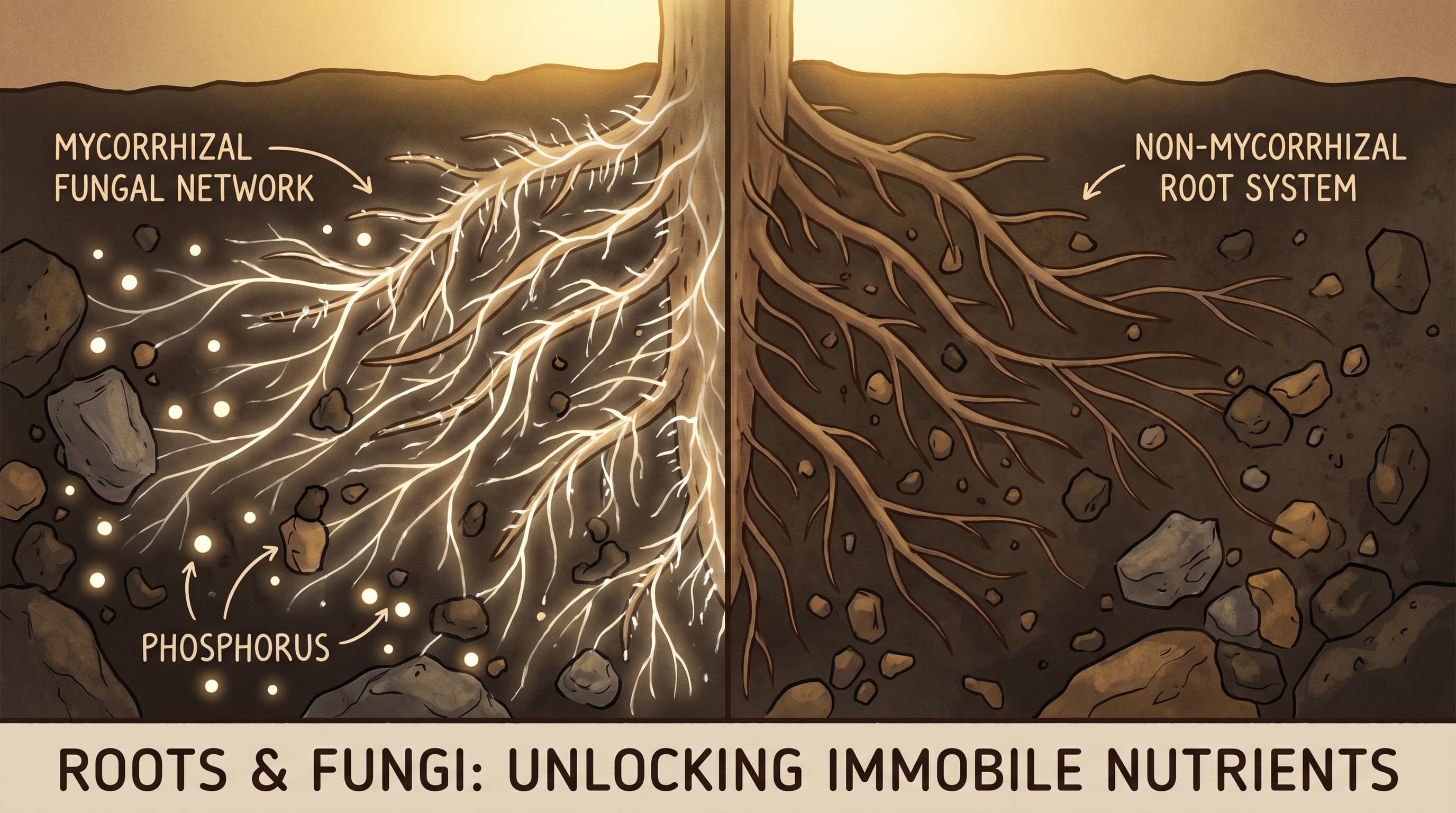
What makes phosphorus behave so differently from nitrogen is that it is immobile in the soil. Where nitrate moves freely with water, phosphorus binds tightly to soil particles and barely moves at all - it locks up with iron and aluminum in acidic soil and with calcium in alkaline soil, and it is most available only in a narrow band around neutral, roughly pH 6 to 7. Because it does not travel to the root, the root has to grow to it - or hire something that can.
That something is the mycorrhizal fungi from Module 1. Because phosphorus is so immobile, plants evolved their fungal partnership largely to reach it: the fungal threads extend far beyond the root and mine phosphorus the root could never touch, trading it for sugar. Here is the catch that ties the whole course together - plants form that partnership when phosphorus is scarce, and when soluble phosphorus is abundant the plant stops investing in the fungi and the partnership fades. So heavy soluble phosphate, exactly like heavy soluble nitrogen, switches off the biology that builds long-term fertility, and on top of that it directly blocks the uptake of zinc and iron, inducing micronutrient shortages in soils that are not actually short on them.
Reading phosphorus on a plant: because it is mobile inside the plant (even though immobile in soil), deficiency shows on the oldest leaves first - a dull, dark blue-green cast, often with purple or reddish tints on stems and leaf undersides, along with stunting, delayed maturity, and poor flowering and fruiting. One common trap: cold soil mimics phosphorus deficiency, because cold roots and sluggish biology cannot take phosphorus up even when it is present, so early-spring purpling often fixes itself as the soil warms. Excess phosphorus rarely burns, but it suppresses mycorrhizae, induces zinc and iron deficiency, and is the nutrient most associated with water pollution, as the next lessons show.
In organic inputs, phosphorus is held in organic compounds and in materials like bone, which is calcium phosphate. It is released gradually by soil microbes and their enzymes, which keeps it in the root zone and in step with biology rather than flushing through or locking up - and bone-bearing whole-animal inputs deliver phosphorus and calcium together.
Plain-English takeaway: Phosphorus powers energy, roots, and flowering, but it is immobile in soil, so plants rely on mycorrhizal fungi to reach it. Flooding the soil with soluble phosphate switches those fungi off and blocks zinc and iron - another reason balance beats excess.
Potassium: the regulator and quality nutrient
Potassium is the third big number and the most underrated. Where nitrogen builds tissue and phosphorus stores energy, potassium does not become part of the structure at all - it stays dissolved and mobile inside the plant and runs the machinery. It controls the stomata, the tiny leaf pores that manage water loss and gas exchange, so it governs water use and drought tolerance. It activates dozens of enzymes and drives the transport of sugars from the leaves into fruit and roots. And it builds stem strength, disease and stress resistance, cold and winter hardiness, and - the thing gardeners actually notice - fruit size, flavor, and quality. Potassium is why a tomato is sweet and firm and why a plant stands up straight and shrugs off a hard winter. It is fair to call it the quality nutrient.
In the soil, potassium sits between nitrogen and phosphorus in how easily it moves. It carries a positive charge, so the soil holds it on the same exchange sites that hold calcium and magnesium - except in sandy, low-organic-matter soils, where it leaches more readily, and in containers, where everything washes through faster.
Reading potassium on a plant: it is mobile inside the plant, so like nitrogen and phosphorus, deficiency shows on the oldest leaves first - here as a classic scorching, yellowing, and browning of the leaf margins (the outer edges) while the center stays green, along with weak stems and poor fruit quality. Potassium also has a quirk called luxury consumption: plants take up more than they actually need when it is freely available. It is not toxic to the plant in any practical way, but it is wasteful, and - more importantly - excess potassium blocks the uptake of magnesium and calcium, one of the most common real-world balance problems. A soil over-fed with potassium can show magnesium deficiency even when magnesium is plentiful.
Plain-English takeaway: Potassium is the regulator and quality nutrient - it runs water, enzymes, sugar transport, toughness, and fruit quality. It shows deficiency as scorched leaf margins on old leaves, and too much of it blocks magnesium and calcium.
The team: nitrogen, phosphorus, potassium
It helps to hold the three macronutrients as a team with distinct jobs. Nitrogen builds green, leafy growth. Phosphorus powers roots, energy, and reproduction. Potassium regulates water, quality, and toughness. A plant needs all three, in balance and at the right stage - heavy on nitrogen while it builds leaf, leaning toward phosphorus as it roots and sets buds, and toward potassium as it fills fruit and hardens for winter. The single biggest macronutrient mistake is over-weighting one (usually nitrogen) and starving the result of flowers, fruit, or strength.
One difference worth knowing: phosphorus is finite
There is a quiet sustainability point hidden in phosphorus. Nitrogen, as Module 2 explained, is effectively unlimited - the air is full of it, and industry can fix it at will. Phosphorus is the opposite: it is mined from phosphate rock, a non-renewable resource concentrated in just a few countries, and there is no substitute for it in growing food. Using phosphorus efficiently and recycling it - including returning it to the soil through organic matter and biology rather than letting it wash away - is a genuine long-term concern, not just a soil-health preference. It is one more reason that holding nutrients in living soil, where they are used rather than lost, matters.
Why potassium is the quality nutrient
It is worth dwelling on why potassium earns its "quality nutrient" name, because it is the macronutrient gardeners most often under-appreciate. A plant well supplied with potassium manages its water better and rides out drought and heat with less stress; it stands up instead of flopping; it resists disease more readily; and its fruit is larger, firmer, sweeter, and stores longer. Two tomatoes grown side by side, one short on potassium and one not, can look similar on the vine and taste worlds apart. For anyone growing for flavor and keeping quality, potassium is where a great deal of the result actually lives.
The bloom-booster myth and the over-feeding trap
Here is a myth worth puncturing: the "bloom booster," a high-middle-number fertilizer sold on the promise of more flowers. Phosphorus is needed for flowering, but adding more than the plant can use does not produce more blooms - it suppresses the mycorrhizae and micronutrients instead, and most soils already hold plenty of phosphorus. In fact, many established garden soils test high in phosphorus from years of feeding, and adding more only raises the risk of runoff and induced zinc or iron shortages. Potassium, which can leach from sandy soils and containers, is more often the one genuinely in need. The honest answer to "should I add phosphorus or potassium" is almost always "test first," because feeding by habit is exactly how soils end up out of balance.
Where phosphorus and potassium come from
The source shapes how these nutrients behave. In organic growing, phosphorus comes from bone-based materials, rock phosphate, manures, and compost, and is released slowly so it tends to stay in the root zone. Potassium comes from kelp, greensand, wood ash, compost, and manures, and from the natural weathering of soil minerals. Whole-food inputs deliver both alongside the broad spectrum of other nutrients, so you are not bolting on one element at a time.
The reassuring takeaway for a home grower is that you rarely need to chase phosphorus and potassium with special products. A soil built up with compost, a whole-food amendment, and good organic-matter practices tends to supply both in balance, and a periodic soil test catches the exceptions. Reach for a targeted addition only when a test or a clear deficiency tells you to - and with finite, easily-wasted phosphorus especially, the goal is to keep it in living soil and let biology recycle it rather than keep piling more on.
How the three work through a season
Nitrogen, phosphorus, and potassium are not used in equal measure at every moment - their emphasis shifts as a plant grows, which is the practical payoff of understanding all three. Early on, a seedling or transplant leans on phosphorus and biology to build roots and establish. As it grows leaf and frame, nitrogen takes the lead. And as it flowers, sets fruit, and hardens for winter, potassium becomes the star, building quality and toughness while steady calcium keeps the fruit sound. A grower who feeds heavy nitrogen all season gets a big green plant and a small harvest; one who lets the emphasis move from phosphorus to nitrogen to potassium works with the plant's own rhythm.
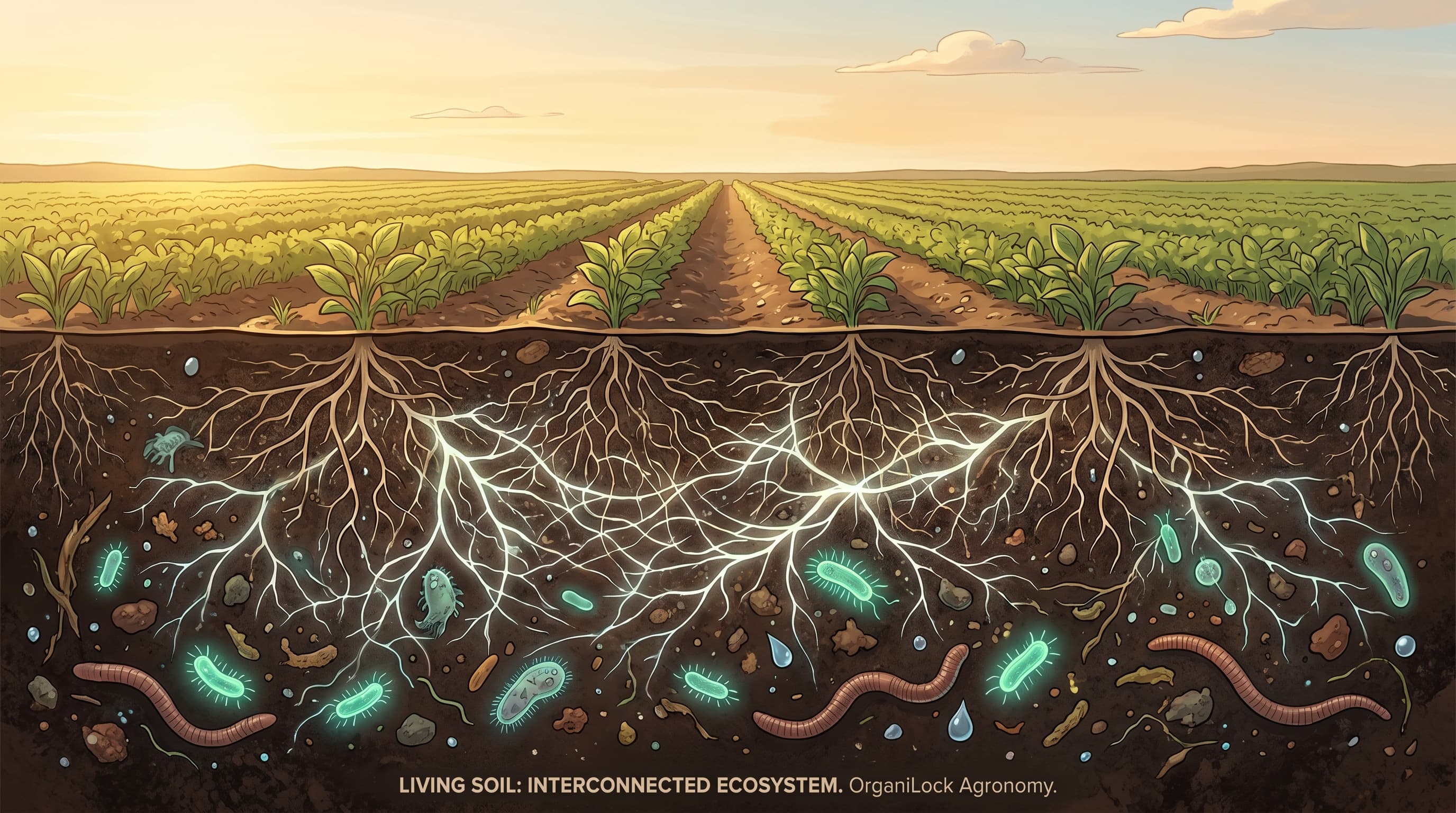
This is exactly the rhythm a living soil provides on its own. Because biology releases the broad spectrum gradually and the plant draws what it needs when it needs it, feeding the soil sidesteps much of the timing guesswork that comes with trying to spoon out single nutrients on a schedule. Hold the simple version: nitrogen for leaf, phosphorus for roots and bloom, potassium for quality and toughness, used in a shifting balance rather than a constant heavy dose.
Where this is heading
Phosphorus and potassium round out the macronutrients, but the plant's full diet runs to seventeen elements. The next lesson meets the rest of them - the secondary nutrients and the trace micronutrients - and hands you a single diagnostic trick that makes sense of nearly all of their deficiencies.