Seventeen elements are essential to plants, meaning a plant cannot complete its life cycle without each one. We have covered the three macronutrients - nitrogen, phosphorus, potassium. This lesson covers everyone else: the secondary nutrients (calcium, magnesium, sulfur) needed in moderate amounts, and the micronutrients (iron, manganese, zinc, copper, boron, molybdenum, and a couple of others) needed only in traces. "Secondary" and "micro" refer strictly to quantity, never to importance - a plant starved of a trace nutrient fails just as surely as one starved of nitrogen. The good news is that a single diagnostic idea makes reading almost all of them straightforward.
The one trick: old leaves or new leaves?
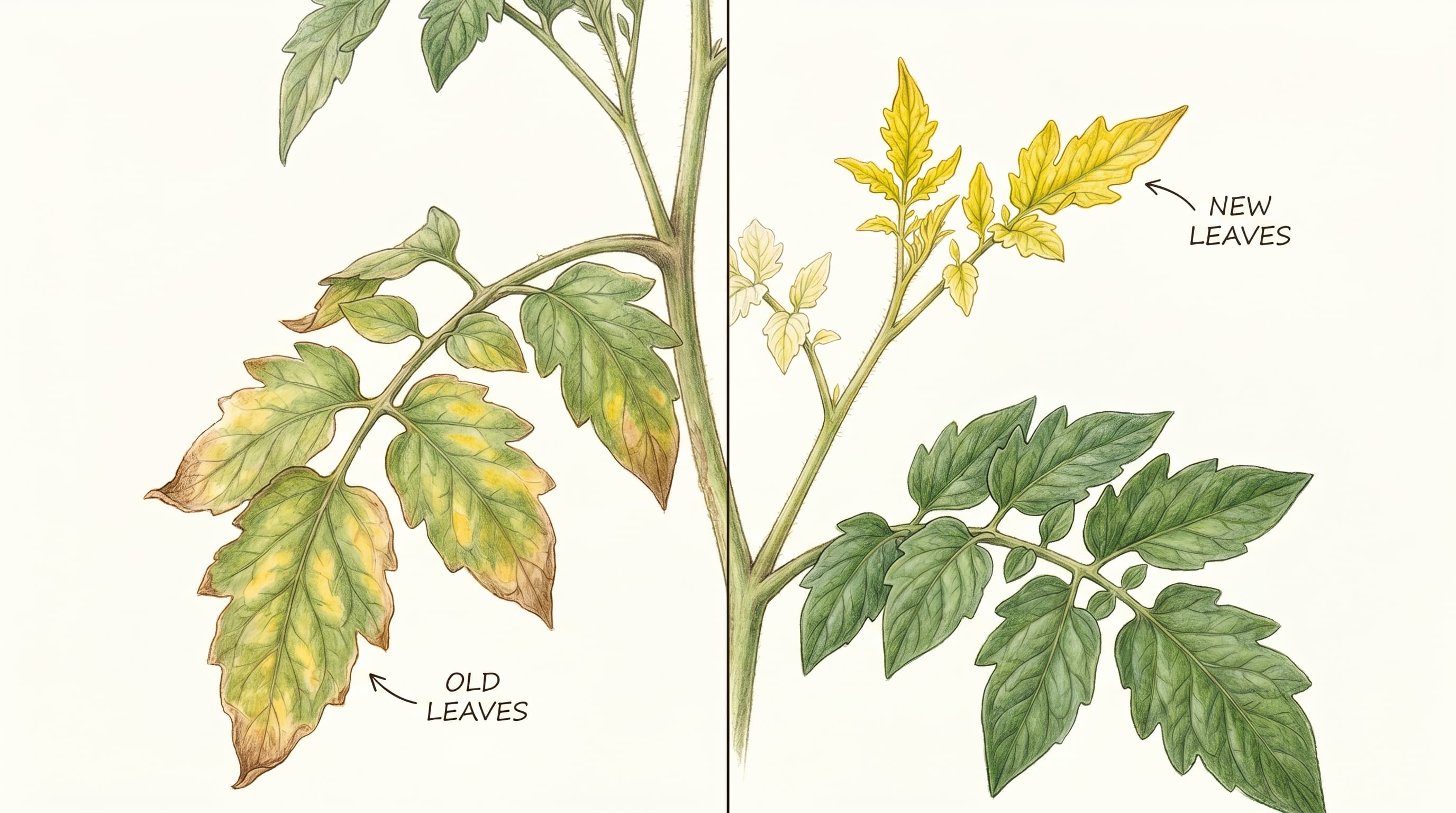
Before the cast of characters, learn the trick that organizes them. Nutrients differ in whether the plant can move them from old tissue to new, and that single property tells you where a deficiency will show up.
- Mobile nutrients - the plant can pull them out of old leaves and relocate them to feed new growth, so when these run short, the oldest, lowest leaves suffer first. Nitrogen, phosphorus, potassium, and magnesium are mobile.
- Immobile nutrients - the plant cannot move them once they are placed, so when these run short, the newest growth at the tips suffers first while the old leaves stay fine. Calcium, boron, iron, manganese, zinc, and copper are immobile; sulfur is in between.
So the first question to ask a struggling plant is simply: is the problem on the old leaves or the new ones? Old-leaf symptoms point to a mobile nutrient; new-leaf symptoms point to an immobile one. It does not name the exact nutrient by itself, but it cuts the list in half and is the single most useful habit in nutrient diagnosis.
Plain-English takeaway: Ask one question first: are the symptoms on the old leaves or the new ones? Old-leaf problems point to a mobile nutrient (N, P, K, Mg); new-leaf problems point to an immobile one (Ca, B, Fe, Mn, Zn, Cu).
The secondary nutrients
Calcium is the cell-wall nutrient - the cement that builds strong cell walls and membranes, essential at the growing points where new tissue forms. It is immobile and moves only with the water stream, so it cannot be relocated from old tissue to new. That is why calcium problems appear at the growing tips and in fast-expanding fruit: blossom-end rot in tomatoes and peppers, tip burn in lettuce and cabbage, bitter pit in apples. The crucial, money-saving insight is that these are almost never soil calcium shortages - they are delivery failures caused by uneven watering, which interrupts the water stream that carries calcium to the fruit. Steady, even moisture fixes blossom-end rot far more reliably than adding calcium ever will. (For reference, Soil Food carries 2.2% calcium on its label.)
Magnesium sits at the literal center of the chlorophyll molecule - one magnesium atom anchors every chlorophyll molecule - so it is indispensable to photosynthesis. It is mobile, so deficiency appears on the older leaves as interveinal chlorosis: yellowing between the veins while the veins themselves stay green, often with the leaf edges curling. Because excess potassium or calcium can block magnesium uptake, magnesium deficiency is very often a balance problem rather than a true shortage - a theme the next lesson develops.
Sulfur is a building block of proteins, several amino acids, and vitamins, and it is closely tied to how the plant uses nitrogen. Functionally it behaves much like nitrogen, but because it is less mobile in the plant, its deficiency shows as a general yellowing of the youngest, newest leaves - a useful contrast with nitrogen, which yellows the oldest leaves first. Sulfur comes largely from organic matter, so soils low in organic matter are the ones most likely to run short.
Notice a useful pattern across the secondary nutrients: their problems are so often about balance and delivery rather than raw shortage. Calcium is usually a watering problem, not a soil shortage; magnesium is usually blocked by excess potassium or calcium, not absent; sulfur tracks organic matter. Add a single secondary nutrient blindly and you risk creating a new imbalance - over-liming for calcium can lock up magnesium and several micronutrients at once. The reliable move is to keep the soil rich in organic matter and balanced, and to correct a specific nutrient only when a test confirms it.
The micronutrients
Needed in trace amounts, essential all the same. Two themes run through almost all of them: most lock up at high pH, so a great many "micronutrient deficiencies" are really pH problems, and most are immobile, so their symptoms show on new growth.
- Iron is required to make chlorophyll, and its deficiency is the most common micronutrient problem: interveinal chlorosis on the youngest leaves - yellow leaf, green veins. It is almost always a high-pH lockup or a waterlogged-root problem rather than a true soil shortage, which is why acid-loving plants yellow so readily in alkaline soil.
- Manganese works alongside iron in photosynthesis; its deficiency looks similar (interveinal chlorosis on new leaves) and is also pH-driven.
- Zinc drives growth hormones and enzyme systems; deficiency causes stunted "little leaf," rosetting, and shortened stems. It is the micronutrient most often suppressed by excess phosphorus - the classic over-fertilized-with-phosphate induced deficiency.
- Copper supports enzymes and reproduction; deficiency causes wilting and poor pollination, and the margin between enough and too much is narrow.
- Boron is needed for cell-wall formation, pollination, and fruit and seed set. It is immobile, so deficiency hits growing points and causes hollow or corky stems and roots and poor fruit set. Boron has the narrowest margin between deficiency and toxicity of any nutrient - a little is essential, slightly too much is toxic - so it should never be broadcast casually.
- Molybdenum is needed for the plant to use nitrogen and for legumes to fix it, and it is required in the smallest amount of all. It is unusual in becoming less available at low pH, the opposite of most micronutrients.
- Chlorine and nickel round out the seventeen; both are needed only in traces, and deficiencies are rare in practice because they are widespread in the environment.
The pattern worth remembering
Step back and a pattern emerges that the next lesson builds on: most of the time, when a plant shows a micronutrient deficiency, the micronutrient is present in the soil but unavailable - locked up by the wrong pH or blocked by an excess of another nutrient. Adding more of the locked-up nutrient usually does not help, and with some (boron especially) it does harm. The right first moves are almost always to check pH and overall balance, not to reach for a single-nutrient additive. A soil test is what tells you which it is.
Plain-English takeaway: Most micronutrient deficiencies are not true shortages - they are pH lockups or imbalances. Check pH and balance before adding any single micronutrient, because more of a locked-up nutrient rarely helps and some (like boron) are easy to overdo.
Putting the diagnosis together
Combine the old-leaf-versus-new-leaf trick with the pattern of the symptom and you can read most nutrient problems on sight. First ask where: old leaves point to a mobile nutrient, new leaves to an immobile one. Then ask what the yellowing looks like. A uniform, overall yellowing starting on old leaves is the nitrogen signature. Yellowing between green veins (interveinal chlorosis) is magnesium on old leaves or iron and manganese on new ones. Scorched, browning leaf margins on old leaves point to potassium. Dull, purple-tinged old leaves point to phosphorus. Deformed or dying growing tips point to calcium or boron. None of this is foolproof - watering, root damage, pests, and pH all mimic deficiencies - but location plus pattern narrows the field fast and tells you what to confirm with a test.
A word on toxicity: more is not safer
It is tempting to treat any unhealthy plant by adding nutrients, but several elements are toxic in excess, and over-supplementing is a real way to harm a garden. Boron has the narrowest safe range of all - a casual sprinkle of borax can poison a bed. Manganese and aluminum turn toxic in acidic soil. Even harmless-sounding "feed everything" approaches can spike the soil-water salts and induce the very antagonisms the next lesson describes. The rule that protects you is the same one that runs through this whole course: feed a broad, balanced diet through living soil, and add a single concentrated nutrient only when a test or an unmistakable deficiency calls for it.
Where the supporting cast comes from
In organic growing, the secondary and trace nutrients arrive mostly through whole, broad-spectrum inputs and the steady breakdown of organic matter. Calcium comes from lime (which also raises pH) or gypsum (which does not); magnesium from dolomitic lime or, used cautiously, Epsom salt - cautiously because dumping magnesium can throw off the calcium and potassium balance; sulfur largely from organic matter and gypsum. The micronutrients are present in most soils and in any rich organic input, and are released by biology as needed. This is why a soil fed with compost and a whole-food amendment tends to keep the entire supporting cast available without a cabinet full of single-element products - and why reaching for those products should follow a test, not a hunch.
Where a broad diet fits
This is also the quiet case for feeding a broad spectrum rather than a few concentrated nutrients. The secondary and trace nutrients come along naturally in whole, organic inputs and are released from organic matter by the same biology that handles everything else, so a soil rich in organic matter and life tends to keep the whole supporting cast available without a shelf of separate additives. OrganiLock's whole-food approach carries that broad spectrum - including the 2.2% calcium on Soil Food's label - in a single input, which is the practical advantage the next lesson explains in terms of balance.
Test, do not guess
If one practice separates good nutrient management from frustration, it is testing instead of guessing. The symptoms in this lesson overlap heavily - half a dozen problems can yellow a leaf - and many "deficiencies" are really pH or balance issues that adding the nutrient will not fix. A soil test cuts through all of it. In the United States, your local Cooperative Extension service offers low-cost soil tests with recommendations for your region, and it is the single best step a serious grower can take. Test a new bed before planting and an established garden every couple of years, read pH first, and let the result tell you what (if anything) to add. It is cheaper than a season of guessing, and far cheaper than the damage a wrong guess can do.
The broader lesson here is humility in the face of a living system. Seventeen nutrients, each with its own behavior, all interacting, all gated by pH and biology - it sounds impossibly complex to manage element by element, and it is. The way through is not to master every nutrient individually but to build a soil that manages them for you: rich in organic matter, alive with biology, balanced in its inputs, and corrected only where a test shows a real gap. Do that, and the supporting cast largely takes care of itself.
Where this is heading
You now know the full cast - macros, secondaries, and micros - and the old-leaf-versus-new-leaf trick for reading them. The next lesson is the one that ties it all together and is, for many growers, the most useful in the course: how these nutrients interact, why balance matters more than any single number, and why the same fertilizer works in one garden and fails in the next.