This is the lesson most fertilizer programs skip, and it is the most important one in the module. Up to now we have looked at nutrients one at a time, as if each acted alone. They do not. The presence of one nutrient changes how the plant takes up another - sometimes helping, more often competing - so an excess is never just wasted; it can create a brand-new deficiency of something else that is sitting right there in the soil. Once you understand nutrient balance, a lot of mysterious plant problems suddenly make sense, and a lot of fertilizer stops looking necessary.
The Law of the Minimum
The single most useful idea in plant nutrition is over 180 years old: Liebig's Law of the Minimum. Growth is limited by the scarcest essential resource, not by the total amount of nutrients present. The classic picture is a barrel built of staves of different heights - water fills it only to the height of the shortest stave, no matter how tall the others are. If potassium is the short stave, adding more nitrogen does not raise the water line one bit; it may even lower it.
Three consequences follow, and they shape everything else.
- The most-limiting nutrient sets the ceiling. Finding which nutrient is short matters far more than adding more of whatever is on hand.
- "More is better" is false at the system level, not just for nitrogen. Pushing any one nutrient past sufficiency wastes money, can harm the plant, and can lock out others.
- Balance, not maximum, is the goal. A broad, balanced supply the plant and soil can actually use beats a big dose of any single element.
There is a refinement worth knowing, sometimes called the Law of the Optimum: for each nutrient there is a deficiency range where the plant is starved, a sufficiency range where it has what it needs, and a luxury-or-toxicity range where more does nothing useful or starts to harm. Good nutrition keeps every element in its sufficiency band, all at the same time - a harder and more interesting goal than chasing a high number on a bag.
Plain-English takeaway: Growth is capped by the scarcest nutrient, not the total (Liebig's Law of the Minimum). So balance beats maximum, and "more is better" is false - past sufficiency, extra of one nutrient wastes money and can lock out another.
When nutrients fight: antagonism and synergy
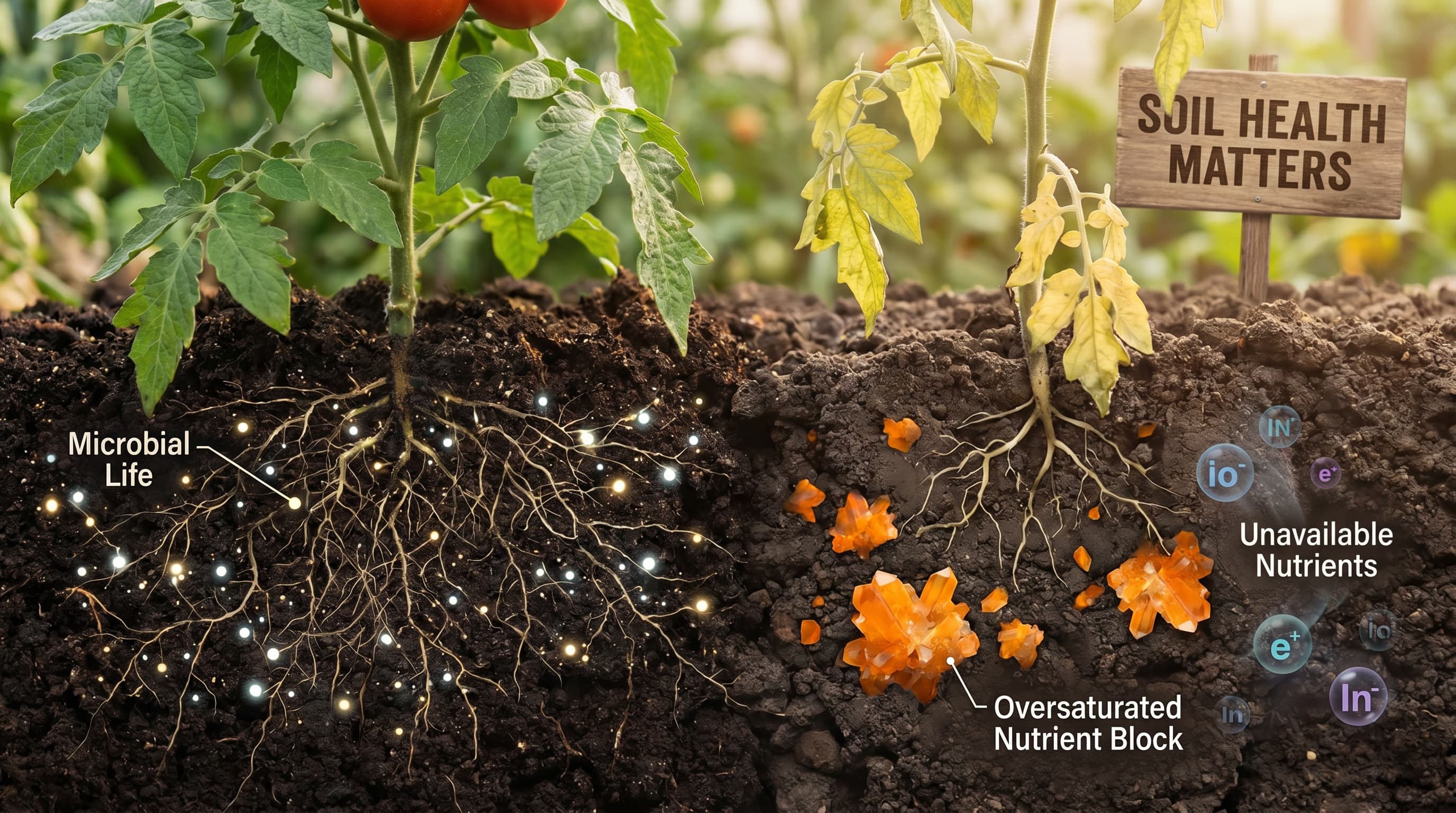
Nutrients interact, and the interactions are specific enough to name. Most are antagonisms - an excess of one suppressing another - which is why over-applying a single nutrient is the easiest way to manufacture a deficiency.
- Excess potassium suppresses magnesium and calcium - the most common real-world balance error, yellowing plants with induced magnesium deficiency even in magnesium-rich soil.
- Excess phosphorus suppresses zinc and iron (and, as Lesson 7 covered, suppresses mycorrhizae). Over-fertilizing with phosphate is a classic cause of induced zinc deficiency.
- Excess nitrogen suppresses potassium, copper, and boron, and pushes soft, leafy growth at the expense of roots, flowers, and stress tolerance.
- Excess calcium suppresses magnesium, potassium, boron, phosphorus, and iron - over-liming can lock up several nutrients at once.
- Excess magnesium suppresses calcium and potassium, and iron and manganese compete, so a large excess of one can induce a shortage of the other.
There are synergies too - adequate nitrogen improves the uptake of phosphorus and magnesium, and appropriate calcium improves root function and the uptake of several nutrients - but the dominant practical message is the antagonism one: spiking a single soluble nutrient is the easiest way to create a new problem.
Plain-English takeaway: Nutrients compete: too much potassium blocks magnesium and calcium, too much phosphorus blocks zinc and iron, too much calcium blocks several at once. Spiking one soluble nutrient is the easiest way to manufacture a deficiency of another.
pH: the master gate
If one factor decides how much of everything else a plant can reach, it is soil pH. pH does not feed the plant, but it controls the availability of nearly every nutrient, which is why the same fertilizer can work beautifully in one garden and do nothing in the next.
pH measures how acidic or alkaline the soil is, on a scale where 7 is neutral, lower is acidic, and higher is alkaline. Most nutrients are most available in a slightly acidic to neutral band, roughly pH 6.0 to 7.0, which is the target for most vegetables and ornamentals. In alkaline soil, phosphorus locks up with calcium and iron, manganese, zinc, and copper become unavailable - high-pH gardens commonly show iron chlorosis even with plenty of iron present. In acidic soil, phosphorus locks up with iron and aluminum, calcium and magnesium grow scarce, and aluminum and manganese can climb toward toxic levels. Acid-loving plants such as blueberries and azaleas are the exception that proves the rule: they need low pH to keep iron available.
The practical lesson is to check pH before adding more of a nutrient. Correcting pH - lime to raise it, sulfur or acidifying inputs to lower it - often releases nutrients already in the soil, which is cheaper and healthier than piling on more fertilizer. And because organic matter and biology buffer pH and keep it stable, building living soil makes pH swings less punishing in the first place.
Plain-English takeaway: Soil pH is the master gate on nutrient availability - most nutrients are freely available only around pH 6 to 7. Check and correct pH before adding nutrients, because the right pH often releases what is already there.
CEC: the soil's pantry
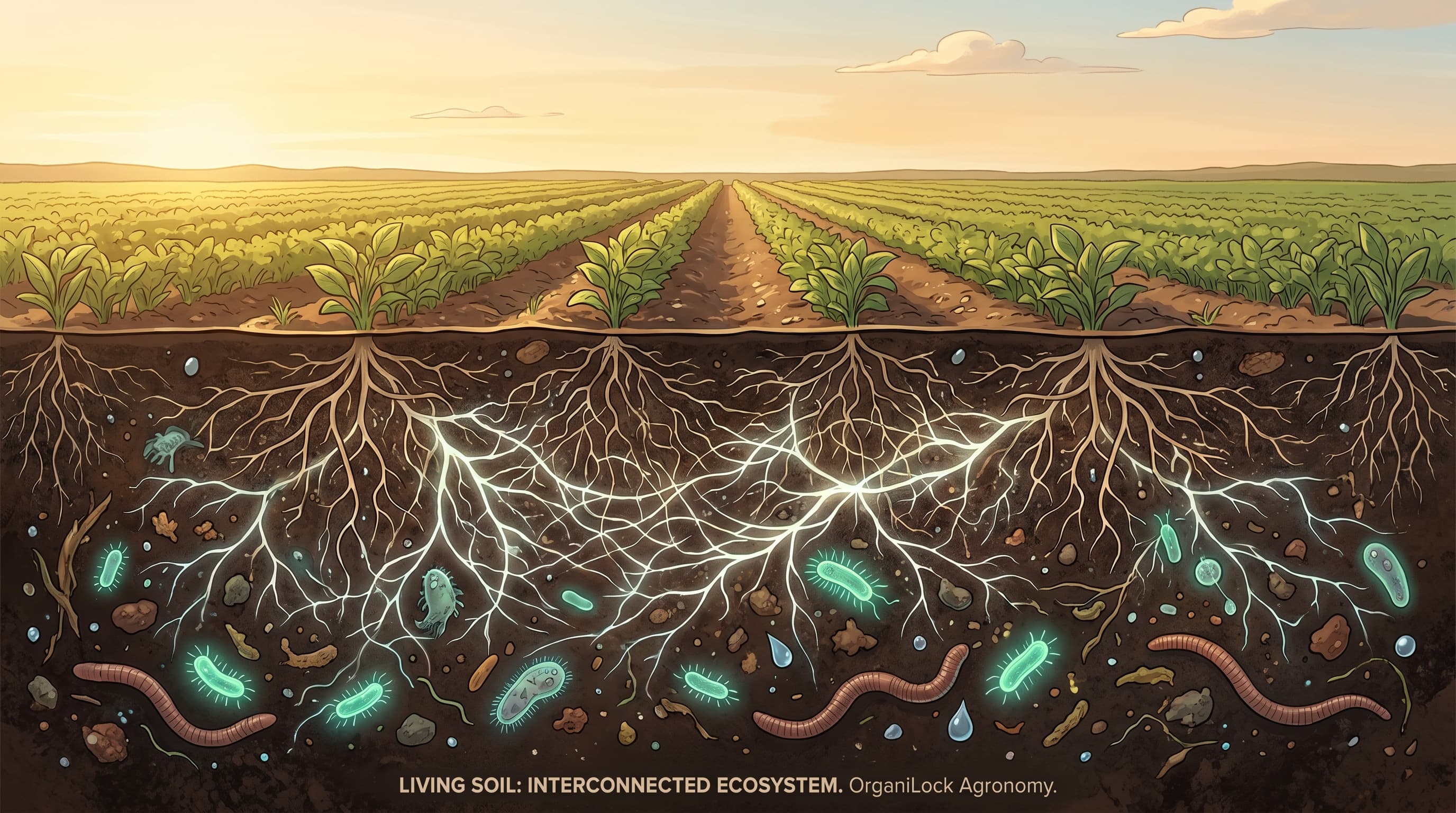
The companion idea to pH is cation exchange capacity, or CEC - the soil's ability to hold positively charged nutrients and hand them to roots on demand. Several key nutrients are cations: potassium, calcium, magnesium, ammonium, and most micronutrient metals. They are held on the negatively charged surfaces of clay and organic matter, like goods on a pantry shelf, available to roots but not washed away by the next rain. Nitrate, by contrast, is negatively charged, so it is not held by CEC and leaches freely - a big part of why nitrogen is so loss-prone while potassium and calcium stay put better.
Sandy soils have low CEC - little clay, often little organic matter - so they hold few nutrients and leach quickly, needing lighter, more frequent feeding. Clay and organic-rich soils have high CEC and hold a large reserve. The single most controllable lever on CEC is organic matter, whose capacity to hold cations is enormous - far more per unit weight than clay. So building organic matter directly enlarges the soil's nutrient pantry, its water-holding capacity, and its pH buffering, all at once.
A real balance puzzle
Here is how the rules play out in practice. Imagine a gardener whose plants are yellowing between the veins of their older leaves. The textbook answer is magnesium deficiency, so they add magnesium - and nothing improves. Why? Because the real cause was too much potassium from years of heavy feeding, which was blocking magnesium uptake; piling on more magnesium could not win against the potassium flood. The fix was to stop over-applying potassium and let the balance recover. Now imagine the yellowing is on the new leaves instead, with green veins: that points to iron, but adding iron does nothing because the true culprit is a high soil pH locking the iron up. Correcting pH releases the iron already present. In both cases, the lesson is the same - read the whole system, not the single symptom, and the cheapest fix is usually balance and pH, not another bag of fertilizer.
The balance of the cations
Soil scientists pay attention not just to how much calcium, magnesium, and potassium a soil holds, but to their proportions to one another, because those three cations compete for the same exchange sites and the same uptake. A soil can test "adequate" in each one and still grow poorly if the ratios are badly skewed - too much of one crowding out the others. You do not need to memorize target ratios to grow well, but it is worth knowing that "balance" is literal: it is the proportions among nutrients, not just their individual amounts, that a healthy soil keeps in check. Building organic matter and feeding broadly is what holds those proportions steady without a spreadsheet.
Reading a soil test with balance in mind
All of this changes how you read a soil test, which Module 4 covers in full. The order matters: look at pH first, because it gates everything; then organic matter and CEC, because they tell you the soil's capacity and health; and only then the individual nutrients - read relative to each other, not in isolation. A soil testing high in potassium and low in magnesium is a balance problem to correct by easing the potassium, not a magnesium hole to fill. Reading the numbers as a system, rather than as a checklist to top up, is the single biggest difference between feeding wisely and feeding by habit.
Why this is the real case for biology-first
Put the whole lesson together and you arrive at the strongest, most honest argument for a broad-spectrum, biology-first approach - and it is real agronomy, not a slogan. Two reasons.
- Balance beats spikes. A broad-spectrum input that delivers many nutrients together, in proportions closer to what a plant actually contains, is far less likely to trigger an induced deficiency than a concentrated dose of one soluble salt.
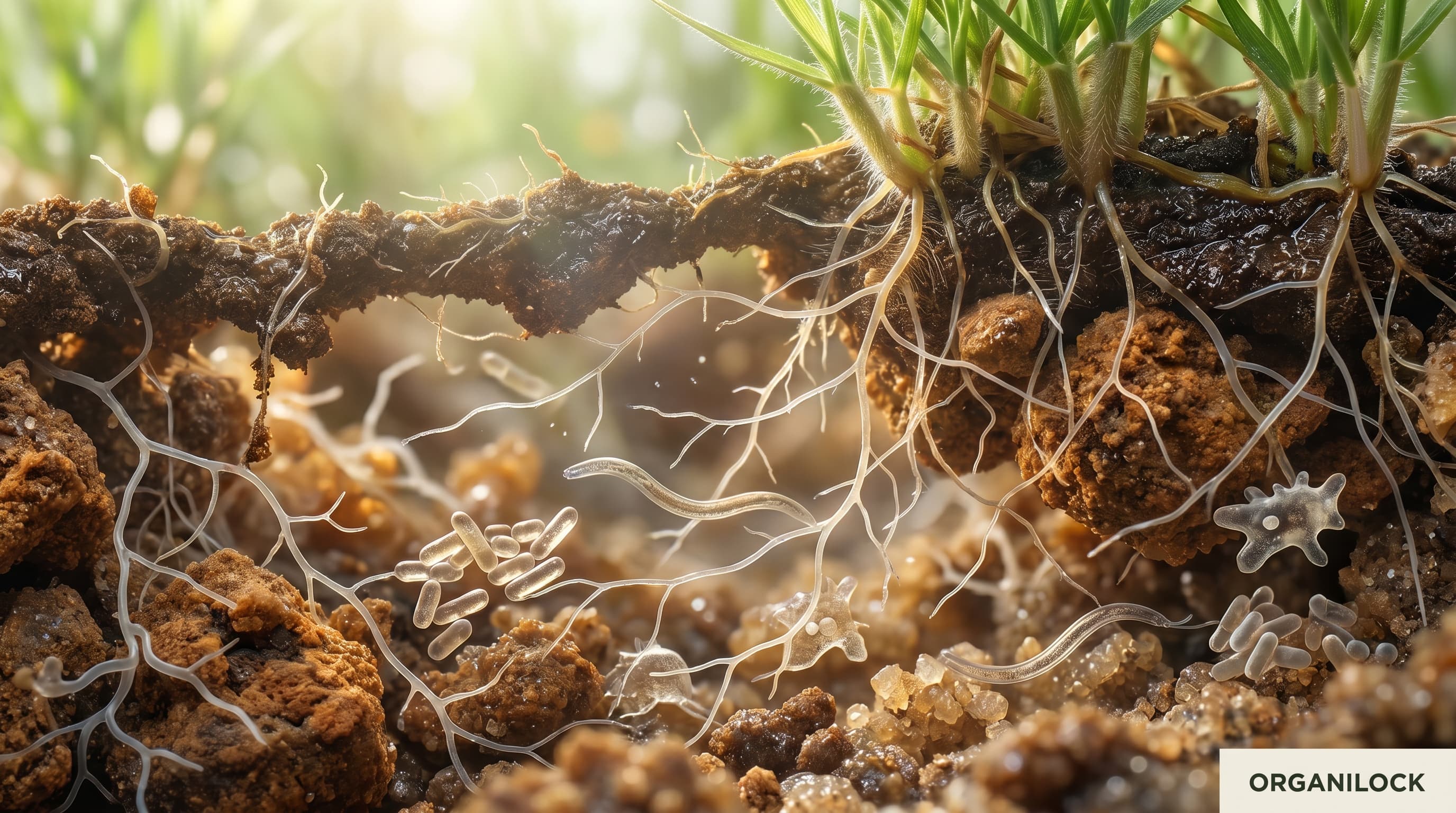
- Biology meters the delivery. When nutrients are released gradually by soil microbes rather than dumped as soluble salts, the soil solution never spikes high enough in any one nutrient to slam the door on another. The living soil acts as a buffer that holds the balance the chemistry of this lesson demands.
None of this is a promise that any product prevents every deficiency or replaces a soil test. It is simply that the system delivering nutrients gradually, in balance, and in a living soil is working with the rules of this lesson rather than against them.
Plain-English takeaway: The honest case for broad-spectrum, biology-released feeding is the balance rule itself: many nutrients delivered together and metered by soil life never spike high enough to lock out one another, the way a single concentrated salt does.
The over-application trap
If there is a single most common and most expensive mistake in feeding plants, it is over-application - adding more than the plant can use, out of generosity or habit. This lesson explains why it backfires: past sufficiency, extra nutrients do not add growth, they induce deficiencies of other nutrients, spike soil salts, push soft disease-prone growth, and run off into water, all while costing money. "Feed to need" - matched to a soil test and the crop in front of you - is both the cheaper and the more responsible practice. More fertilizer is the answer far less often than the shelf at the garden center implies, and a great deal of plant trouble is solved not by adding something but by stopping the overfeeding that caused it.
This is the quiet reason a biology-first soil is so forgiving: when nutrients are held in living soil and released on demand, it is genuinely hard to over-apply your way into the antagonisms above, because the soil never lets any one nutrient spike. The system protects you from the most common mistake almost automatically.
Where this is heading
You now have the master rules - the limiting nutrient, the antagonisms, pH, and CEC. The final lesson of this module puts them to work on the question every grower actually asks: what does this particular plant want? Different plants, at different stages, in different settings, want very different things, and matching nutrition to the plant is where the science becomes a harvest.