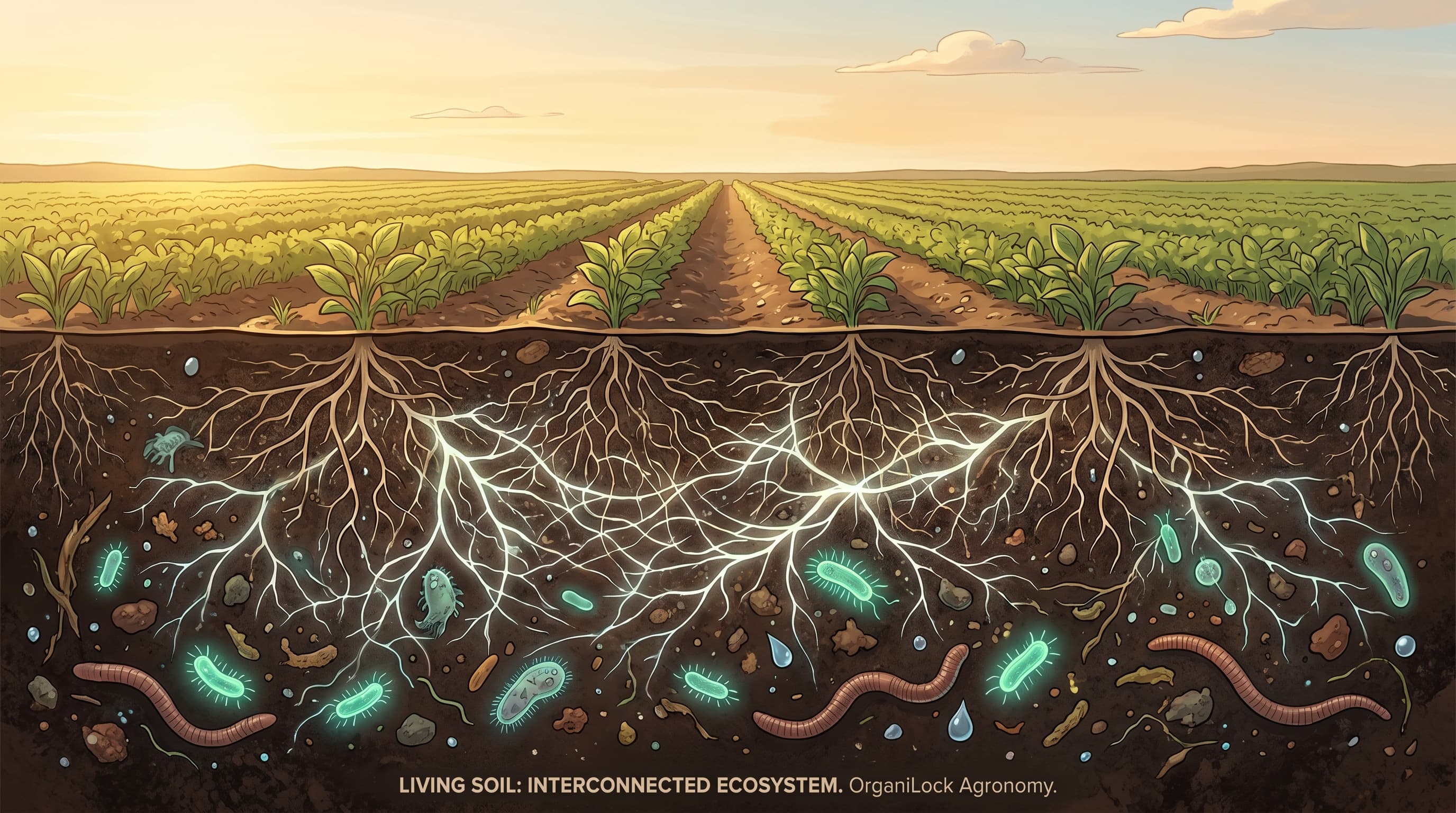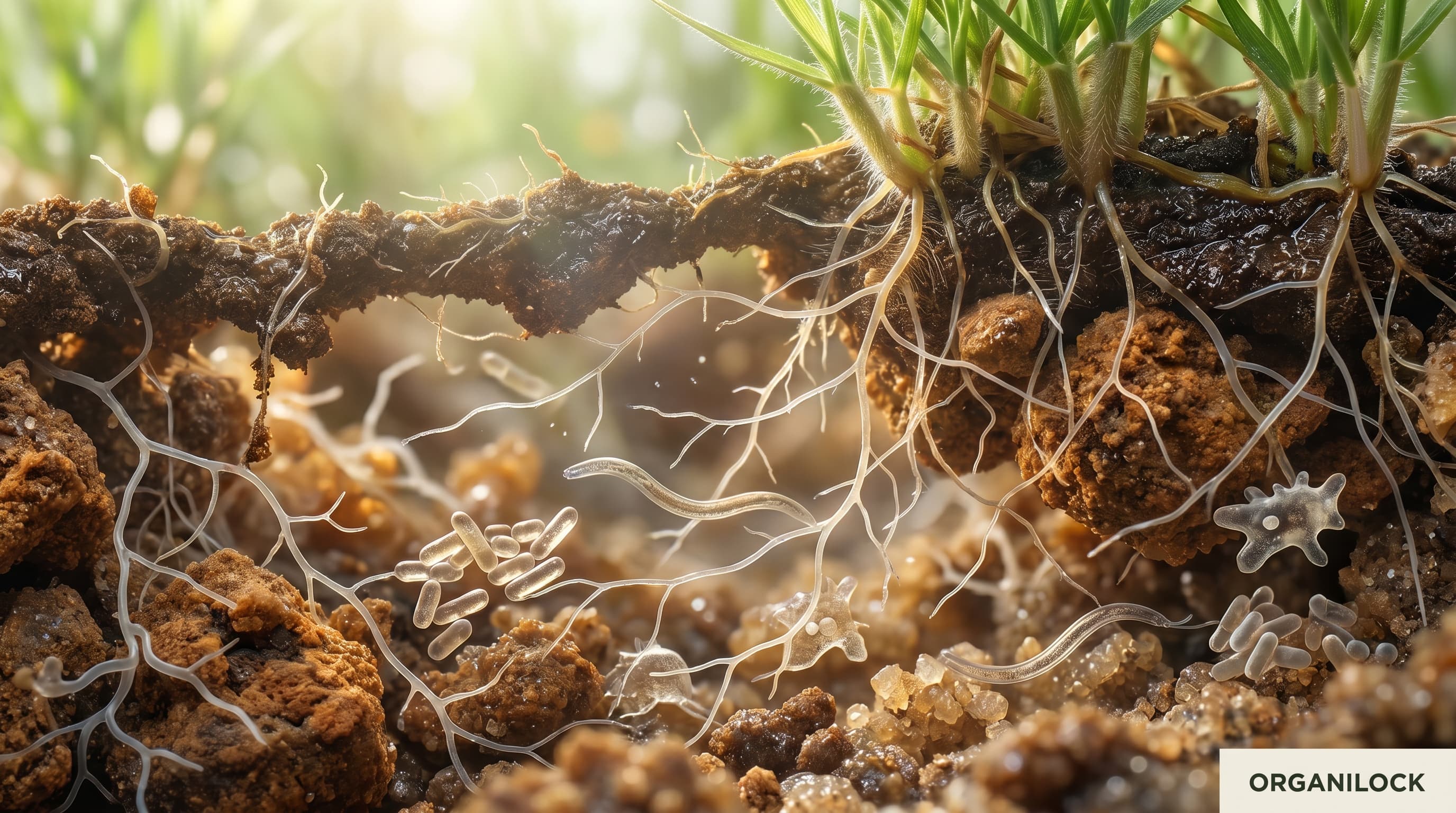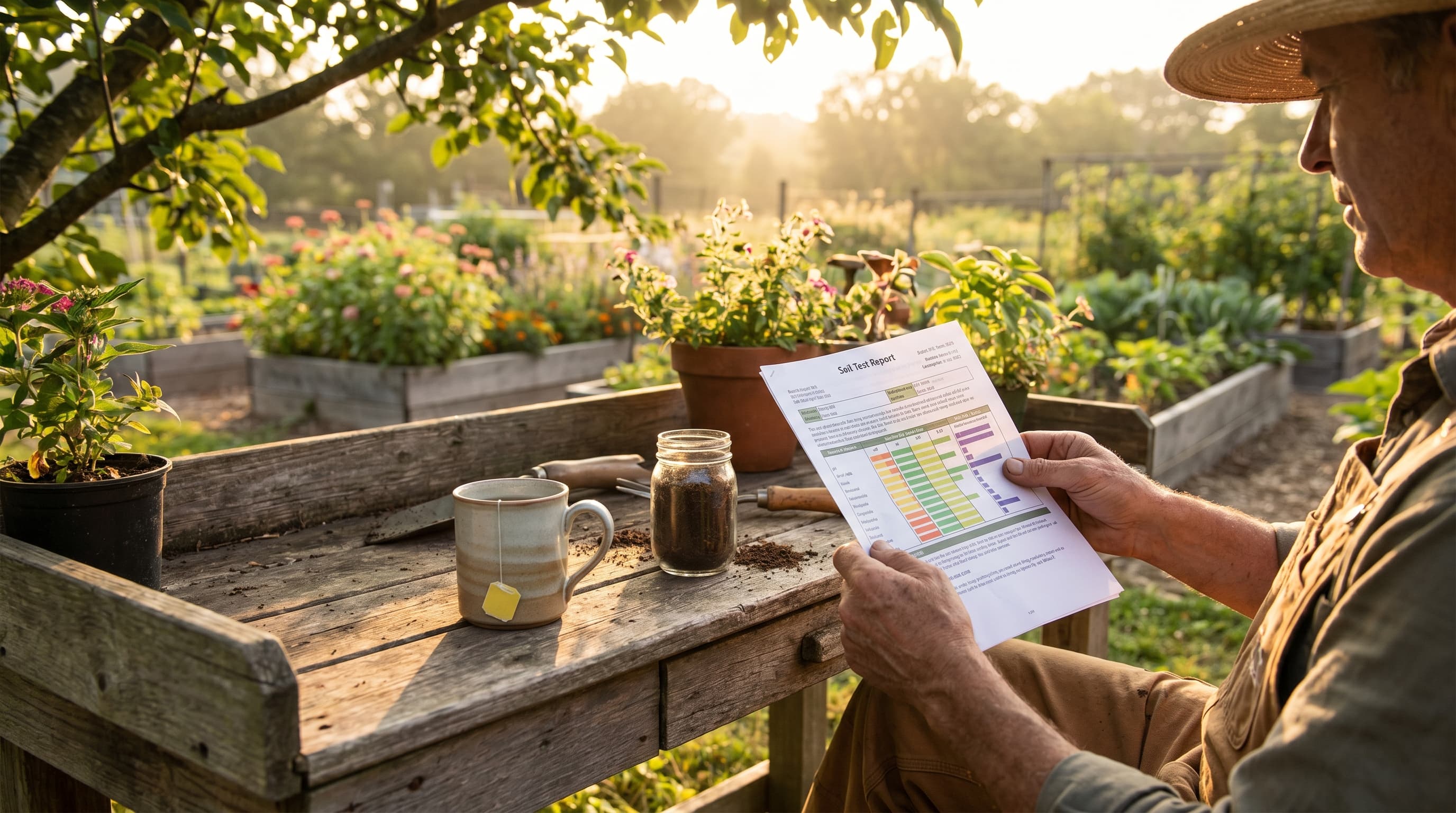
You now understand what soil is, how its biology works, and what every nutrient does. This lesson turns that understanding into something you can use on a Tuesday afternoon, because two documents stand between the science and the garden: the soil test report and the product label. Most growers find both intimidating and skip them. After this lesson you will read them with confidence - and that single skill will save you more money and trouble than any product.
The soil test: your garden's blood work
A soil test is the one tool that turns guessing into knowing. Think of it as blood work for your garden: a snapshot of what is actually there, so you stop treating problems you only imagine. A basic test reports a handful of things.
- Soil pH - the master gate on nutrient availability from Module 3. The first number to read.
- Buffer pH - a second reading some labs use to calculate exactly how much lime a soil needs; you can usually ignore it except to follow the lime recommendation.
- Phosphorus, potassium, calcium, magnesium, and sometimes sulfur and the micronutrients - the nutrient levels, usually as parts per million or pounds per acre, each with a rating like low, medium, optimum, or high.
- Organic matter percentage - the single best indicator of long-term soil health from Module 1.
- Cation exchange capacity (CEC) - the size of the soil's nutrient pantry from Module 3.
One thing you usually will not see is nitrogen. That surprises people, but it is on purpose: nitrate is so mobile and changeable that a single point-in-time reading is nearly meaningless. Nitrogen is managed by feeding the crop and watching the plant, not by chasing a test number - which is exactly why the reading skills from Module 2 matter so much.
It is worth saying plainly why this one document is worth the small effort: almost every expensive gardening mistake - the burned lawn, the leafy fruitless tomato, the yellowing shrub fed harder and harder to no effect - traces back to acting without knowing. A test replaces a year of guessing with an afternoon of reading. You do not need to test obsessively or understand every line; reading the few that matter, in order, is enough to put you ahead of most gardeners and to make every product decision that follows an informed one.
How to read a soil test, in order
The order you read a test in matters as much as the numbers, and most people read it backwards - jumping to the nutrient levels and ignoring the context. Read it like this.
- Start with pH. It gates the availability of everything else, so a pH problem has to be fixed first or no amount of fertilizer will work. Lime raises a low pH; sulfur or acidifying inputs lower a high one.
- Then read organic matter and CEC. Together they tell you the soil's health and its capacity to hold what you add - a low-organic-matter, low-CEC soil needs building before it needs feeding.
- Then read the nutrients relative to each other, not in isolation. A soil "high" in potassium and "low" in magnesium is a balance problem (Module 3), not a magnesium hole to fill. The ratings matter more to a home grower than the raw numbers.
A good report comes with regional recommendations - follow them, but now you understand what they mean and why. The point of reading a test in this order is that it stops you from the most common mistake: dumping a nutrient the soil did not actually need.
Plain-English takeaway: Read a soil test in order - pH first (it gates everything), then organic matter and CEC (the soil's health and capacity), then the nutrients relative to one another. Ratings matter more than raw numbers, and most reports skip nitrogen on purpose.
Where to get one, and how often
In the United States, the best and cheapest option is your local Cooperative Extension service, which offers low-cost soil tests with interpretation tuned to your region's soils and crops. Test a new bed before you plant it, and an established garden every two or three years - more often only if you are correcting a known problem. It is a small cost that pays for itself many times over by telling you what not to buy.
The product label: reading what is in the bag
The other document is the label on whatever you are about to add to your soil, and it is more readable than it looks once you know the parts.
- The three numbers (N-P-K) are the guaranteed minimum percentages by weight of nitrogen, available phosphate, and soluble potash. A "10-10-10" is 10% of each; the rest is other nutrients and carrier. Remember the oxide convention from Module 3 - the P and K numbers are phosphate and potash, not the pure element.
- The guaranteed analysis is the legally backed breakdown. It may also list calcium, magnesium, sulfur, and micronutrients, and - importantly - the forms of nitrogen, including how much is water-insoluble (slow-release). A high slow-release fraction is a quality signal (Module 2).
- "Derived from" lists the actual ingredient sources, and it tells you more about how a product behaves than the three numbers do. It is the difference between nitrogen from urea and nitrogen from feather meal, or phosphate from a soluble salt versus from bone.
Reading the "derived from" line is the single most revealing habit you can build at the garden center. Two products with identical N-P-K numbers can behave completely differently depending on what they are made from - one a fast soluble salt, the other a slow biological feed. The three numbers tell you how much; the "derived from" line tells you what kind.
Two more label details reward a closer look. First, the breakdown of the nitrogen: a good label states how much of the nitrogen is "water-insoluble" or slow-release, and a higher slow-release fraction signals a gentler, longer-feeding, lower-burn product (Module 2). Second, look past the three numbers to whether calcium, magnesium, sulfur, and micronutrients are listed at all - a broad-spectrum product names a fuller cast, while a simple soluble salt lists only its one or three nutrients. Neither the form nor the spectrum shows up in the headline N-P-K, which is exactly why those headline numbers are the least informative part of the label once you know what else to look for.
Amendment versus fertilizer
A small distinction with big implications: a fertilizer is labeled to feed the plant by its guaranteed analysis, while a soil amendment is labeled to improve the soil itself - its structure, biology, and organic matter. Many of the best products do both, but the label category tells you the maker's primary claim. A bag of soluble crystals is selling you a feeding; a living, carbon-rich amendment is selling you a better soil. After this course, you know which one compounds over time.
OMRI Listed versus USDA Organic
Finally, the labels that confuse almost everyone: "organic," "OMRI Listed," and "USDA Organic" are three different things.
- "Organic" can describe the ingredients (natural, carbon-based, not synthetic) or a formal certification. A product can be made from organic inputs without carrying any certification, so the word alone tells you less than people assume.
- OMRI Listed means a material has been reviewed by the Organic Materials Review Institute as allowed for use in certified-organic production. It is a statement about the input.
- USDA Organic is a certification of the final crop and the farm that grew it. It is a statement about the end product, not the fertilizer.
They are related but distinct: OMRI is about what you put in, USDA Organic is about what comes out. Among OrganiLock's products, Soil Food is the OMRI-Listed one; Plant Food and the Refresh line are not claimed as OMRI or certified organic - and now you know exactly what that distinction does and does not mean.
Plain-English takeaway: On a label, read the "derived from" line and the slow-release fraction, not just the three numbers - two products with the same N-P-K can behave completely differently. And know that "OMRI Listed" is about the input while "USDA Organic" certifies the final crop.
A sample test, read the right way
Imagine a typical report: pH 5.4, organic matter 1.8%, CEC on the low side, phosphorus rated "high," potassium "low," magnesium "medium." A beginner reads "potassium low" and buys potassium. Read in order, the report says something different. The pH of 5.4 is acidic enough to be locking up nutrients and stressing the plants, so the first move is lime to bring it toward neutral. The 1.8% organic matter and low CEC say this is a thin, depleted soil that needs building - compost and organic matter - before it needs much feeding. Phosphorus is already high, so adding any would be wasteful and risk locking up zinc and iron. Only potassium is genuinely low and worth supplying. The report that looked like "add potassium" actually says "raise the pH, build organic matter, add a little potassium, and leave the phosphorus alone." That is the difference reading in order makes.
Three soil-test traps
A few misreadings are common enough to name. The first is treating a "high" reading as good news - past optimum, more is not better, and a high phosphorus or potassium number is a reason to stop adding it, not a badge to be proud of. The second is chasing raw numbers instead of ratings and balance; the labs publish ratings precisely because the right amount depends on your soil's CEC and the balance among nutrients, not an absolute figure. The third is expecting the test to manage nitrogen for you - it cannot, because nitrogen is too mobile to capture in a snapshot, so that one stays a matter of feeding the crop and reading the plant.
Notice that all three traps share a root: reading the test as a shopping list to top up rather than as a portrait of a system to understand. The numbers are not targets to max out; they are clues to what your particular soil is and is not short of, read against pH, organic matter, and one another.
When the right move is to do nothing
One of the most valuable things a soil test can tell you is that your soil is fine and needs nothing this year. It is a genuinely common result in an established, well-tended garden, and it saves you money and spares your soil the imbalances that come from feeding by reflex. Growing well is not about constant intervention; it is about making the few changes that matter and otherwise letting a healthy soil do its work. A grower who can read a test and confidently buy nothing has learned something most never do - that the goal is a soil that does not need rescuing, and that reaching for a product should follow a real, identified need rather than a vague sense that more must be better.
Putting it together
Here is the whole skill in one motion. A soil test tells you what your soil actually has and needs; a label tells you what a product actually is and does. Read the test in order, identify the real gap (often pH or organic matter, not a missing nutrient), then choose a product whose "derived from" line and form match that gap - and lean toward the ones that build the soil rather than just feed the plant. That is how you stop buying things your garden does not need and start making the few changes that actually move it. The final lesson puts it all into a single practice.