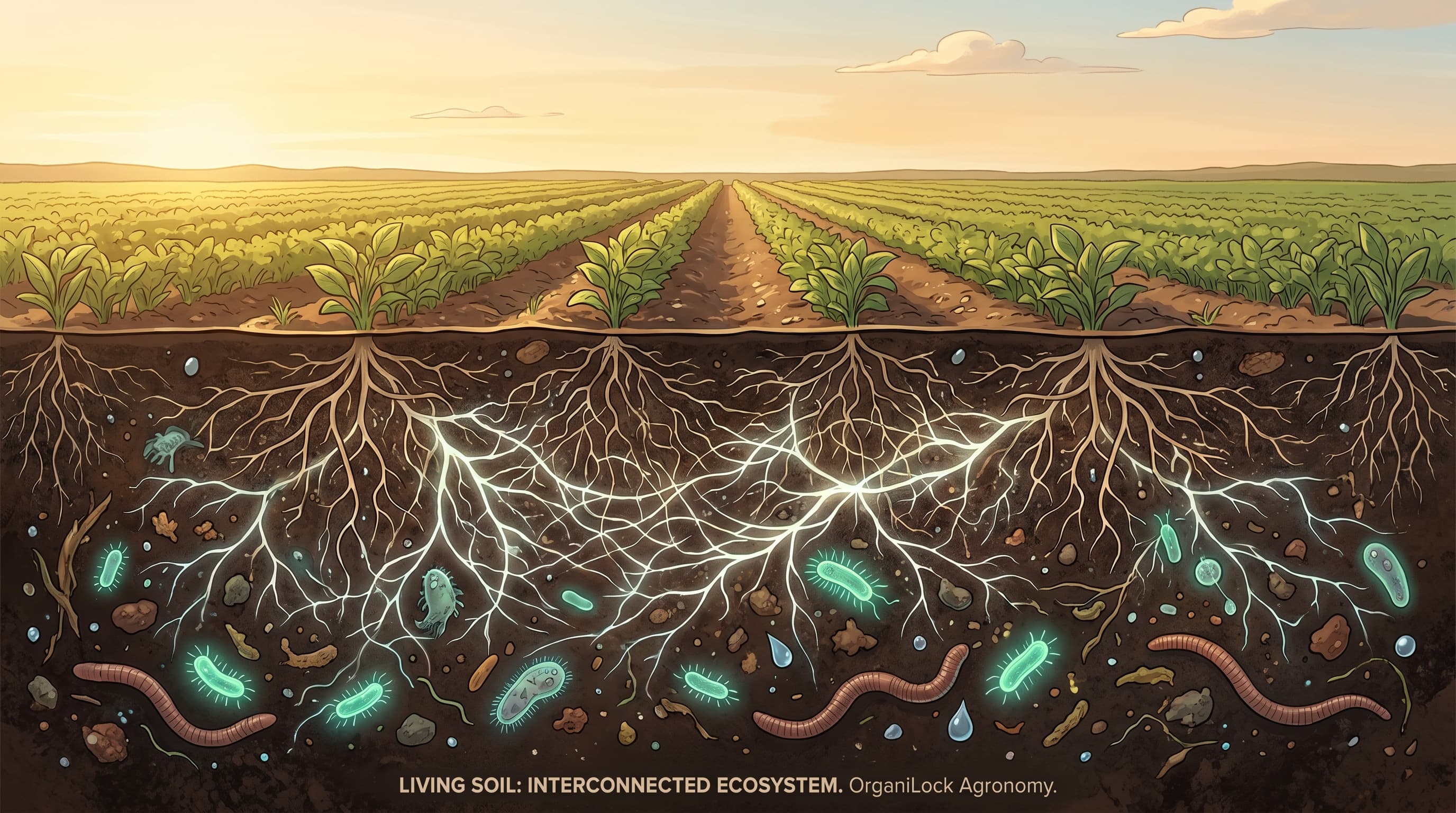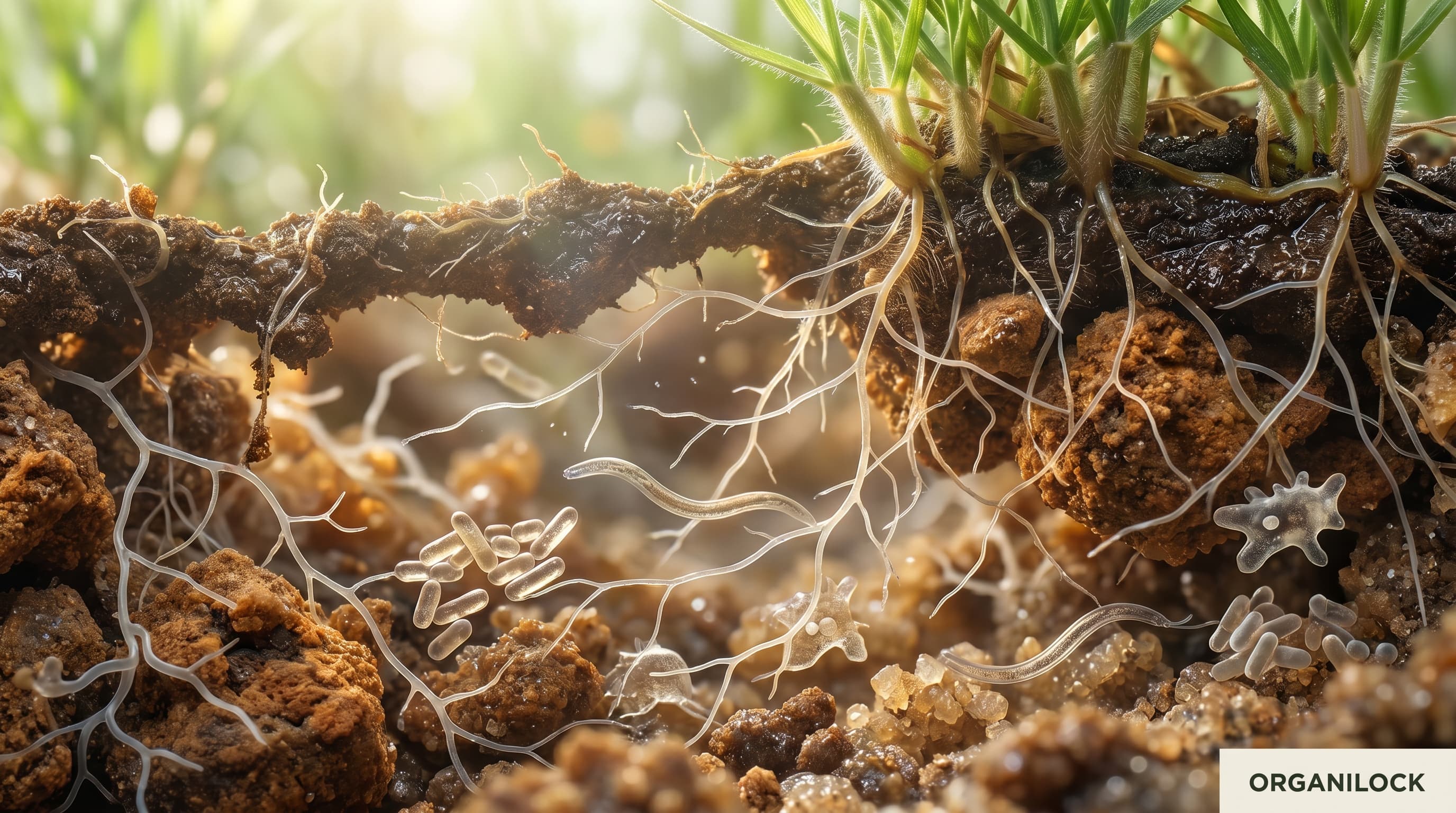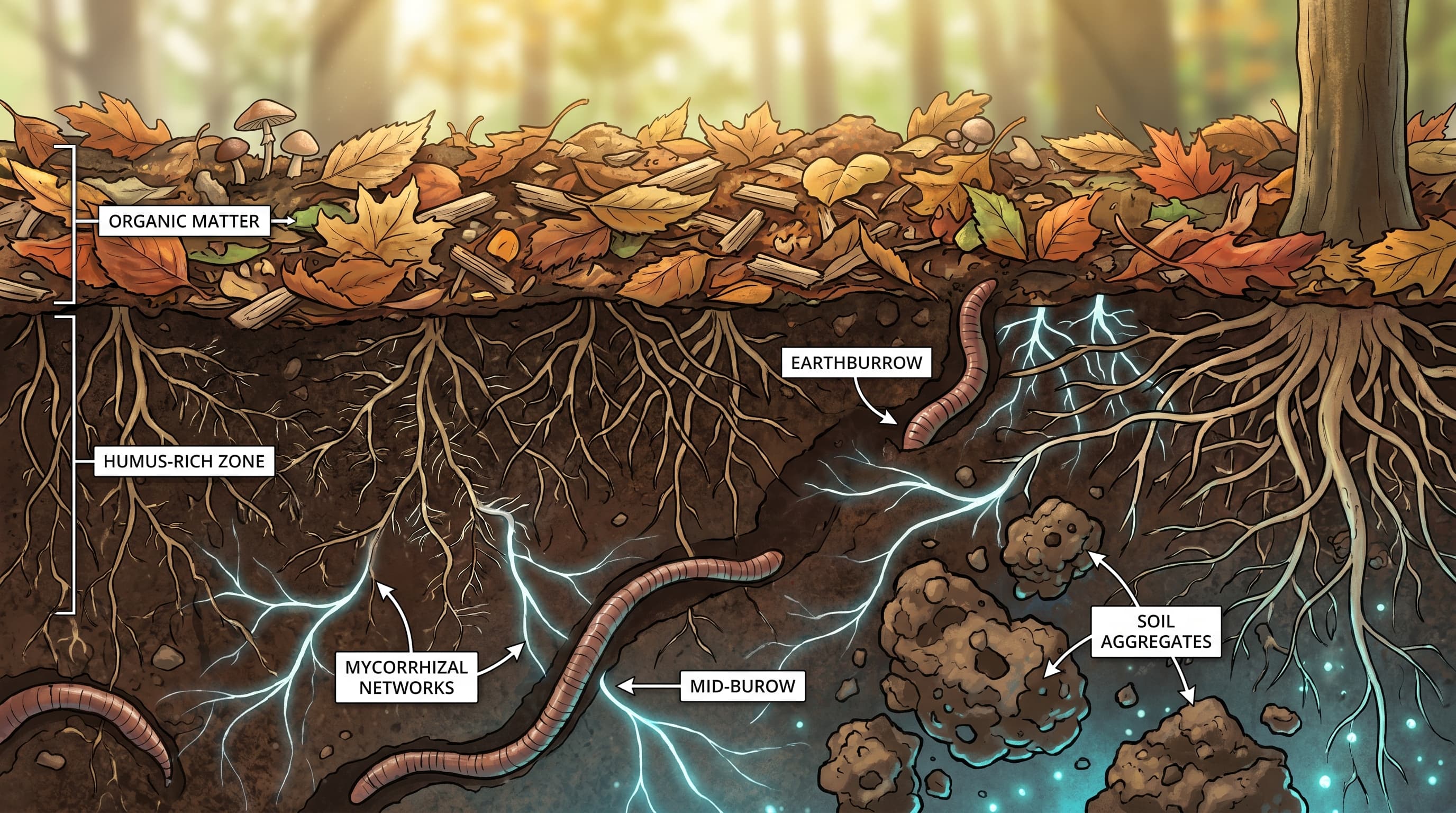
Every lesson in this course has pointed, in its own way, to a single conclusion: the most powerful thing you can do for your plants is build a living soil. Not chase a number, not dump a nutrient, not buy the brightest bag - but feed and protect the living system that turns dirt into fertility. This final lesson gathers the whole course into a handful of practices you can live by, shows where OrganiLock's products fit into them, and ends where soil always does: with the question of what you leave behind.
The regenerative toolkit
Across the soil-health movement the same handful of principles keep appearing, because they work. You have met every one of them in this course; here they are together as a single practice.
- Keep the soil covered. Bare soil bakes, erodes, and starves; a blanket of mulch or living plants protects the biology, holds moisture, and feeds the food web from the top down (Modules 1-2).
- Keep living roots in the ground. Roots feed the soil sugar and keep the biology fed year-round; cover crops and successive plantings extend that as far into the year as you can manage (Module 2).
- Disturb the soil as little as possible. Every tillage pass shreds fungal networks and burns organic matter; less disturbance lets structure and biology build (Modules 1 and 3).
- Build organic matter relentlessly. Compost, mulch, residues, and carbon-rich amendments are the fuel for everything - water-holding, nutrient-holding, structure, and life (Module 1).
- Feed a broad, balanced diet, not single spikes. Balance beats maximum; a broad spectrum delivered through living soil avoids the antagonisms and losses of concentrated soluble salts (Modules 2-3).
- Encourage diversity. A diversity of plants and inputs supports a diversity of soil life, and a diverse food web is a resilient, disease-suppressive one (Module 2).
None of these is exotic, and none requires perfection. Soil is forgiving and patient; do a few of these, most of the time, and the compounding cycle from Module 1 does the rest, building a soil that grows better and asks for less each year.
Plain-English takeaway: The whole course reduces to a short practice: keep the soil covered, keep living roots in it, disturb it little, build organic matter, feed a broad balanced diet, and encourage diversity. Do most of these, most of the time, and the soil improves itself.
The rhythm of a soil-building year
Put into a season, the practice has a natural rhythm. In spring, build and wake the soil before planting - this is when a foundation amendment sets up the biology for the year. Through the growing season, keep things covered and feed to the plant in front of you, replenishing containers and beds more often because they draw down fast. In fall, ease off nitrogen, plant cover crops or lay down mulch and compost, and feed the soil itself for next year - the most overlooked, highest-return habit there is. And over years, watch the organic-matter number on your soil test climb, slowly, as the whole system gets richer. The work compounds; that is the entire point.
Where OrganiLock fits
OrganiLock's products are built to make this practice easy, and the whole course explains why they are designed the way they are. Soil Food is the foundation - a slow-release, OMRI-Listed, whole-food amendment that delivers organic nitrogen, a broad spectrum of nutrients, soil microbes (including both types of mycorrhizae, so it suits nearly any plant), the carbon to feed them, and biochar to house them. It is what you reach for to build and rebuild living soil. The Refresh line keeps that soil fed season to season in the specific setting you grow in - raised beds, containers, houseplants, landscapes. And Plant Food is the fast, direct boost for when a plant wants an immediate feed, used with the rate discipline any soluble feed calls for.
When it comes to how much, the OrganiLock calculator turns your beds, pots, or planting area into an actual amount, and the glossary and the "which product is right for you" guide help you match product to need. The thread through all of them is the one this course has made over and over: get good nutrition and a broad spectrum into a living soil, and let that soil do most of the work. The products are not a substitute for the practice - they are tools that serve it.
Try the OrganiLock calculator - size any product for your own beds, pots, or planting area ->
The bigger picture: the soil you leave behind
It is worth ending where soil naturally leads, beyond this season's tomatoes. Topsoil, as Module 1 noted, forms about an inch every five centuries and can be lost in a few careless ones; roughly 95% of our food comes from it; and around the world it is being lost far faster than it forms. Those are sobering facts, and it would be dishonest to pretend a home garden reverses them. But the same practices that grow a better garden - covering the soil, building organic matter, feeding the biology, disturbing it less - are exactly the practices that hold and rebuild soil at every scale. A garden tended this way is a small, real example of growing that gives back more than it takes.
That is what regenerative means, and it is the quiet idea underneath everything OrganiLock makes: that you can feed plants and build the soil at the same time, that fertility can compound instead of deplete, and that good growing leaves the ground better than it found it. It is offered not as a guarantee or a crusade, but as a better way to tend a living thing - which a soil very much is.
Plain-English takeaway: Building living soil is not just better gardening; it is the same practice that holds and rebuilds soil at every scale. Regenerative growing means leaving the ground better than you found it - feeding plants and building soil at the same time.
Where to start (you do not have to do it all)
If the full toolkit feels like a lot, do not let it stop you - soil building rewards even a single good habit, and you can layer the rest on over time. If you do just one thing, mulch your beds and stop leaving soil bare; it protects and feeds the biology with almost no effort. If you do two, start a simple compost pile and add it where you can. From there, ease off the tiller, keep something growing in the off-season, and lean toward broad, biological feeding over concentrated salts. None of this has to happen at once, and none of it has to be done perfectly. A garden moved even part of the way toward these practices grows visibly better, and each habit makes the next one easier as the soil comes to life.
The compounding years
It helps to picture what building soil actually looks like over time, because the rewards arrive on a different schedule than a bag of soluble feed. In the first year, you may notice better moisture-holding and a few more worms. By the third year, the soil is visibly darker and crumblier, holds rain instead of shedding it, and needs less watering and less feeding to grow the same crop. By the fifth year and beyond, you are working with a genuinely living soil - resilient through dry spells, quicker to warm, slow to compact, and increasingly self-feeding, with the organic-matter number on your test climbing season after season. That is the compounding cycle from Module 1 made real: a soil that gets richer, easier, and more forgiving every year you tend it, the opposite of one that needs ever more inputs just to stand still.
"But my soil is terrible"
Almost everyone starts with soil they think is hopeless - bricklike clay, pure sand, the compacted fill around a new house. Here is the encouraging truth from this whole course: texture is the one thing you cannot change, and it is also the one thing you do not need to. Every soil, however poor, responds to the same practices, because what you are building - structure, organic matter, and biology - can be built on any texture. Heavy clay becomes workable and crumbly as aggregates form; thin sand learns to hold water and nutrients as organic matter accumulates; dead fill comes back to life as the food web moves in. It is slower on some soils than others, but no soil is beyond improving, and the worse it starts, the more dramatic the change you will see.
Trusting a slower kind of result
The hardest part of the biology-first approach is not the doing; it is the waiting. A soluble feed gives a fast, visible green-up that feels like proof, while building soil works underground and shows itself gradually. It takes a little faith at first to trust that the slower path is the better one - faith the science in this course is meant to give you. The green-up from a soluble salt is real but shallow and short, often bought at the cost of the soil; the improvement from building living soil is slower but deep, compounding, and lasting. Once you have seen a garden go through a few seasons of it - watched the soil darken, the watering ease, the plants grow sturdier - the waiting stops feeling like waiting and starts feeling like investing. Most growers who make the shift never go back.
A simple plan for a first season
To make all of this concrete, here is a straightforward way to put the course into practice over one season. Start by testing your soil and reading it in order, fixing pH first if it is off. Build the bed or planting area with a foundation amendment and compost to wake up the biology and supply a broad spectrum of nutrients. Mulch the surface and keep it mulched. Choose plants suited to your conditions, and feed them according to what they are - more for the heavy feeders, little for the light ones - reaching for a fast boost only when a particular plant clearly wants one, and replenishing containers more often. As the season ends, resist the urge to strip the bed bare; instead feed the soil for next year with compost, a cover crop, or a fresh layer of mulch. Repeat that loop, adjust it to what your soil test and your plants tell you, and you are no longer following a recipe - you are reading and tending a living system, which is exactly what this course set out to teach.
What you have accomplished
Take a moment, because you have come a long way. You started with the idea that soil is just dirt. You now understand that it is a living, structured system; how its food web feeds your plants; what organic matter and carbon do; how nitrogen really works and why its form matters; what every nutrient does and how to read a struggling plant; how nutrients interact and why balance beats excess; how to match feeding to any plant; and how to read a soil test and a label like a professional. That is more working knowledge of soil than most people ever gain, and it will make you a markedly better grower for the rest of your life.
One step remains: the final exam, drawing on everything across the four modules. Pass it and you will have earned your OrganiLock Soil School: Foundations certificate - and, more importantly, the understanding behind it. Good luck. You have earned the shot.